
Banishment & Prison: The Price of Speaking Out in Nicaragua
Between exile and persecution, Nicaraguan writers and journalists struggle to make their voices heard inside and outside the country.
By Gabriela Selser (Confidencial)
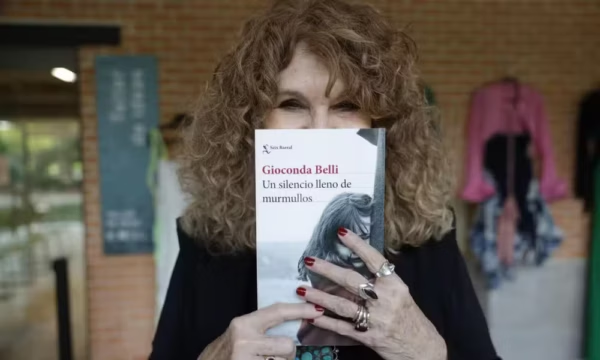
HAVANA TIMES – “I have nowhere to live, I chose words,” says Nicaraguan poet Gioconda Belli in one of her recent verses of pain and exile. Lines that undoubtedly summarize the condition of hundreds of journalists, writers, and artists who over the last seven years have been forced to leave their country, Nicaragua, because of their commitment to freedom.
Like Belli (Managua, 1948), Nicaraguan intellectuals have been persecuted since April 2018, when a social uprising put the government of Daniel Ortega and his wife, Rosario Murillo, on the ropes. What began as a youth protest against an imposed reform to the social security system turned into the largest civic revolt in decades in the volcanic Central American nation.
The writers and poets did not participate in violent actions, nor did the journalists who provided uninterrupted coverage of the crisis and documented the deaths of at least 350 people at the hands of police and paramilitaries. But the simple act of raising our voices against the regime’s authoritarian course made us targets of repression and forced us into indefinite exile, just as it did hundreds of thousands of other Nicaraguans. Not a few say that Daniel Ortega is now a tyrant crueler and more perverse than Anastasio Somoza, whom he helped overthrow in 1979 as one of the commanders of the Sandinista movement that once won the sympathy of Latin American youth.
Along with Gioconda Belli, Sergio Ramírez—former Sandinista vice president, winner of the 2017 Cervantes Prize and the 2025 Vargas Llosa Prize—also went into exile. Both were stripped of their property, their old-age pensions, and their Nicaraguan citizenship, a measure also applied to hundreds of opponents and their families.
The most prominent living figures of Nicaraguan literature reside in Madrid, unable to return home by order of the regime, as is the case for the celebrated troubadours Carlos and Luis Enrique Mejía Godoy, exiled in the United States and Costa Rica, respectively, along with dozens of other artists—including musicians, visual artists, editors, and chroniclers.
Clandestine Poets
Alongside censorship of books by critical authors—today labeled “coup-mongers” and “traitors”—the government persecutes anyone who challenges the official narrative used to justify repression: writers, cultural promoters, or simply the owners of venues where new books are only rarely presented.
For young poet William Gonzalez Guevara, now living in Spain, Nicaragua is currently “a republic of clandestine writers.” Hidden, scattered, “their pens resist under pseudonyms […] there is not a single space where one can feel free,” Gonzalez wrote in a recent article.
“Nicaragua is a cultural desert that no one sees agonizing. A thirsty verse. In these thousands of square kilometers, nothing remains of that poetic revolution driven by Ernesto Cardenal. It seems that the ghost of Somoza has returned under another name: Daniel Ortega. Poetry has taken refuge on farms, secret readings are held in parish halls and cathedrals. There are no independent publishers, and the content of those that survive is conditioned by what the regime dictates,” he stated.
Ernesto Cardenal (1925–2020), the legendary Trappist priest who in the 1970s founded a community of guerrilla poets on Solentiname Island, in southern Nicaragua, served as culture minister in the Sandinista revolution. Honored worldwide, he was persecuted in his own country until the end of his days by Rosario Murillo: she, who claims a place among poets, fabricated trials seeking to imprison him, expropriate him, and—during his funeral in Managua’s cathedral—sent shock forces that assaulted and beat journalists.
Today, many writers and artists in exile choose to keep a low profile, since their relatives back in Nicaragua have been threatened with prison. A few weeks ago, the government publicly displayed cultural journalist Fabiola Tercero—after keeping her under de facto house arrest for more than a year, without judicial charges or any legal process—and accused independent media of lying for reporting her disappearance.
Reporting Amid Silence
After the events of 2018, Nicaragua was left without printed newspapers. All critical media outlets were shut down and confiscated by the regime, which forced more than 250 independent journalists into exile. Today the country has only radio and TV stations controlled by Ortega’s children, where young people trained by Russians and Chinese debut as managers of official propaganda.
Journalist Lucía Pineda Ubau, director of the portal 100% Noticias—the most-watched TV channel in Nicaragua until its shutdown and confiscation seven years ago—was imprisoned for six months along with the channel’s director and owner, Miguel Mora. She sums up what she lived through in two words: “a hell.” Both now work on the site from exile in the United States, with a very small staff, since everything they owned in Managua was stolen: their building, studios, and equipment.
The same fate befell other prestigious outlets now operating from Costa Rica, such as the portal CONFIDENCIAL, directed by respected journalist Carlos Fernando Chamorro, and the nearly century-old newspaper La Prensa, whose offices and $10 million worth of equipment were confiscated by the government. From exile, other independent platforms also report—with great effort and scarce resources—such as Artículo 66, Nicaragua Investiga, Intertextual, Radio Darío Internacional, and Divergentes, to name just a few.
In a newly released survey, the professional association Periodistas y Comunicadores Independientes de Nicaragua (PCIN) revealed the impact of exile on reporters, most of whom now live in Costa Rica, the United States, and Spain. Eighty-one percent have seen their income drop drastically in the past year, and 59% have had to seek supplementary jobs in sectors such as hospitality, construction, and domestic services.
In recent years, Ortega and Murillo have also shut down twenty private universities and more than 5,600 NGOs, including Catholic Church social-assistance groups, and have prohibited the Church from holding public processions. At least 260 priests and nuns have been banished in retaliation for supporting social protests or for saying something in a homily that angered the regime.
During the Somoza dictatorship, communicators practiced what was called “catacomb journalism”: meeting in church courtyards or parks to read news that the tyrant censored. Today, not even that is allowed. Every corner of the country is watched.
According to the opposition, Nicaragua currently has at least 73 political prisoners—lawyers, students, human rights defenders, Indigenous forest rangers, and social activists—several of them disappeared, as even their relatives are not allowed to see them.
First published in Spanish by *Letras Libres and reposted by Confidencial.
Translated and posted in English by Havana Times.