
Darkness on Havana’s Streets, Excess Light at Film Festival
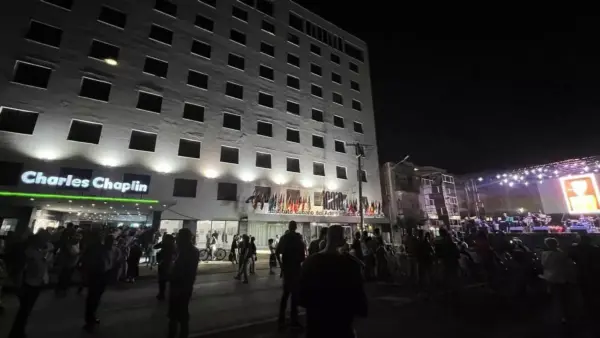
“It feels like a set trying to say ‘everything is fine,’ but the editing cut fools no one.”
HAVANA TIMES – This 46th edition of the Havana Film Festival is not illuminated by The Century of Light. Viewers interviewed by this newspaper feel trapped in a context full of Adorable Lies, in a reality that might as well have come from the world of Juan of the Dead. Havana’s streets, meanwhile, prove that Memories of Underdevelopment remain as relevant as ever.
“From Guanabacoa to Luyanó, passing through Regla, you feel like you’re living a sequence from Death of a Bureaucrat,” confesses a film buff who travels to 23rd Avenue to attend the festival. When he finally reaches El Vedado—its cinemas, its concerts in front of the Chaplin Theater—the sensation is of entering a parallel fiction. “It looks like a set trying to say ‘everything is fine.’ But the editing cut fools no one,” he says.
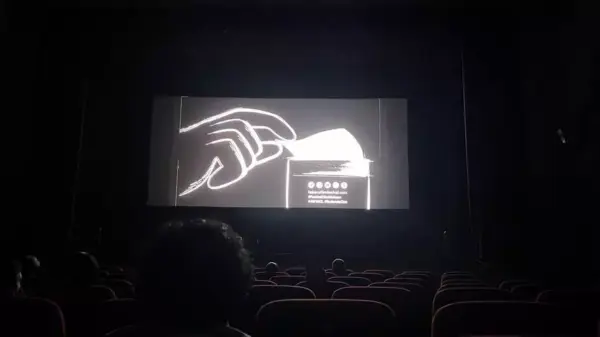
“Blackouts over there, lights on here,” the attendee from eastern Havana sums up. “In El Vedado there are lights, music, screens. In my house, not even enough to charge my phone.” More than one film has suffered an “unexpected final cut.” The Brazilian film Secret Agent ended abruptly when the electricity abandoned the Yara cinema. “The same thing happened the first day,” he recounts. “Other cinemas have stopped mid-screening, with the plot interrupted. Reality devours fiction.”
From exile, the gaze upon the Island acquires an even sharper edge. Filmmaker Carlos Lechuga, based in Madrid, recently published one of the most devastating diagnoses of the Cuba he left behind. “The country is sick, without hospitals, the electric system collapsed, thousands of places across Cuba without water. Zero hygiene. Nothing to eat. Prices through the roof and salaries are laughable. The country dollarized and people earning in pesos,” he wrote, referring directly to the structural collapse that conditions any attempt at cultural life on the Island. His summary is implacable: “They have destroyed Cuba.”
The festival’s opening was also marked by an explicit political gesture. Organizers inaugurated the event by sending “messages of support to Venezuela,” a nod to Nicolás Maduro that many consider “out of place,” yet inseparable from the State’s ideological machinery in any large cultural event.
Meanwhile, the official narrative insists that the festival demonstrates “the luminous resistance of Cuban culture.” That’s how first lady Lis Cuesta put it on X, claiming that the event—with 2,200 works submitted from 42 countries, though only 222 shown—proves that “Culture continues to be vital for the Cuban people” and acts as “a living bridge with the world.” She also boasted that the registration fees—around $15,000—would help sustain the festival, and that “generator plants are already installed in the Project 23 cinemas,” along with mobile screens “ready to bring the magic of cinema to the communities.” In response, one user quipped: “No bread, but circus. Will the screenings be done in rotating blocks, like the blackouts?”
The cinephile interviewed by 14ymedio explains that theaters fill up “when the film is Cuban or when there’s a premiere that sparks curiosity.” But when classic foreign films are shown, like Mecánica Nacional, “barely 50 people take a seat,” most of them seeking “to escape for a while from the darkness in their homes and enjoy a breath of air-conditioning,” more than any cinematic nostalgia.
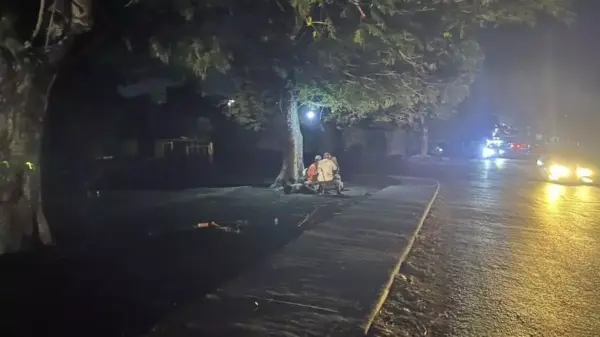
“We don’t even check the Telegram blackout group anymore,” says another young man. “No need: we know there won’t be power in the afternoon or evening.” Resignation has become a method of daily survival. “And we’re still better off than the average Cuban,” admits a resident of El Vedado. “You can’t wash, cook, or plan anything. We live improvising—and the worst part is everyone knows this won’t get better.”
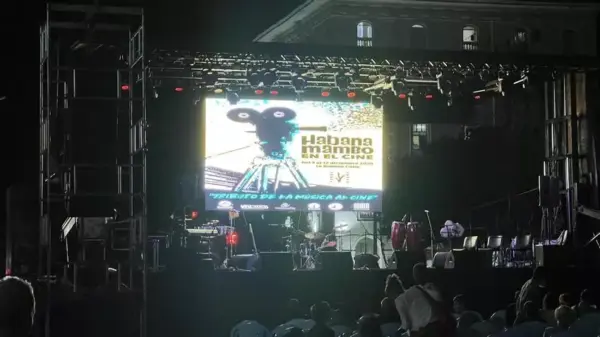
In front of the Chaplin cinema, there is music every night. Arnaldo y su Talismán opened the festival with iconic themes from Cuban cinema but—ironically—did not sing Don’t Let the Little Light Go Out. “It would have been an anthem,” jokes one spectator. Those stages with loudspeakers are small oases of escape, a musical curtain trying to drown out the buzzing of generators and the swarm of mosquitoes that accompanies every outdoor screening.
Beyond the superficial glow, some viewers and creators reflect on the deterioration of cultural quality in a country where the infrastructure is crumbling, and the public is exhausted and currently battered by an arbovirus epidemic. Precarity does not distinguish between art forms; what’s happening in cinema echoes what the Havana Theater Festival experienced in November.
Its most honest critic, Norge Espinosa, said the edition “won’t be remembered,” a phrase that distills the artistic and conceptual insufficiency of an event that should be a cultural flagship. He noted that the festival failed to rise above “the general mediocrity of the works its curatorship proposed,” pointing to a selection that was scattered, weakly articulated, and lacking works capable of sustaining a genuine aesthetic dialogue with the contemporary scene.
He also questioned that the curatorship seemed more like “an exercise in survival” than a solid cultural project, with programming unable to connect either with the public or with the city. For Espinosa, the theater festival was “an act of resistance,” but its logistical and artistic fragility ultimately exposed a scene trying to rise under adverse conditions that undermine its ambitions.
It is very likely that the balance of the Film Festival will resemble that of the theater festival—especially because the country’s situation worsens at an astonishing speed. When the show ends each night, spectators return to neighborhoods like Guanabacoa, Regla, or Luyanó, where the blackout awaits them. They turn on their rechargeable lamps, try to cook, survive a little longer. That is what the festival truly represents today: the contradiction between a cultural ideal and an ever-harder daily life without respite. “It’s like living in The Survivors,” the cinephile concludes, “but without the fine dark humor.”
First published in Spanish by 14ymedio and translated and posed in English by Havana Times.
This article reminds me of an essay written by a famous French director who debuted a film during WWII during the Nazi occupation of France. This Director was a member of the Resistance and used the premier of his film as the occasion to carry out an assassination attempt of high-ranking Nazi officers. Quentin Tarantino loosely based one of his films on this essay. The irony of the essay and the Tarantino film is that the Germans allowed the film to be shown as a gesture of cultural separation from the war. Yet, the director used the debut to carry out the most sinister assassination attempt imaginable. Cuba, according to the First Lady continues to stake out the cultural high ground in the midst of all of its problems. But the reality is, the film festival only highlights how bad things really are in Cuba.