
Cuba Has a New Exchange Rate, What Doesn’t It Mean?
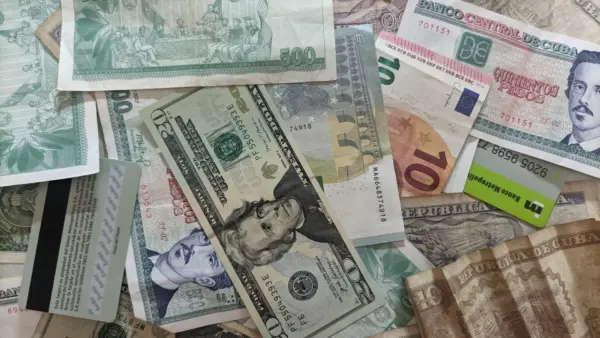
HAVANA TIMES – Cuba rolled out a new exchange rate last Thursday, more than anything to wage war on the digital platform El Toque, so for the moment no results have been seen on the national economic scene.
The new rate will be floating and will coexist with the other two rates that remain officially in force and are fixed: the one operating at 1 dollar to 24 pesos (1×24) for state enterprises, and the one operating at 1 to 120 (1×120), more symbolic than anything else because it was supposedly the publicly accessible rate, but in practice no bank had the backing to exchange currency for the public and it only worked if you had a magic wand or a relative on the other side of the computer.
As explained by Juana Lilia Delgado, Minister-President of the Central Bank of Cuba (BCC), the new rate seeks to make it easier for “exporters and other suppliers of foreign currency to sell at a competitive price, determined by supply and demand.”
The BCC’s Director of Macroeconomic Policy, Ian Pedro Carbonell Karell, clarified that the 1×24 rate is for allocations made by the State on a case-by-case basis, and that the 1×120 rate will be used by certain entities also defined by the Government, based on their capacity to generate external income, while the floating rate (launched at 1×410) would be used by natural persons and private businesses.
This is like a buffet, where there are juicy options for the VIPs and others for those who can only afford a simple plate of rice.
The authorities acknowledged— with the sincerity that characterizes them when it comes to justifying blunders of all kinds— that at present the country does not have the conditions to implement a single exchange rate, a goal they hope to achieve gradually, without defining dates.
This “gradual” business sounds very familiar to Cubans, because it neither establishes a specific time frame for its duration nor guarantees that it won’t be wiped out at a stroke, as happened previously with the now-defunct CUC, for example.
Our gurus, true artists of balance who slide along the tightrope of promises performing the same old acrobatics, once again propose a spectacle that defies logic and, of course, economics.
Clearly, the sharp drop in foreign-currency income and the accumulated imbalances caused by constant macroeconomic experiments to dress up a form of capitalism within socialism make it impossible to know where we are headed.
While the change is intended to stimulate profitability and competitiveness among selected state or private entities, with the aim of strengthening the trade balance and expanding the availability of resources, in concrete terms what matters most to the average Cuban is that their purchasing power in Cuban pesos— the currency they receive as wages— grows in relation to the foreign currencies that rule with impunity.
These are nothing more than tools to try to bring order to this crazy economy and, above all, to capture the juicy flow of remittances, currently absorbed by the informal foreign-exchange market, while prices on the street keep boiling over like a pressure cooker without a valve.
This is like an economic dance without music, in a country where the concept of “competitive” was banished decades ago and now must be reborn accompanied by unicorns and fairy godmothers. In other words, it sounds good on paper.
Ironically, it is a “floating” rate in a country where nothing floats except the ingenuity of the average Cuban trying to survive day by day, amid transitions more abrupt than a crashing wave on the Malecon.
Juggling their salary until the end of the month, trying to keep it from dissolving like a sugar cube in hot water, Cubans look at one another in disbelief at yet another experiment, which as always will depend not on what is decreed in an office, but on what is actually produced.
The rate may be more tempting than an ice cream on a hot day, but it must come hand in hand with the productivity of companies, injecting the stipulated 20 percent of their profits into the new foreign-exchange market.
In concrete terms we are starting off badly, because the BCC set a limit of just 100 dollars per transaction for operations under the so-called new floating exchange rate, since it depends on what is collected in remittances, international transfers, and other state revenues.
So this market will not really be free nor will it have a stable supply of dollars to sell, and that is why the street rate remains in force amid this partial dollarization of the economy, which does not solve the supply deficit in pesos and continues to depend on the sending of remittances, the main lifeline for thousands of Cuban families.
This Saturday, the fairs in the Cuban capital had the same prices as last week, inflated for several months. The good news is that they didn’t go up, and that alone is worth celebrating in this context where money seems to grow in the grass without any need for irrigation.
The great wheel of capitalism keeps turning, and we, mere mortals, are nothing more than pawns in this financial chess game— only now, we will be a bit more entertained following the adventures of the new exchange rate, more ghostly than a labyrinth in the dark.
We remain mere props in this comedy of errors, aboard a ship without a course, trying to find the path toward the light— the one supposedly at the end of the tunnel, which we have been searching for during more than 60 years.
If tourists can get a 410 exchange rate from foreign debit cards more will come back to Cuba and it will be much safer than carrying large amounts of cash
Todos los cubanos no se desesperen, este es solo un corto tiempo en la tierra en comparación con la eternidad en el cielo, Su regalo para nosotros. Su hijo.. que murió por nuestros pecados, así que si lo aceptamos en nuestros corazones.. tendremos el cielo en la eternidad para regocijarnos, no más dolor, tristeza, ira, hambre, enfermedad.. Cuba, hay muchas naciones por ahí que también sufren, y no sabemos por qué Dios permite que algunos sufran así, pero Su propósito no lo conocemos.. solo sabemos que está con nosotros..
God is with you in your struggles ,. Ask Him for endurance, steadfastness, health, for dailly bread.. and He will not disappoint.
God bless you all in Cuba and all oppressed countries. Remember Christ is still watching. All glory to Christ as we celebrate His birth and love for us.