
The Dilemma Many Cubans Face: Buy Food or Medicines?
when they stock the neighborhood pharmacy
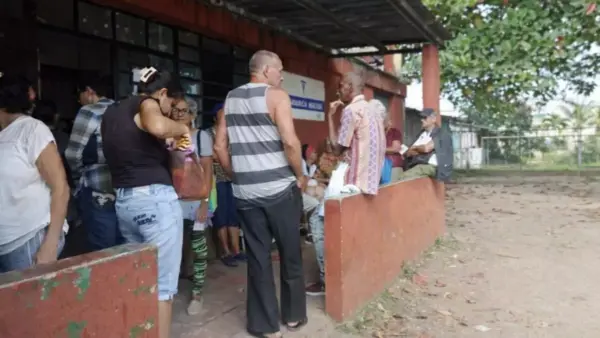
“The 1,000 pesos I had saved to buy a little piece of meat are going to go on medicines,” says a retired woman in San Jose de las Lajas, Havana.
By Julio Cesar Contreras (14ymedio)
HAVANA TIMES – San Jose de las Lajas / At seven in the morning, the green gate of the pharmacy in the La Micro neighborhood already had a line in front of it that stretched around the corner. There was no sign announcing the arrival of medicines, nor any official voice confirming it, but in San Jose de las Lajas important news spreads by word of mouth at the speed of need.
It was enough for someone to say “something came in” for many to leave a pot on the stove, a broom leaning against the wall, or a grandchild in a neighbor’s care, and head out with their ration card folded in their pocket. The scene, repeated so many times in recent years, took on a particularly urgent air this past Monday: it wasn’t about buying, but about not waiting any longer.
“It’s been more than four months since captopril arrived,” says Mabel, a second-grade teacher, as she fans herself with a school notebook she carries in her purse. During that time, she has bought it on the street for 500 pesos per blister pack, a sum that eats up a good part of her salary. To be there she left her students with a teaching assistant and practically ran out. “This isn’t about getting ahead, it’s about not ending up with nothing,” she sums up. In front of her, a pair of women check their prescriptions repeatedly, as if the paper might evaporate before reaching the counter.
The La Micro pharmacy is a small place, with worn walls and lighting that doesn’t fully dispel the dimness. Sales move along at the usual slow pace, and each customer seems to take longer to be served than the one before. Outside, those waiting make do however they can: sitting on the wall, standing under the fiber cement roof, or leaning against the rusted window bars. Most are middle-aged or elderly people, with that accumulated weariness that not even good news can erase.
“I even brought a prescription for amoxicillin, although they told me no antibiotics came in,” Mabel comments in a low voice. The complaint is repeated among those present: “First they supply other establishments in town; what gets here is what’s left over.” The usual suspicions about favoritism and friendships also hang in the air, a constant murmur that no one ever quite confirms but that forms part of the landscape. Distrust, like the line itself, has become structural.
Zenaida, a 67-year-old retired architect, marked her place in line at five in the morning and still has number seven. “The 1,000 pesos I had saved to buy a little piece of meat are going to go on medicines,” she says without raising her voice. She suffers from several chronic illnesses and knows well the cruel arithmetic of these times: either eat better or sleep without pain. “I thought nothing would come in until January. I’d rather spend the 31st with just rice and beans than spend the night awake with aching joints,” she confesses as she takes two 500-peso bills out of her purse, wrinkled from being saved so long.
Inside the shop, an employee strictly controls access to the counter. Leaning out of the barred window, he repeats the rule: three prescriptions per person, no more. “As long as I’m here, there won’t be any disorder,” he warns, aware that some see every shipment of medicines as a business opportunity. His vigilance contrasts with the precariousness of the system he is trying to uphold: few drugs, too many needs, and a distribution chain battered by theft, dertour, and lack of oversight, as documented in recent months by investigations into the deterioration of the public health system.
The scene becomes almost ritualistic. Every time someone comes out with a bag in hand, the others ask what they managed to buy, how much there was, what has already run out. The inventory is reconstructed in real time: captopril, some clonazepam, limited analgesics. Nothing enough for everyone waiting, nor to last very long. “This is a breather, not a solution,” comments a retiree as he adjusts his cap and looks at the ground. “Now they might bring more again in March or April. That’s why I ran here.”
The approach of the end of the year runs through all the conversations. No one talks about celebrations, but about survival. In the line, stories cross of expired prescriptions, months without treatment, impossible prices on the informal market. Some remember when the pharmacy was a place for quick errands and not a site to test physical endurance. Others prefer not to remember.
In San José de las Lajas, as in the rest of the country, the shortage of medicines has forced people with chronic illnesses to reorganize their lives around scarcity. The pharmacy becomes a meeting point, a social thermometer, a stage where wear and tear is measured. This Monday, the arrival of “a little” medicine did not solve the problem, but it did activate a minimal, almost defensive hope: not to be left completely unprotected.
As midday approaches and the line begins to thin, some head home with the essentials; others, empty-handed.
First published in Spanish by 14ymedio and translated and posted in English by Havana Times.