
Ortega: The Americas Longest-Serving 21st Century Dictator
Will his dynasty continue?
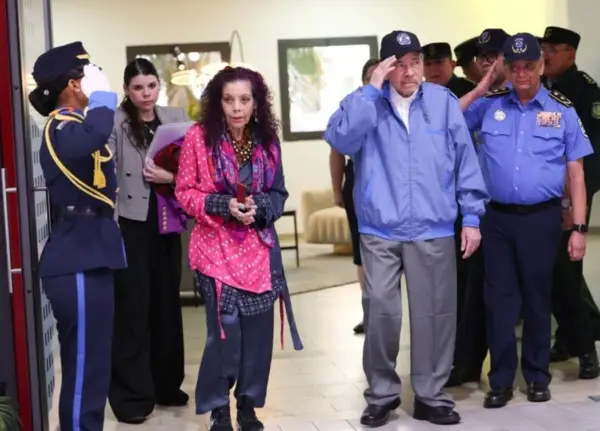
External pressure or internal fracture could remove him from power, but only a strong democratic opposition, without a police state, can open a transition.
By Carlos F. Chamorro (Confidencial)
HAVANA TIMES – On January 10, 2026, Daniel Ortega completed 19 consecutive years in power, far surpassing Anastasio Somoza Garcia, founder of the 20th-century dynasty, who ruled Nicaragua for 16 years and, after his death, was succeeded by his sons Luis and Anastasio.
The strongman of the Sandinista Front is now the longest-ruling dictator in Latin America and the Caribbean, an anomaly in this 21st century of electoral volatility and political turnover. To this must be added an even more bizarre feature: a family-marital dictatorship. According to the new Constitution that instituted “dynastic succession” in 2025, Daniel Ortega now shares the “co-presidency” with his wife, the “co-president” Rosario Murillo.
In his marathon career for power, Ortega was first coordinator of the Government Junta of National Reconstruction during the Sandinista revolution that overthrew the dictatorship of Anastasio Somoza Debayle in 1979, and in 1985 he was elected president. In 1990 the former Sandinista guerrilla handed over power, following his electoral defeat to my mother Violeta Barrios Chamorro, who in turn initiated the democratic transition.
After losing two other elections and spending 16 years in the opposition “governing from below,” Ortega alternated between capturing the judiciary, violent uprisings, and crisis political negotiations, and he returned to power through elections in 2007 as the result of a successful political tactic and a fortuitous incident.
The tactical success was the “pact” with the corrupt former president Arnoldo Aleman in the year 2000, which reduced the threshold to win in the first round—tailor-made to Ortega’s electoral support—to a minimum of 35% of the vote and five percentage points over second place. Thus, Ortega won with 38%, while 62% of voters split between two right-wing parties and a third social-democratic one. Although, what truly allowed him to reach that 38% of the vote was the sudden death, three months before the election—under circumstances never fully clarified—of Herty Lewites, the popular former mayor of Managua, who had been expelled from the FSLN for disputing the nomination with Ortega. Lewites had been projected as the candidate of the democratic left (MRS), taking from Ortega a large percentage of Sandinista voters.
Nothing, therefore, was inevitable—not Ortega’s return to power, nor his consolidation as a dictator for 19 years—facilitated by the derailment of the democratic transition, which had many indispensable collaborators, starting with the betrayal of the military and police chiefs who surrendered their institutions to the family dictatorship, just as the National Guard had done in the Somoza era in the last century.
In his second presidency, Ortega came in determined to stay in power forever. He executed a “coup from above” that demolished democratic institutions, made electoral fraud standard practice, outlawed and repressed the opposition, until he achieved monopoly control over the branches of state—the Supreme Court, the Legislature, the Electoral Authority, and the Comptroller’s Office. Likewise, co-opting the Army and National Police, formerly the key of the democratic transition, into the family political control of the presidential couple.
Questioned in his early years by the majority opposition, his authoritarian project found a path to legitimacy and stability beginning in 2009 by striking an alliance with the major business elites of Nicaragua and the region (Central America, Mexico, Colombia, the United States, and Canada), who were allowed to co-govern the economy at the expense of transparency and democracy. These were also the years of high oil prices and Venezuelan cooperation under Hugo Chavez, through the funneling of over $5 billion dollars via a parallel private budget to finance the regime’s welfare programs, but above all to enrich the private businesses of the ruling family.
In 2011, Ortega was re-elected in violation of a constitution that had prohibited consecutive re-election or a third term after two alternating governments. Once again, he was re-elected in 2016, inaugurating a hegemonic party system by stripping the opposition of its seats in Parliament and installing his wife in the line of constitutional succession as vice president. However, when he was forced to govern without the economic muscle of Venezuelan petrodollars and faced the first popular protests by university students, the regime—designed not to tolerate democratic opposition—provoked the worst bloodbath in Nicaragua’s history in peacetime.
The authoritarian corporative model and the alliance with big business collapsed during the April 2018 rebellion, a spontaneous self-organized protest that led to 100 days of civic insurrection—mass marches, university occupations, national strikes, neighborhood barricades, and roadblocks—that put the regime on the ropes, demanding an end to the dictatorship and early elections.
Ortega and Murillo responded with a no-holds-barred police and paramilitary repression, backed by the Army high command, resulting in more than 350 killings and political persecution that produced thousands of arbitrary detentions and tens of thousands of exiles. The institutional dictatorship, accustomed to using repression selectively, became a bloody dictatorship, and since September 2018 imposed a police state, de facto suspending all democratic rights and freedoms: assembly, mobilization, press and expression, association, and even religious freedom.
In November 2021, Ortega discarded his last chance to risk power and hold competitive elections, even under a police state. Certain that he would be defeated by any contender, he jailed the seven opposition pre-candidates and re-elected himself for a third consecutive term, without political competition. His illegal re-election triggered majority rejection in the OAS, which questioned the legitimacy of his government but never managed to gather the 24 votes needed to sanction the dictatorship for violating the Inter-American Democratic Charter.
As a preview of what would happen in Venezuela three years later, when Nicolas Maduro stole the election he lost to Edmundo González and imposed himself by force, in Nicaragua the democratic governments of the Americas and the Inter-American system failed to halt a dictatorship that today tends to normalize itself. Even though some democratic leaders naively bet that once re-elected Ortega would call for some kind of national dialogue, under the full command of Rosario Murillo the dictatorship instead continued to radicalize its path toward an even more totalitarian scheme.
Between 2021 and 2025, the regime swept away all civil society—universities, media outlets, business associations, civil and religious organizations, including the Red Cross, the nuns of Mother Teresa of Calcutta, and even the Miss Nicaragua pageant. In all, the dictatorship eliminated more than 5,500 civil society organizations, tightened censorship, and unleashed an aggressive political persecution against the Catholic Church, jailing and later banishing dozens of priests and four bishops. The cherry on top of the repression was a vengeful campaign of transnational repression, based on stripping more than 450 citizens of their nationality, carrying out terrorist assaults in Costa Rica, and canceling the right to travel and return to the country in freedom.
Briefly summarized, that explains the longevity of the Ortega-Murillo dictatorship, although there is another structural pillar supporting the resilience of the repressive regime. Unlike Cuba and Venezuela, the Nicaraguan economy is not collapsing, and despite property confiscations and the collapse of legal security, according to bureaucrats at the International Monetary Fund the economy is in good health. That’s what the macroeconomic figures say, due to international reserves built on exports to the United States and other DR-CAFTA countries; to the exodus of one million Nicaraguans who send home remittances equivalent to 30% of the GDP; and to a scheme of corruption and extortion over the private business sector.
The dynastic succession of Rosario Murillo at the head of total power began many years before it was formalized in the Constitution, through an endless purge of Ortega loyalists who were replaced by people loyal to Murillo, causing erosion in the dictatorship’s support base within Sandinismo. With Ortega an absent ruler, Murillo, omnipresent, governs with a team of 25 political operators, including five of her children, who control—without opposition—repression, the centralization of the state-party, the economy and corruption, and the regime’s censorship and propaganda.
The fall of Nicolas Maduro, a product of the US military intervention in Venezuela, caused a mix of panic and paranoia inside the “El Carmen” presidential bunker. Murillo decreed a state of alert that produced more than 60 new political prisoners for commenting on or celebrating Maduro’s capture, and at the same time Ortega and Murillo adopted an unusually cautious diplomatic language, expressing solidarity with Chavismo but without mentioning Donald Trump by name.
In reality, Nicaragua is not on the radar of priorities for the Trump administration in Latin America. On the eve of Trump’s return to the presidency in 2025, the dictatorship canceled the use of Managua’s international airport as a trampoline for intercontinental flights promoting illegal migration to the United States. And although the DEA announced its withdrawal from Nicaragua due to the regime’s lack of cooperation, the Nicaraguan Army strives to show results in drug interdiction, despite the fact that Nayib Bukele’s security minister—Trump’s man for Central America—insists that the cocaine being moved northward through the Pacific comes from Nicaragua.
Nor do Ortega’s alliances with Russia and China—whom he seeks to represent as a pawn in Central America—seem to bother the Trump administration, not even the violations of the CAFTA treaty documented at length by the US Trade Office. However, given the unpredictability of Trump and his lieutenant Marco Rubio, it is imperative to recognize that any extraordinary act of external pressure, or even an internal fracture, could dislodge Ortega and Murillo from power, but only a strong democratic opposition, without a police state, could open the path to a transition.
The end of the dynastic dictatorship and a democratic resurgence in Nicaragua begins with unity in action by the opposition inside Nicaragua, and not only in exile; with the gradual reconstruction of the civic fabric—including democratic civil society, the Catholic Church, and the business sector—to weaken the police state; and with a roadmap for “the day after” that places justice without impunity at the forefront.
Meanwhile, the only space for freedom that exists in Nicaragua as I write these lines is the independent press, operating from exile, which every day is defeating the dictatorship’s censorship.
First published in Spanish by Confidencial and translated and posted in English by Havana Times.