
How Viable & Imminent Could a US Naval Blockade of Cuba Be?
HAVANA TIMES — The possibility of a US naval blockade of Cuba has entered political and media debate. On January 24, 2026, Cuban Vice Minister of Foreign Affairs Carlos Fernandez de Cossío denounced what he described as a “brutal” attempt by the US government to prevent fuel from reaching the country—a measure that, he said, would constitute an act of aggression against a state that poses no threat to Washington.
The Kremlin also expressed concern about a potential naval blockade. Presidential spokesperson Dmitry Peskov said Moscow is closely following international press reports and other official information on the issue. Without confirming specific scenarios, Russia underscored the importance of Cuba’s independence and national interests.
What reports were they referring to? The US outlet Politico revealed that President Donald Trump was reportedly considering imposing a naval blockade to cut off oil supplies to Cuba as part of a pressure strategy aimed at provoking regime change on the island. According to that report, the proposal had been discussed at high levels of the White House, but there has been no public confirmation or official decision to date.
The debate has also generated public interpretations from various political actors and analysts. Miguel Cossio, director of the Cuban Museum of the Diaspora in Miami, warned that in the face of “a naval blockade that prevents oil from entering Cuba, the government would be forced to sit down and negotiate,” highlighting the political pressure such a move could generate in Havana. Political analyst Andy Gomez, for his part, said: “The discussion doesn’t surprise me; it’s been talked about for weeks,” and noted that any eventual regime change, in his view, would depend more on internal dynamics than on external measures.
This raises a key question: how viable and how imminent could a US naval blockade against Cuba be? Answering it requires going beyond political rhetoric and examining the legal, military, and diplomatic limits of a measure that, under international law, has far deeper implications than public debate often suggests.
This explainer focuses on a legal and geopolitical analysis of the proposed scenario, drawing on international law and known military capabilities, and does not constitute an assertion or prediction of future events.
What Is a Naval Blockade?
A naval blockade is a military operation by which a state prevents, through the use or threat of force, maritime access to the ports and coasts of another state. It is a measure regulated by international humanitarian law—specifically, the law of armed conflict at sea—and is historically associated with situations of war or armed conflict.
According to the San Remo Manual on International Law Applicable to Armed Conflicts at Sea (1994), a naval blockade may be imposed legally only in the context of an armed conflict and must meet strict requirements, including formal declaration and notification, effective enforcement, allowance for indispensable humanitarian aid, and respect for the principles of proportionality and distinction.
In addition, Article 2(4) of the United Nations Charter prohibits “the threat or use of force against the territorial integrity or political independence of any state.” A naval blockade—because it entails coercive interdiction of maritime traffic by military forces—is considered a form of use of force. In that framework, if imposed unilaterally outside a recognized armed conflict, it may be considered an act of aggression.
The only exceptions recognized under the UN Charter are self-defense in response to an armed attack (Article 51) or explicit authorization by the UN Security Council under Chapter VII, which allows coercive measures—including naval operations—when there is a determination of “a threat to the peace, breach of the peace, or act of aggression.” Such a scenario is highly unlikely given the balance of power in the Council and the historical positions of permanent members such as Russia and China regarding Cuba.
To date, there is no public evidence or formal allegation that Cuba poses such a military threat to the United States.
From this perspective, a naval blockade in the strict sense is not an economic sanction or an administrative measure, but a high-impact military action with profound legal, diplomatic, and strategic consequences.
International practice reinforces this legal framework. Even in periods of high political tension, states have avoided labeling actions as “naval blockades” outside wartime contexts. The most cited case is that of the United States during the 1962 Missile Crisis, when the John F. Kennedy administration opted for the term “naval quarantine” to avoid the implicit recognition of a state of war and to reduce the risk of direct confrontation with the Soviet Union, as well as the legal implications before the international community.
From a Logistical and Technical Standpoint, What Would the United States Need to Impose a Naval Blockade on Cuba?
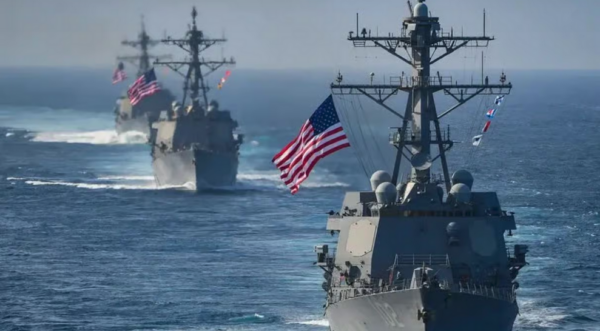
From a military and operational perspective, an effective naval blockade against Cuba would require a sustained, complex, large-scale naval operation—far beyond a mere deterrent presence in the Caribbean.
First, the United States would need to deploy and permanently maintain a naval force capable of controlling the island’s main maritime access points. Cuba has more than 5,700 kilometers of coastline, multiple key commercial ports (Havana, Matanzas, Cienfuegos, Santiago de Cuba, Mariel), and lies in an area of intense international maritime traffic. An effective blockade would require simultaneous coverage of multiple areas, both north and south of the island, as well as approach routes from the Gulf of Mexico, the western Caribbean, and the Atlantic.
In terms of naval assets, this would involve surface vessels capable of interdiction, boarding, and inspection; patrol ships; submarines for surveillance, deterrence, and covert control of sea lanes; maritime patrol aircraft; and integrated intelligence, surveillance, and reconnaissance (ISR) systems, including satellites, radars, and command-and-control links.
Moreover, a naval blockade would not be limited to intercepting Cuban vessels. To be effective, the United States would have to interdict or inspect ships from third countries, greatly increasing operational complexity and diplomatic risk, as many of these vessels would be sailing under foreign flags and carrying commercial cargoes considered legal under international law.
From a logistical standpoint, the operation would also require nearby support bases (ports, airfields, at-sea replenishment), constant rotation of units, and the capacity to sustain the operation for weeks or months—entailing significant economic and military costs.
Consequently, while the United States possesses the technical and military capacity to carry out a naval blockade, doing so against Cuba would require a sustained naval mobilization that is legally contentious and politically costly.
Why Is the Term “Naval Blockade” Being Used?
The recurring use of the term “naval blockade” in the current debate does not necessarily reflect the technical or legal description of a specific measure, but rather the political, symbolic, and communicative value the expression carries. In contexts of high tension, the concept functions as a discursive shortcut that condenses multiple meanings and scenarios, even if not all are viable in practice.
First, the term operates as a rhetorical tool. In public debate, “naval blockade” evokes an image of total encirclement, military coercion, and immediate economic suffocation, amplifying its emotional and media impact. Its use allows hypothetical scenarios to be suggested without detailing the complex legal, military, and diplomatic requirements such a measure would entail in reality.
Second, the expression can function as an instrument of psychological pressure. In that sense, it plays a deterrent or intimidating role aimed at authorities, economic actors, and public opinion alike.
Third, speaking of a naval blockade sends an internal political message, both in the United States and in Cuba. In the US context, hardline language toward Havana often resonates with certain segments of the electorate and political circles that advocate extreme pressure. In the Cuban case, denouncing a possible naval blockade reinforces the narrative of external threat and aggression, with potential mobilizing effects domestically.
Added to this is a deliberate—or functional—confusion between distinct concepts that often permeates media debate. Frequently, the economic embargo and certain targeted maritime interdictions carried out by the United States under specific legal frameworks—such as combating drug trafficking, arms smuggling, or irregular migration—are treated as equivalent. None of these measures, by themselves, constitute a naval blockade in the strict sense, even if their cumulative effect may resemble one on a country’s trade and logistics.
In practice, what could occur—without being formally labeled a “naval blockade”—is a tightening of economic and logistical pressure. This could include increased maritime surveillance in the Caribbean, selective inspections of vessels under various legal pretexts, heightened indirect pressure on shipping companies, insurers, and port operators, and more aggressive application of secondary sanctions against third countries or companies that trade with Cuba.
Although the United States has the military capacity to execute a large-scale naval operation, it lacks a solid legal basis and a favorable international environment to do so without incurring significant diplomatic costs. The interdiction of third-country vessels, interference with freedom of navigation, and the risk of regional escalation would make a unilateral naval blockade a politically costly and legally contentious decision.
First published in Spanish by El Toque and translated and posted in English by Havana Times.