
The Rio Grande Is Not Just a River
Border Walls and Buoy Barriers Are Killing the Rio Grande. I Have a Front Row Seat.
By Elsa Hull* (Border Chronicle)
HAVANA TIMES – Flush with $51.6 billion from Trump’s budget bill, Customs and Border Protection and the Department of War are rapidly building a border wall and installing floating buoy barriers across the southern border. The Border Chronicle invited residents to write about the construction and its impacts on the environment and their communities. This reflection by Elsa Hull from South Texas follows Myles Traphagen’s article in December on southern Arizona.
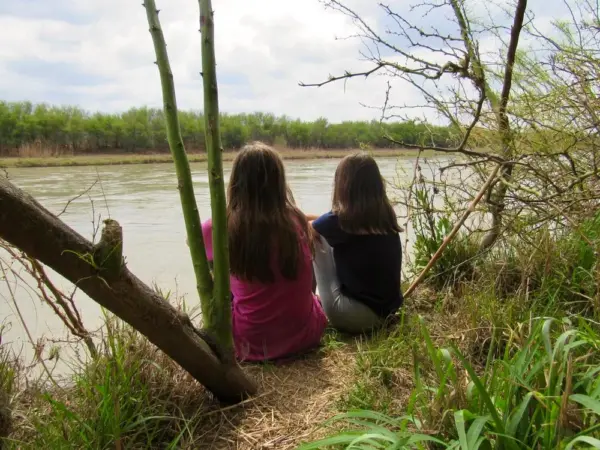
The Rio Grande is not just a river; it is an inseparable part of my identity. Much of my professional life has been spent in service to this river, monitoring its water quality along a 300-mile stretch to help protect the vibrant ecosystems and communities it sustains. The Rio Grande is also my backyard. For more than 25 years, I’ve lived near the river, where I raised my family and created a bird and wildlife sanctuary on our small property near San Ygnacio in South Texas.
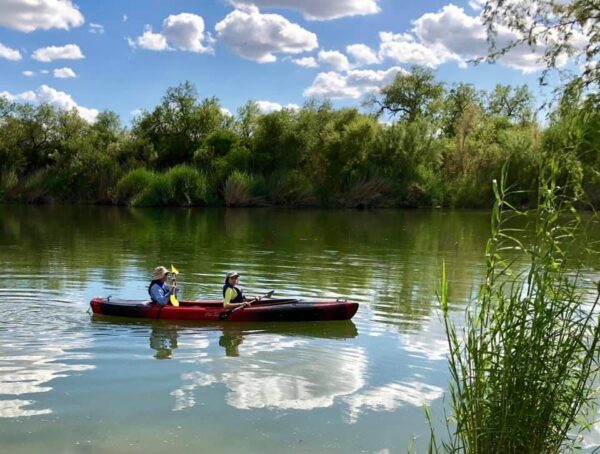
Much of my spare time is spent kayaking, camping, and observing wildlife with friends and family on the Rio Grande. But now our homes, our communities, and our river are under imminent threat. The federal government has announced it will build 108 miles of 30-foot-high steel bollard wall in the Border Patrol’s Laredo Sector, where I live, along with a 150-foot-wide enforcement zone on either side.
And that’s not all. The Trump administration wants a double layer of wall along the entire southern border. In South Texas, where the Rio Grande serves as the border with Mexico, the second wall will be a “waterborne barrier,” consisting of floating orange cylindrical buoys nearly five feet in diameter. Altogether, the federal government plans to install 500 miles of these buoys from the discharge of Amistad Reservoir to the Gulf of Mexico, including the section of river where I live. The installation has already begun downriver near Brownsville.
I can tell you that the river does not need more walls; it needs investment. Last year, the lower Rio Grande was named the fifth most endangered river in the country, owing to drought, overallocation, deteriorating infrastructure, and lack of governmental funding, among other factors. It is the sole source of drinking water for 6 million people, and it is vital to the farming and ranching industries of South Texas.
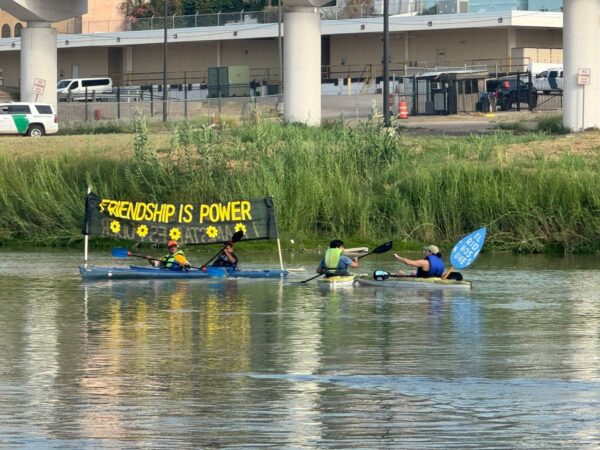
The river also unites communities on both sides of the border, including the sister cities of Laredo and Nuevo Laredo. Last August, we participated in the trinational Friends across Borders event and celebrated friendship with kayaking, banners, music, and dancing under the international bridge on both sides of the river. A binational consortium has made efforts to enhance this shared cultural resource with designs for a six-mile, 1,000-acre binational park along the river in Laredo–Nuevo Laredo. All this will come to an abrupt halt, quashed by a racist monument of walls and buoys. We will be cut off from our river—no more kayaking, fishing, or sister-city celebrations along its banks. Ranchers will no longer be able to graze and water their cattle along the river. Even deer hunting, an integral part of South Texas culture and economy, will be harmed as deer populations become fragmented and species decline.
And that is not all that will be lost. The Carrizo Comecrudo Nation, or Esto’k Gna in their native tongue, are the original people of the lands along the Rio Grande. In early 2025, I was honored to assist the tribe with archaeological surveys ahead of wall construction in Starr County to document their habitation and sovereignty along the borderlands. The River Pierce Foundation, an organization that manages the San Ygnacio Historic District (National Register of Historic Places, 1973), has been collaborating with the tribe to recover and preserve tribal history in South Texas. Their efforts to achieve federal recognition will be erased by wall construction. The San Ygnacio Historic District will be forever changed by this wall as historical buildings and settlements will be destroyed.
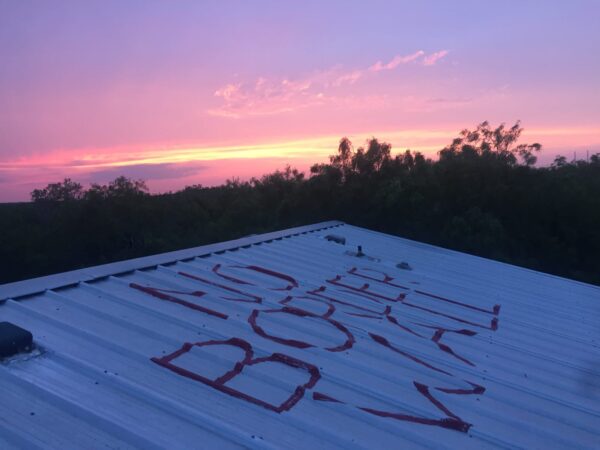
On a more personal level, the proposed wall path depicted on CBP’s “Smart Wall” map is utterly devastating, because it shows how the wall will slice through the riparian area adjacent to my three-acre property, extending the enforcement zone through my front yard and possibly my home (CBP will be holding a meeting with landowners in February). Even if my home is spared, I will be living under the shadow of a wall. I will have to watch the sun set through the bars of a prison. And my view of the Rio Grande will include the “second” border wall of massive floating orange buoys.
The dark night skies will be washed out by the proposed stadium lights planned as part of the “wall system,” and gone will be the nights of watching meteor showers with my daughters. Worse still, my efforts to preserve this land as a bird and wildlife sanctuary will be obliterated. I have documented over 150 bird species here, as well as other wildlife, including threatened species such as the Texas tortoise and Texas indigo snake. With the menace of the border wall looming over me, I think of all the wildlife that relies on my little sanctuary and the natural beauty that will be destroyed. Last year, a black bear was caught on video as it crossed Highway 83 just upriver from me in Zapata County, heading toward a stretch of state wall. Since the wall is not yet contiguous, there is hope that the bear made its way to the river.
The devastation caused by these border walls goes well beyond my small property. Just downstream from me, wall construction is underway on lands managed by the U.S. Fish and Wildlife Service. Crucial wildlife areas within the Lower Rio Grande Valley National Wildlife Refuge will be divided, and much of the refuge will be behind the wall. Endangered species such as the ocelot and jaguarundi may face extinction as wall construction destroys habitat and further fragments populations.
This wildlife refuge land is part of a critical migration corridor for the Rio Grande Flyway, where more than 400 bird species migrate between Canada and Mexico. Birders come to South Texas from all over the world searching for species such as the Morelet’s seedeater, plain chachalaca, groove-billed ani, green jay, and Altamira oriole. A few years ago, I documented a tropical species rare even to our area, the rufous-capped warbler, on my property, which caused quite a stir in the local and national birding communities. Critical riparian bird habitat will be destroyed by wall construction, and migration will be interrupted by the bright lighting along the wall.
As the land barrier threatens our homes and the environment, the 500 miles of buoys on the river could also be catastrophic for our communities. In 2010, when Hurricane Alex dumped huge amounts of rain into the watershed, I witnessed large, heavy shipping containers dislodged upstream come to rest in the river by Laredo. I can imagine the death and destruction that will ensue when the next severe flood dislodges these floating barriers, taking out infrastructure such as bridges and pump stations as it washes downstream.
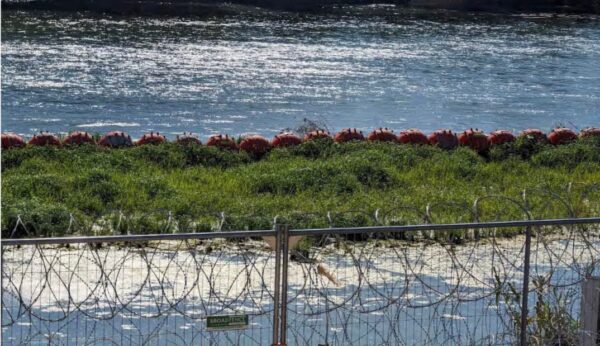
We already have a window into the environmental damage these buoys can cause because we have state-funded buoy barriers on the Rio Grande near Eagle Pass. Texas governor Greg Abbott authorized the installation of 2,000 feet of interconnected four-foot buoys. They are “anchored” to the riverbed using cables and concrete blocks, with a mesh below to prevent swimming underneath. But these buoys—like the ones being installed by the Trump administration—are designed for deep open water, not a flowing river, where they trap debris and sediment, creating unnatural island formations and changing the river’s course.
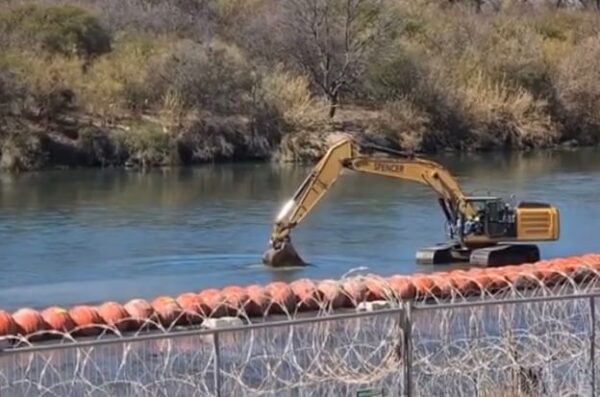
In December, I witnessed this damage firsthand when I participated in an ongoing environmental study conducted on these buoys. We observed that most of them were not floating but resting on the riverbed. The buoys are designed to rotate to prevent someone from climbing over them, but since they are being used in shallow water, this intended deterrent function has failed.
Additionally, they require frequent maintenance (further wasting tax dollars) to remove debris and dredge the accumulated sediment from the riverbed. Heavy machinery is driven into the river to conduct this maintenance, further damaging the riverbed and harming aquatic species, including the endangered Texas horn shell and the threatened Mexican fawnsfoot found in Laredo’s stretch of the river. Increased silt in the river also means that water pumps could be damaged, making it harder for farmers and municipalities to receive water. Microplastics, which have been linked to cancer and organ damage in living organisms, will also be released into the water as the buoys degrade from sunlight and erosion.
This deterioration of water quality will harm the ecosystem and our food and drinking water supplies and will impact not only the millions of people who rely on the river for drinking water but will also be felt throughout the country, as the Rio Grande Valley, a major agricultural area in Texas, ships produce throughout the U.S., Canada, and Mexico.
I’ve often kayaked along the Rio Grande with friends and family, enjoying the stunning scenery of tall sandstone bluffs in northern Webb County, exhilarating rapids downstream in Zapata County, stands of tall black willows, and yellow-bloomed retama rich with avian life, along with families picnicking and fishing along both banks. I cannot imagine being cut off from our beautiful river by walls and buoys. But this is already occurring in the Rio Grande Valley, where the federal government has declared 250 miles of South Texas a National Defense Area, under military control, after acquiring the levees from the International Boundary and Water Commission, a binational agency that is supposed to protect the river and uphold treaties with Mexico but has instead become a political pawn. Residents of the borderlands are now under threat of detention just for trying to access our river.
With apprehensions by Border Patrol at historic lows across the southern border and Laredo, the largest city in our area, being named by the FBI as the safest city in Texas and ranked the 13th safest city in the U.S. (all without a wall), it makes absolutely no sense to force a multibillion-dollar barrier system into our area. Walls will not stop people, but they will stop wildlife and disrupt our homes and community. This is not a partisan issue. This is not about border security. This is about Big Government seizing our land and our river to award construction contracts to line the pockets of their political donors, including companies such as Fisher Sand and Gravel, notorious for the shoddy construction of the crowdfunded wall near Mission, Texas, and marred by the grift, arrests, and convictions of some of their associates. This is about Big Government waiving over 30 federal laws to build this wall because it cannot be constructed legally. This is about Big Government seizing control of our only source of drinking water. This is about Big Government treating border residents as second-class citizens who don’t deserve the same rights and protections as the rest of the country.
Constructing a wall of this magnitude is unprecedented, and it, along with the buoys in our river, will have far-reaching harms. The people of the borderlands deserve investment in our communities, not projects that degrade us. Join and support groups opposing the wall, such as the No Border Wall Coalition in Laredo. Contact your elected officials. Submit public comments to CBP. Let them know our tax dollars must be spent on schools, hospitals, infrastructure, and the environment, not on costly, destructive barrier systems that create more problems while solving nothing. I should know; I’ve seen it firsthand.
*Elsa Hull lives in a rural area on the border near the historical town of San Ygnacio in South Texas, where she has raised two daughters and many fur babies. She has a background in environmental science, with 25 years of experience in water quality monitoring and providing technical expertise to drinking water systems along the border. She has been fighting border wall construction since 2019.