
How Goods Move in Havana, Cuba Paralyzed by Fuel Shortages
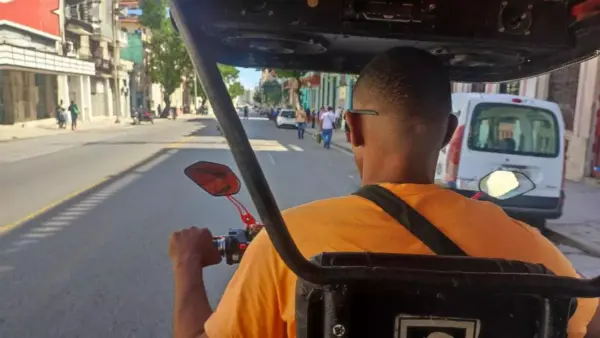
“If I work twelve hours, I can make more than 5,000 pesos ($10 USD) a day, although it’s quite hard.”
By Natalia Lopez Moya (14ymedio)
HAVANA TIMES – In a city that is practically at a standstill, some people never stop. You see them crossing empty streets, dodging the potholes along the Malecón or pedaling uphill on Tulipán with a backpack on their backs. They wear no uniforms and have no employment contracts, yet they carry much of Havana’s economy on wheels. They are the young delivery workers, a generation that in these days of fuel shortages has become indispensable in the movement of goods.
Yasiel, 26, delivers pizzas, medicines, and small packages. Orders reach him via WhatsApp from private businesses in the Cuban capital, desperate for the lack of messengers with cars or gasoline motorcycles. Sometimes they ask him for flowers, a cake, or even a plastic basin to bathe a baby. “Whatever can be strapped onto the rack,” he tells 14ymedio as he adjusts the bags on his bicycle that he will deliver to several points around the city. He has no self-employment license and does not belong to any small or medium-sized enterprise, yet he earns more than many professionals. “If I work twelve hours, I can make more than 5,000 pesos a day, although it’s quite hard.”
On Friday night, when only a few electric tricycles and some pedestrians who preferred walking on the asphalt rather than the neglected sidewalks were traveling along Rancho Boyeros Avenue, Yasiel was still making deliveries. An enormous backpack hung from his back and another, even larger, from his chest. He was coming from Playa municipality, near the Almendares River, heading to Nuevo Vedado. “I’m exhausted because I haven’t stopped pedaling all day. Could you give me a glass of water?” he asked one of his customers, nearly fainting.
The company Yasiel was delivering for, one of many that operate digital platforms where emigrants buy food and other basic supplies for their relatives on the Island, “is liquidating its merchandise ahead of what’s coming,” the young man says. The online shop has launched a 15% discount on all its products, and “if they’re frozen, you can get them for up to 25% less,” he explains. Fearing that blackouts will grow longer each day, “many people are avoiding buying anything that requires refrigeration.”
This Friday, the deliveries Yasiel made were mainly canned goods, grains, and cookies. “There were jars of chickpeas that you could tell had been sitting in the warehouse for a while because of the dust on top.” Bags of flour, sardines, tuna, powdered milk, cereal, vegetable oil, and the ever-reliable cans of Spam rounded out the orders. “For the first time since I started this job, I didn’t move a single package of frozen chicken quarters today.” No one wants a power outage to turn their food into a stinking puddle of water and blood.
In Telegram groups with names like Delivery Habana 24/7 or Mensajeros de Plaza, workers share orders, routes, and clients. Sometimes they also share warnings: “Don’t go through Infanta, it’s pitch dark because of the blackout.” These are work forums, but also spaces of camaraderie. “Here we alert each other when a business is looking for workers, when the power is out, or if a street is closed for a march. We’re like a brotherhood, but without headquarters,” Yasiel explains.
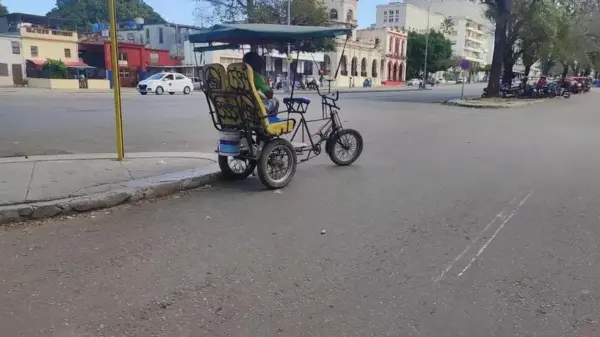
Marcos, 34, nicknamed El Ruedas [Wheels], has spent weeks transporting “more food than people” in his bicycle taxi. Originally from distant Banes in Holguín province, he has spent five years running passenger routes between Central Havana, Cerro, and Old Havana. At the beginning of February, he got a call from a friend who works for a digital site that distributes everything from food to hardware supplies. “He told me they needed bicycles or electric motorcycles because they had fewer and fewer cars due to the gasoline problem.”
Since then, Marcos has “combed Havana” from one side to the other transporting sausages, soft drinks, butter, and whatever a Cuban emigrant in Miami, Berlin, or Madrid buys for family members on the Island. “I’ve been lucky, and besides what they pay me, I’ve received good tips because when people see me arriving in the bicycle taxi, they reach into their pockets to give me something.” Where others fear a worsening fuel crisis, the Holguín native sees his niche: “Now it’s our turn, the ones who don’t need oil or electricity.”
The day he remembers most gratefully was last Monday, when he delivered “coffee and some of those tubes used so bedridden patients can urinate” to a house in Casino Deportivo. “The little old lady who received me tipped me a dollar,” he recalls. That same day, the U.S. dollar was approaching 500 Cuban pesos on the informal market. “It’s things like that that keep me in this job, though there are bitter moments too.”
In the darkness of a street in the Cerro neighborhood, Marcos watches over his shoulder while handing over one of the orders. Using his phone’s flashlight, he checks the sheet listing products that a digital store has processed for a Havana family. “These are times when you have to stay very alert because people know we’re delivering food and items paid for in foreign currency. We’re a target when we do that.” To avoid complaints later, each product must be verified against the list in front of the recipient, a process that takes time and increases the risk.
Beyond robberies, Marcos’s biggest fear until this week was “that the strong heat would come and it wouldn’t be so easy to pedal from place to place.” However, in recent hours he has had three orders canceled, raising new concerns. “Several of those digital sites are closing off orders from abroad because they can’t guarantee delivery anymore. This is getting ugly.” If online purchases grind to a halt, it won’t matter how strong the messenger’s calves are: “I’ll have to go back to moving people, and dealing with flesh-and-blood customers is more complicated.”
The boom in informal delivery grew alongside the energy crisis and the collapse of state transport, but it reached its peak during the covid-19 pandemic. Now, with the near disappearance of fuel on the Island, after the executive order signed by Donald Trump penalizing countries that send crude oil to Cuba with tariffs, gasoline- and diesel-powered vehicles are becoming increasingly scarce, and electric tricycles can’t keep up. In that vacuum, motorcycles and bicycles are trying to fill the gap left in transporting goods.
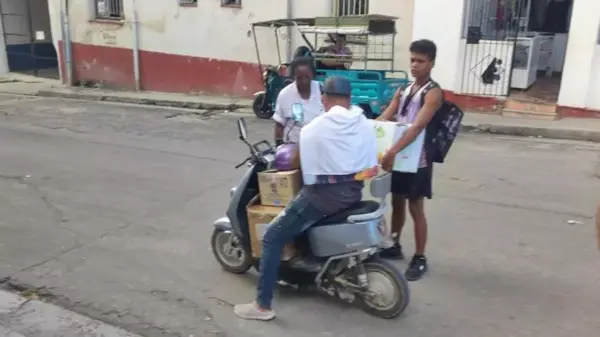
“I used to work in a refrigeration repair shop, but this pays better,” Landy, 30, tells this newspaper. He coordinates a network of ten messengers. His “headquarters” is a WhatsApp chat. “The small and medium-sized businesses write to me, I pass along the address and calculate the commission. There’s no boss and no fixed schedule. If there’s no connection, I disconnect, and that’s it.” With each trip, the messenger earns between 1,000 and 1,500 pesos, depending on the distance. “There’s no contract, but there’s trust,” the entrepreneur adds. “They pay me my commission at the end of the day, based on the trips completed.”
Most are young men, though there are women as well. Some are university students, IT specialists, or engineers. All are trying to earn money to support their families, and they prefer the independence of not being tied to a state job and being able to work with several businesses at once. “I don’t want anyone bossing me around. I take a job when I need to, and when I don’t feel like it, I stay home,” sums up a 23-year-old delivery worker with an electric tricycle. “My boss is the battery.”
The job is full of risks. “Sometimes it runs out in the middle of the darkness, and I have to push the tricycle until I find a place where I can charge it,” explains a young man from San Miguel del Padrón who makes deliveries in what he calls “a tough area.” Wearing gloves, a helmet, and a black jacket with “Rider” on the back, he distributes packages for small businesses in the municipality, but also takes jobs from larger digital platforms.
The leading online store has announced that it is canceling all its orders starting this Friday. Supermarket, which had managed to extend its deliveries across nearly the entire Island, informed customers that it will only process orders already received. “Due to the current situation regarding fuel availability in Cuba, our logistics operations have been temporarily limited,” reads its website.
Yasiel refuses to let such announcements paralyze him. For Saturday, he has a full schedule of deliveries. “It’s Valentine’s Day, and I’m not going to stop pedaling. I’ll rest tomorrow.” The future is something he avoids thinking about in a country where announcements of cancellations, closures, and interruptions come one day after another.
Translated by Regina Anavy for Translating Cuba.