
Cuba Is Worth It
HAVANA TIMES — Now that I see people crowded at bus stops, waiting for transportation that barely exists, I remember what bus service in Alamar (where I live in Havana), was like in the 1980s. There were six routes, including a local line, and even during summer vacation the depot administration would run a bus to the eastern beaches.
The basic viability of public transportation granted life a similarly basic dose of poetry.
You could go out well dressed and board a clean vehicle. No overcrowding, no pushing, and even less chance of being harassed by the bulging fly of some predator.
Of course, no one questioned where the oil came from, or the supplies in the farmers’ markets, or those dollar stores accessible only to foreigners. We were lulled by the dream of a budding socialism that would one day be like that of the Soviet Union, East Germany, Czechoslovakia…
Countries to which so many Cubans traveled to study or to work in production. And they returned loaded with clothes and appliances (those who didn’t defect and settle forever in remote landscapes, naturalizing languages, cultures, and climates so different from the tropics).
When all of that collapsed in 1990, I wondered: if they were doing so well, how did they fall? And if we in Cuba were the ones who were screwed, why didn’t we fall first? Or immediately afterward?
Today, thirty-six years later, Cuba faces a generalized collapse, with no change yet in sight. We have reached the lowest level: near-total dysfunction, unsanitary conditions, rampant inflation, extreme desperation…
Trips from Havana to the eastern part of the country now cost 25,000 pesos! (Five times most monthly salaries.)
There isn’t even fuel for airplanes. Boarding school students are being transferred and relocated away from their schools.
Everything is much worse than during the “Special Period” crisis (what we got instead of the transition to capitalism that Eastern European countries experienced). Back then, buses were replaced by enormous trucks whose roughness was softened with pastel colors and the word painted on the side: Metrobus.
At that time, I went with my mother to sell our handicrafts at the G y 23 fair in Vedado. She never adapted to the savage change. She would tell me about bus service before the fateful “triumph” of ’59, and with nostalgia about the streetcars.
The only time I was ever able to ride a streetcar was in Saint-Etienne, France. Although the friend who accompanied me was embarrassed because the glass door was dirty from the autumn drizzle, its cautious speed allowed me to see everything more slowly, almost as if in another era. It made me understand the delights of a modern and functional world. That beatitude of small cities, a life with the right to peace, beauty, and calm.
Was it like that in my country? Not just the Havana nights that many describe as hallucinatory—no, I mean an intuitive sense of comfort and safety.
Those of us who did not know the Cuba of before were left lost between what was promised and what actually came: an overwhelming process of destruction.
We lost our bearings. We lost our faith.
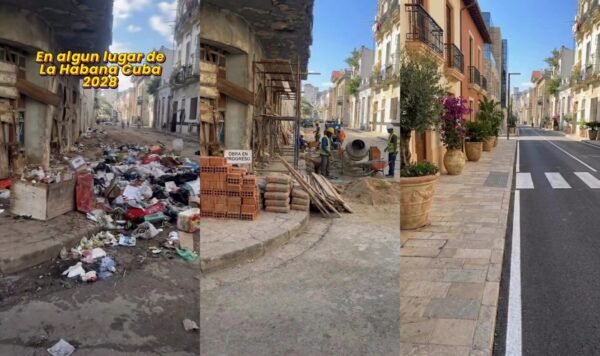
And yet, for some time now, I’ve seen videos on social media where places on the Island are reconstructed through artificial intelligence. Grotesque garbage dumps disappear; buildings in ruins, in a matter of seconds, become skyscrapers. Majestic bridges, fountains with cheerful jets of water, smooth, clean streets where people walk alert and purposeful. Not in this entrenched attitude of permanent waiting.
Songs are emerging that express love for Cuba. They speak of divine blessing over an Island frozen in time. Expert geopolitical analysts—and also seers, astrologers, tarot readers, babalaos—assure us that the end of the curse is approaching. That a breaking point is coming, and then regeneration.
Perhaps because of that, or because of the supposed US ships and aircraft stationed in the waters surrounding the Island by order of Donald Trump, people have regained hope. Despite the vertical plunge that looms with the oil crisis—or perhaps because of it.
Many simply say: “Now something really has to happen. Because this can’t go on.”
And while the government speaks only of harsher levels of sacrifice, exhaustion has reached its limit and turned into its opposite: into the awareness that we can build a future—not only in exile. And not only in banishment.
Young people who have decided to begin change by expressing themselves freely on social media articulate it clearly.
I feel it for the first time in many people close to me: Cuba is worth it—yes—as a place to remain, not only to endure and to escape.
Read more from the diary of Veronica Vega here on Havana Times.