
Venezuela National Assembly Unanimously Passes Amnesty Law
Article 9 excludes from amnesty those who have promoted attacks on national territory by foreign states or corporations.
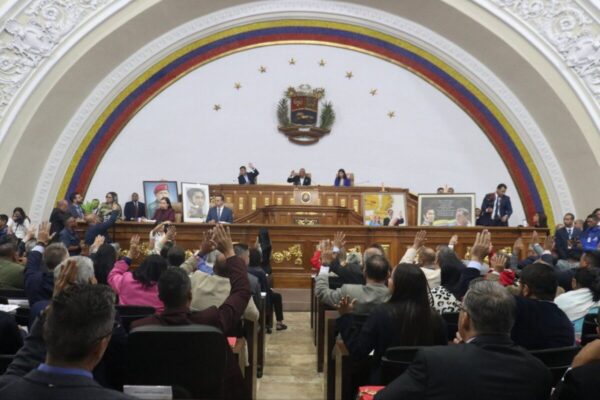
HAVANA TIMES – The Venezuelan National Assembly unanimously passed the Amnesty Law for Democratic Coexistence, following a postponement and persistent demands from human rights defenders and relatives of political prisoners that their proposals be included. They called for the release of political prisoners be expedited, and that their cases result in full freedom.
The president of the National Assembly, Jorge Rodríguez, brother of interim president Delcy Rodriguez, emphasized that “amnesty is forgiveness,” and one cannot forgive someone who has not committed a crime defined under Venezuelan law. He also sought to clarify that the approval of the legal instrument, which consists of 16 articles plus a single provision, does not protect impunity.
The session, called for 4:00 p.m., began with a two-and-a-half-hour delay at the Legislative Palace. Rodriguez promised it would be a “historic” plenary session. He also warned of provocations that could arise after the law’s approval by “extremist” sectors seeking to cause a “new division among Venezuelans.”
Article 9 of the law, for example, approved unanimously, includes among the crimes excluded from amnesty the promotion, solicitation, facilitation, and financing of “armed actions against the people, sovereignty, and territorial integrity by foreign states or corporations.” From this it can be inferred that politicians such as María Corina Machado—who is under criminal investigation for allegedly calling for foreign intervention, according to the ruling party—would not benefit from amnesty.
“Obstacles” Overcome
The obstacle regarding Article 7 that led to the suspension of the bill’s second reading during the previous session was lifted. It was maintained that political prisoners must submit themselves to the legal process, but it was established that those in exile may be represented by a trusted lawyer in requesting amnesty. It was also established that while the benefit is being requested, the person cannot be arrested and must appear personally before the court.
Deputy Nora Bracho (UNT), vice president of the special committee that worked on the bill, explained that due to these additions, the Libertad parliamentary group decided to vote in favor of the article to approve it unanimously.
“The law is not perfect, but it is a step forward for Venezuela’s reconciliation. It will ease the suffering of Venezuelans. We voted in favor of the article because we are committed to the political prisoners, but beneficiaries should receive preferential treatment and not be burdened with unnecessary procedures,” Bracho said, calling for an end to political persecution.
In response, the president of the special committee, Jorge Arreaza, asked that the consensus reached in committee also prevail in the ordinary session. He suggested avoiding speeches driven by political calculations to gain support.
The list of events subject to amnesty, which civil organizations and professional associations had asked to omit in order to avoid unjust exclusions, was ultimately included in Article 8. For the application of the “forgiveness,” 13 specific events will be taken into account:
- The 2002 coup d’état, including attacks on governorships, mayor’s offices, and public and private facilities
- The 2002–February 2003 oil strike
- Demonstrations in the context of the 2004 presidential recall referendum
- Violent incidents and demonstrations in May 2007
- Incidents of July and September 2009
- Demonstrations in the context of the April 2013 presidential elections and proclamation of results
- The 2014 protests
- The installation of the National Assembly in 2019–2020, as a continuation of the 2015 Assembly
- The 2017 protests
- Demonstrations between January and April 2019, except for the crime of military rebellion
- The 2023 presidential candidate selection process (primaries)
- Demonstrations and violent incidents in the context of the July 28, 2024 presidential elections
- Demonstrations in the context of the 2025 regional and National Assembly elections
However, the plenary approved that a special committee may evaluate cases outside this list to decide on amnesty. Events such as the alleged 2018 assassination attempt against Nicolas Maduro were not included, despite NGO warnings that numerous civilians and military personnel have been unjustly detained without due process in connection with those events.
“Misapplication” of the Anti-Hate Law
Deputy Pablo Perez requested that demonstrations over labor demands be included, since union leaders and workers are imprisoned solely for demanding better wages and other labor rights. He also asked that amnesty be extended to all individuals subject to precautionary measures under the Anti-Hate Law.
Jorge Rodriguez intervened to admit that it is “probable” the Anti-Hate Law could be reformed because “it is true that in some cases it was misapplied,” which will be evaluated by the Program for Coexistence and Peace, appointed by Delcy Rodríguez.
Article 9, which received the votes of deputies from UNT, Unión y Cambio, Lápiz, as well as the Democratic Alliance bloc, maintains that amnesty does not apply to crimes involving serious human rights violations, crimes against humanity, war crimes, intentional homicide, drug trafficking and psychotropic substances, and crimes against public assets.
Notably, it was added that individuals prosecuted or convicted for favoring, facilitating, or financing “armed actions against the people,” sovereignty, and territorial integrity by foreign states or corporations will also not be subject to forgiveness.
According to Article 15 (Article 12 in the first reading), it will not be the National Executive, through the Ministry responsible for Justice, that develops and implements mechanisms to ensure compliance with this law, but rather a monitoring commission. The commission may hire experts to help achieve the objectives of the legislation.
This group will be composed of 23 deputies, headed by Jorge Arreaza as president and Nora Bracho as vice president. It drew attention that Cilia Flores was included in the group, currently detained in the United States along with Nicolas Maduro to face trial for “narco-terrorism.”
Article 16 warns that those who commit crimes after the law’s enactment and having benefited from it will be subject to the corresponding legal proceedings. Another addition to the law is that within 15 days, the courts must review and grant amnesty measures.
The session, which lasted nearly two hours (until 8:15 p.m.), concluded without significant disagreements in the debate. Rodriguez ordered that a commission of deputies travel to Miraflores to deliver the enacted law to acting ruler Delcy Rodriguez.
First published in Spanish by Efecto Cocuyo and translated and posted in English by Havana Times.