
Who from Cuba Is the United States Talking To?
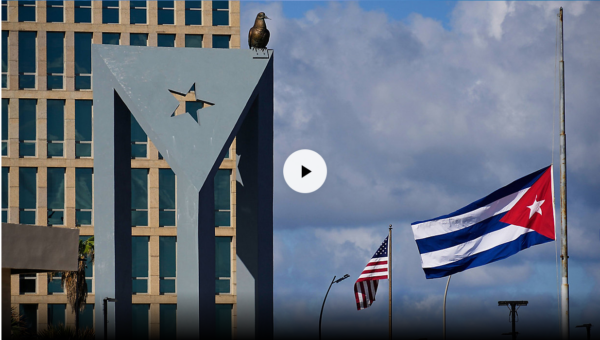
It is a delicate dilemma: exploring paths toward political transition without ignoring the historic demand for accountability from the exile community.
HAVANA TIMES — The secrecy surrounding bilateral talks between the governments of Cuba and the United States is neither new nor alarming to anyone. It has been a fairly common practice in recent decades: hostility has defined relations in front of the cameras, while behind the scenes many important decisions have been made.
On many occasions the Catholic Church has served as mediator, specifically the Vatican — especially after the visit of John Paul II in 1998 — and the current pope, Leo XIV, is among those who have publicly called for dialogue between the two antagonistic administrations.
Recently, statements surfaced from top US authorities — President Donald Trump and his Secretary of State Marco Rubio — asserting that negotiations are underway to avoid “a humanitarian crisis” resulting from the total blockade on oil imposed in recent weeks.
Officially, the dictatorship stresses that it is willing to maintain contacts based on equality, respect, and non-interference in internal affairs — but if they have no idea who is sitting at the negotiating table, they are lost.
The puppet Miguel Diaz-Canel stated on January 12 that no conversations existed with the US government, and a month later the Ministry of Foreign Affairs (MINREX) confirmed it. “We do not have a negotiating table,” emphasized the First Deputy Foreign Minister, Carlos Fernandez de Cossio.
So then, are Trump and Rubio making it up?
The most repeated rumor is that the interlocutor is Raul Guillermo Rodriguez Castro, grandson of the historic leader Raúl Castro. But this seems unlikely, because he holds no real power in this country; his legend is based on privileges acquired and flaunted on social media, with little or no respect from the military high command.
More logical would be his uncle, Interior Ministry Brigadier General Alejandro Castro Espin, and many sources claim this dialogue would be taking place in Mexico — although none of the three countries has confirmed it.
A third figure is also mentioned: Oscar Perez-Oliva Fraga, the great-nephew of Fidel and Raul Castro, a technocrat who, according to some analysts, meets the conditions to occupy the presidency of Cuba in the event of negotiations with Washington. It was precisely the Deputy Prime Minister and Minister of Foreign Trade and Foreign Investment who announced the emergency measures taken after the recent tightening of the economic siege — and that televised appearance would never have fallen to him in the normal hierarchy of the current nomenklatura.
Evidently, he is someone who does not appear in speeches but does show up in strategic reports. And since in Havana this would be seen as treason, secrecy prevails — but one need only look at the smoothness of the recent US operation in Venezuela to realize that none of that can be achieved without someone on the inside clearing the way and opening the door.
When power begins to fracture, pacts are signed in silence and in the shadows. In these same pages we commented weeks ago on the possibility that there might be a Delcy Rodriguez in Cuba — and that is the direction things seem to be heading.
According to recently revealed reports, since April 2025 the Venezuelan vice president had been sounding things out, and the way events unfolded confirms that nothing was accidental. And as long as she continues step by step following the instructions received from Washington, a military operation like the one at the beginning of the year will not be repeated.
Talking to the right person is the key — because although in the United States the continuation of the Castro surname in a transitioning Cuba would not be viewed favorably, it is very important to converse with real power and not with bureaucratic structures that may not reflect the reality of control in Havana. Unfortunately, the ruling clan practically trusts no one outside the family for strategic posts.
The most hardline sectors of the Cuban exile community would consider any dialogue with members of that lineage unacceptable — because, in addition to viewing them as having blood on their hands, they represent in some way the continuity of a system that has exercised absolute control over the Island in recent decades.
It is a delicate dilemma: exploring paths toward political transition without ignoring the historic demand for accountability from the exile community.
Meanwhile, here in Cuba prices continue rising and goods growing scarcer, and many wonder why — until now — fuel imports were never among the legal activities approved for Micro, Small, and Medium-Sized Enterprises (MSMEs) to somehow alleviate the current moment of wide-ranging crisis facing the country.
It is one more sign that the Cuban government is only willing to “let go of information” under pressure, while trying to control everything. The reforms now being shouted for could have been carried out much earlier to avoid reaching this scenario of total fragility — where the only thing they can think about doing is repeat the call for resistance.
Perhaps now the regime would be willing to allow US companies into sectors considered strategic — such as energy, tourism, banking, and telecommunications — but it seems too late for that.
Cuba’s history stands at a critical juncture, and the way this dialogue is handled will be decisive in the transformation process the country urgently needs.
Whether direct negotiations exist at this very moment will be known much later — but I am completely certain that such a person exists, and that the Trump Administration will not give him much time to decide whether he will assume the role history demands of him. Because, as I suggested last week, I do not believe the current occupant of the White House has the patience to remain in the same situation into the second half of this year.