
Do Those Still Living in Cuba Deserve Their Suffering?
Blackouts, misery, and hunger
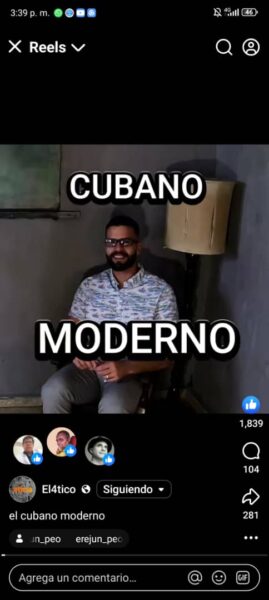
HAVANA TIMES – I came across a reel called “El 4tico” (the little room). I usually pay attention to it, because I find what they share interesting. It can even be humorous, and it is always sharply critical of the system. Young people dress casually, with a fan beside them, halfway through its lifespan—as we say of things that are makeshift or held together with a thousand patches—a chalkboard with something written on it in front, walls covered with newspapers. In this setting, and as if they were rapping hip hop, they say many truths, our truths, which right now it is good not to stop saying.
Since it doesn’t strike me as the “let’s laugh at our problems since we’re going to die anyway” kind of thing, but rather “you’re starving me and taking everything from me, but first I’m going to sing you a piece of my mind.” I really stop and watch the program from beginning to end. I do it with the joy of knowing that these works are being made on the Island itself. Feeling hopeful because of it and giving them my blessing.
But one reached me that was dedicated to the “modern Cuban.” A very controversial topic, and possibly one that goes beyond sadness. The view upheld by the guys on the program—which could be shared by more than one person and supported by certain experiences, among other similar ideas—is this: “the enemy of one Cuban is another Cuban.”
And they develop an entire discourse in which they declare that we are a “bunch of cowards,” liars, charlatans, miserable scoundrels, that we do not know how to fight for our independence, because we were trained to be puppets and slaves of a government that arose from and survives because of that very people who, in some way, still sustain it to this day.
It is true that we have had a tyrannical, exploitative, and humiliating government for longer than it should have lasted, I believe. One we have not known how to rid ourselves of. But is all the responsibility really ours?, I ask myself. And I do not forget—nor do I want to forget—a comment a friend made to me some time ago, when he told me: “a monster like Fidel could only have been produced by a people like the Cubans.” He was not someone who greatly valued having been born in this land, nor did he hold his fellow countrymen in high esteem.
For him, as for what I understood from the program “El 4tico,” we are largely responsible for the catastrophe we experience in our lives, day after day. Not only the Communist Party that governs Cuba with its manipulative discourse and mechanisms of oppression.
However, perhaps out of shame or compassion for those who came before me and suffered more than I have from being Cuban women and men, and for myself as well, I immediately react against this way of passing judgment on us. That is why, in the program’s comments, I shared more or less this idea with them: “We have suffered the deception of a dictatorial system, with its experts (perverse ones) in the machinery of Power for decades, and are we expected to react like European, American, or Japanese people?” This comment of mine, of course, is not beyond question. My aforementioned friend might tear it apart. But it also seems questionable to me to think that the entire weight of the suffering in the country falls on all those who are not in power.
Now then, I feel that we are in such a critical situation, humanly and materially (the destruction is very easy to verify), that we should not also deliver the coup de grâce by telling ourselves that we totally deserve it, because we are totally to blame for this. I believe that beating ourselves over the head is not the solution. I could tell myself “I am 100% responsible” as a spiritual exercise, as Hawaiian spirituality teaches with Ho‘oponopono. Or maintain in a liturgy “through my fault” as in the Catholic Apostolic tradition. But in other realms, such as the historical one, a different understanding of reality is needed.
To what extent would it help me, as a person living in this Cuban society, to know that another Cuban is my rival, my opponent? Wouldn’t it be better to think that we were shaped by a dictatorial system that governs politically and that translated watching over one another and informing on one another into a way of protecting ourselves and defending what it claimed were the best of just causes?
Of course, this is not an easy topic to address in a couple of hours or days. Nor is it a matter of justifying what it was or is up to us to do politically at a given moment, which is not done out of certain fears.
Without a doubt we have the right to think what we think and to express it as such, since that is, after all, a human right—and for that reason, whatever oppresses or crushes it is condemnable. However, I believe that the answer is not in blaming ourselves and viewing ourselves as the most deplorable thing in the human race.
What I did promise myself after finishing this reel, is that I will try to be kinder to my fellow countrymen and women. Whether or not they think like me, belong to my generation, or share my way of believing… Simply for having shared so many misfortunes together on the same land, I believe I owe that. And if along the way I encounter those who had even more to lose, I will try to be kinder still. They show me a life force that I feel and want to respect.
Until the Cuban people take to the mountains their cry’s will be unanswered.