
Cuba: Hotels Practice Exchange-Rate Anarchy with the USD
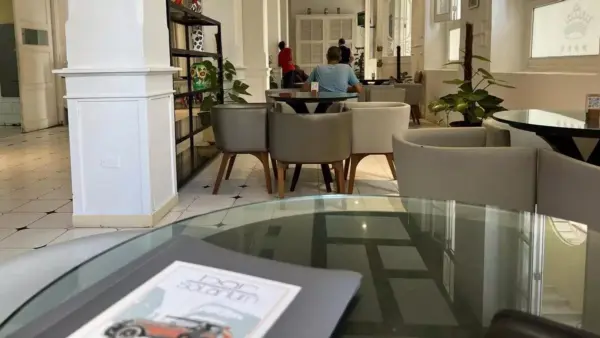
In restaurants, the exchange rate used for prices ranges between 150 and 286 pesos depending on the dishes—well above the official rate of 120, but way below the 445 of the informal market.
HAVANA TIMES – Havana’s Sevilla Hotel operates oblivious to the ups and downs of Cuba’s foreign-currency exchange rate. The establishment, managed by the Spanish hotel chain Melia, follows its own rules: anarchy. The restaurant menu lists prices in Cuban pesos and in dollars, with unexpectedly inconsistent results. If a customer orders a Sevilla sandwich, it costs seven dollars or 1,500 pesos (exchange rate: 214), but if they prefer a Cuban sandwich, they can pay the same seven dollars or 1,800 pesos (257). Always by card, of course, because cash is not accepted.
The hotel, located in a prime central area of the capital just steps from the Capitol building, does not follow the official rate set by the government from which it leases the hotel’s management—that is, 120 pesos per dollar. Nor has it chosen the rate moving in the informal currency market, 445 last Tuesday. Instead, it applies a rate halfway between legality and the black market. Perhaps that pricing policy has something to do with the fact that Melia has, since this year, its own supply company, Mesol, allowing it to provision itself outside the state system.
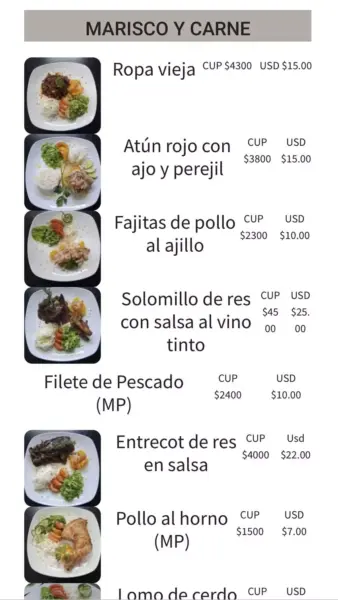
Thus, the menu is a mess from top to bottom. For 15 dollars you can get a plate of bluefin tuna priced at 3,800 pesos (exchange rate: 253), or a ropa vieja listed at 4,300 pesos (286). But at 4,000 pesos—that is, 181 pesos per dollar—you can eat a beef entrecôte that costs 22 dollars if paid in U.S. currency.
The drinks section offers some near-paranormal situations as well. A half-liter bottle of water costs 150 pesos or 2 dollars (an exchange rate of 75 pesos, well below the official 120), but if you prefer a Seven-Up soda, the price in foreign currency is the same, while in national currency it is double (300 pesos).
“The service is terrible; I had the worst cappuccino of my life—water with grime,” says a Cuban sitting in the hotel this weekend. The coffee, incidentally, costs two dollars regardless of how it’s prepared, but the exchange rate is not the same for espresso (100), with milk (125), or the bland cappuccino (150), which in national currency costs the same as the cocktail a foreigner at the neighboring table was drinking—the only tourist in the café.
“Before, you’d pass by Revolution Square and see a caravan of cars. Now, if you’re lucky, you see one or two,” the Cuban says, confirming with his own eyes what the numbers have revealed month after month. Tourism has collapsed on the Island since the pandemic, and through October 31 only 1.4 million international travelers had arrived, 20% fewer than in the already disastrous year 2024.
“The Inglaterra Hotel’s café is more popular,” the Cuban says, although this weekend there wasn’t much movement in that hotel’s rooms either—managed by the Canadian chain Blue Diamond—though the bar had somewhat more customers. In this case, prices are shown only in Cuban pesos, making it impossible to know what exchange rate is applied if one wants to pay with the Clásica card referenced on the menu for dollar payments. The waiters are the first to dissuade any unsuspecting customer who tries. “Are you sure you want to pay in dollars, at the 120 exchange rate?” the employee replies, astonished.
The one that does respect official rates is the Plaza Hotel, located in Old Havana and belonging to the state-owned Gran Caribe group. The menu can be viewed in pesos and dollars, and for all items the exchange corresponds to the 120 set by the government for individuals.
A croquette combo costs five dollars or 600 pesos, while a four-season pizza sells for 2,000 pesos or 16.66 dollars. “Here payment is card-only, whichever you want, because cash isn’t accepted,” says a Havana resident, a regular customer at the restaurant. “It’s better (with cards) in pesos, because if you pay in dollars you lose on the exchange rate they apply,” he reasons, adding that both the service and the quality of the food were good—surprisingly so, given that the clientele was exclusively Cuban.
First published in Spanish by 14ymedio and translated and posted in English by Havana Times.
Never going to Cuba again. Been there 15 times. It is totally fucked.
I have not traveled to Cuba in two years. This is the longest gap between visits in 20 years. I stay in touch with family and friends frequently and they have shared with me incredible stories about the filth in the streets, the increase in crime, the back-breaking inflation and, as this article states, the confusion over money. During my last visit, it was increasingly common for restaurants to post prices on the menu in Cuban pesos but if the waiter suspected that the customer could pay in dollars, he would say the dollar price as well. In those days the street exchange was around 250 pesos for one dollar. Now, I am told it’s easily over 400 pesos. Does the dictatorship have no shame? There are government stores that only accept dollars! In Varadero, I am told that there are places that accept Russian rubles. Where is this going? I used to ask my Cuban friends if they believed that the things would get better. Now, I don’t want to make it worse by asking the question.
The Government might as well start demolishing all their shiny new and unfinished hotels as the tourist industry is now forever finished .. .. .. ..
Anarchy is right. Refusal to be served in some places that do not accept Cuban money is an insult. Is there another country on this planet that allows some businesses to refuse the national currency? For a tourist, Cuba is a labyrinth of ridiculous situations at every step. Bloodbath for first timers. At every corner you get cheated and scammed. Final slap to the face comes at the airport when you try to use your remaining pesos to buy a bottle of water. NO! says the wickedly smiling lady behind the counter … US DOLLARS of fak off!!!