
Is It Better for Cuba to Import Rice or Grow It?
dismantling the myth
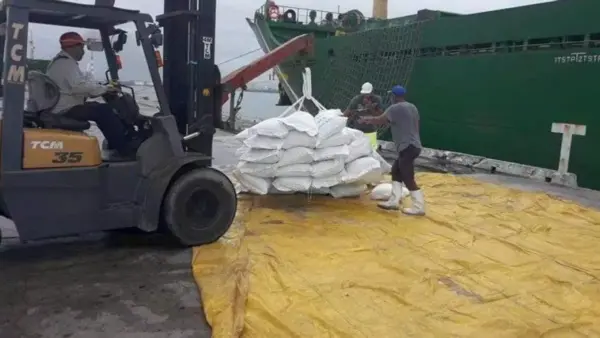
The government strategy to confront the shortage could not have been more senseless: telling farmers to replace tractors and harvesters with oxen teams and manual laborers.
HAVANA TIMES – One month later, residents of Camagüey are still waiting for the four pounds of rice that authorities had promised them at the beginning of December. That grain was part of rationed food products that also included peas, oil and coffee, along with other items destined for specific groups such as pregnant women, small children and the sick.
The commitment was to distribute and sell those subsidized products over the course of December as relief for family budgets prior to year-end celebrations. However, most of the promised products never reached their intended recipients. On the matter, the Ministry of Domestic Trade maintains absolute silence, as it does regarding the January rations, which should already have begun delivery.
In theory, the rationed products guarantee every Cuban seven pounds of rice per month (one pound equals 460 grams), at prices that are between 20 and 30 times lower than those in the supply-and-demand market. Other products are also part of the rations, but rice is the item that generates the most interest because of its importance in local cooking.
When rice is available, Cuba has one of the highest per-capita consumption rates in the world: nearly 50 kilos per person per year. That habit stems in part from tradition (Cubans descend from populations with a marked preference for rice, such as communities in southern Spain and the Chinese), but also from the difficulties of sustaining more balanced and diverse diets.
“I myself feel I haven’t eaten lunch or dinner if I don’t have rice on the plate, and that’s really not true, because when I have the possibility to choose I don’t even look at the rice, but my wallet doesn’t allow me that luxury every day,” confessed journalist Francisco Acevedo a few days ago in a commentary for Havana Times.
Due to the lack of foreign currency to buy rice abroad or inputs to grow it in Cuba, it was not possible during 2025 to meet the distribution cycles for rationed rice. In most provinces it was sold incompletely or months late. At the end of the year, the “debt” for that item exceeded 150,000 tons, equivalent to about $60 million dollars.
Apparently, the Cuban government does not have that money, nor does it expect to have it in the near future. This is suggested by its efforts to promote among the population the idea that the subsidized rationed products are unsustainable and should be replaced by a system that only attends to the most vulnerable sectors.
This is not the initiative of some clueless bureaucrat. In December, the television program “Cuadrando la caja” (Balancing the Box) invited an agronomist, a senior official of the Ministry of Agriculture, to defend the controversial idea that “Cubans consume too much rice — a habit that should change.” The show is produced by Ideas Multimedios the firm that manages Cubadebate (the main government news portal online) and the communication platforms of the Presidency.
Marxlenin Perez Valdes, host of the show, is also the editorial coordinator of Ideas Multimedios and the wife of Fidel Castro Smirnov, grandson of Fidel Castro through his eldest son Fidelito. With such direct lines of communication to the highest authorities, it is unlikely that the program in question was the result of improvisation.
The unanimous rejection of what was presented forced the authorities to pause their cutback plans. But although in the first days of January the 2026 ration books were issued — a tacit confirmation that the rations will remain at least for this year — nobody is fooled into believing that this form of subsidy has much time left.
More Controls Than Resources
The idea that rice is a crop “alien” to Cuba’s conditions is held only in the air-conditioned offices of Ideas Multimedios and the Ministry of Agriculture.
In the countryside, in the traditional rice-growing municipalities of provinces like Granma, Camagüey and Sancti Spíritus, thousands of farmers continue to bet on that grain, which has been cultivated in Cuba for more than 200 years. When consulted for this report, several of them agreed that their biggest problem is not the supposed lack of adaptation of the crop to the Island’s climate… nor even the scarcity of resources. What truly limits production growth is “the State’s obsessive control,” criticized a farmer from Camagüey.
“When harvest season starts this place fills up with bosses who come to make sure not a single sack is kept from being sold to Acopio (the state purchasing company). But before that, no one worries about how we get seeds, fuel or chemicals,” he noted.
The enforcement of Resolution 186 of the Ministry of Agriculture last December is an example of that policy of more controls without an equivalent allocation of resources. The regulation establishes the creation of four registries in which beekeepers, charcoal producers, rice growers and other grain producers (corn, soy and beans) must enroll. It will be a mandatory procedure without which farmers will not be able to receive payments in foreign currency from the State or access financing schemes.
In some provinces rice growers were also told that those who do not enroll will not be able to participate in the so-called “agreements with new forms of management.” Since 2022 those agreements have allowed state rice enterprises and individual farmers to partner with private business owners to grow the rice. The private partners provide pesticides, fertilizers and fuel and in return receive part of the harvest.
On the average, growers cultivating under that model obtain nearly three times more rice per hectare than their counterparts who rely on agro-ecological techniques or limited state allocations.
“Instead of so many registries and controls, what would really help us is if rice received even part of the benefits tobacco growers get. Is it really so difficult to take part of the foreign currency spent on buying rice abroad and use it to produce it here? Until 2018, with the ‘Vietnamese program,’ it was being proved that production in Cuba could grow and even cover national demand,” reflected Miguel Alfredo Abelarde, a rice farmer in Camagüey province.
His arguments are not without logic. Under the Comprehensive Rice Development Program in Cuba, which took place during the 2010s with Vietnamese technical support, the Island’s production grew at an average annual rate of 20%, surpassing 300,000 tons in 2018. The goal was to double that figure within ten years to satisfy 80% of national demand.
It was a perfectly achievable objective, with the added benefit that rice produced in the country was nearly 50% cheaper than imported rice. The problem was that rice production demands resources — fuel above all — which the government already lacked at that time.
The strategy chosen by Cuba to confront the problem could not have been more senseless: cutting resource allocations to a minimum and calling on farmers to grow using ecological products and replacing tractors and harvesters with oxen teams and manual laborers. Meanwhile, the commitments of the rations were fulfilled with costly imports. It was a model destined to sink: national production collapsed more than 70% and imports ended up becoming unsustainable.
The story has points in common with that of the direct hiring of Cuban workers, which foreign joint ventures had demanded for decades. However, Cuba insisted that its professionals could only be hired through state employment agencies, after payment of a hefty fee. As a consequence of that imposition, more and more Indian, Colombian and other foreign workers were brought to the Island to perform jobs that Cubans could do.
In a display of stubbornness and economic blindness, the government of Havana preferred that thousands of dollars in monthly payments go to foreigners rather than to its own workers. Something similar has happened with national rice production. “There’s no way to understand how it can be better to pay 400 or 500 dollars for a ton of rice abroad, and not 200 or 300 for one grown in Cuba,” protested a farmer from Sancti Spiritus.
“The difference between tobacco and rice is that tobacco exports generate foreign currency and rice doesn’t, because it’s destined for the Cuban market, which operates in national currency. That’s why tobacco growers get tanker trucks filled with fuel, while rice growers have to perform miracles to get what their harvesters need,” Abelarde countered.
And when neither imports nor national production are enough to sustain the commitments of the basic rations, there always remains the option of calling some specialist onto television to tell Cubans that they consume “too much” rice.
Cost of fuel equipment and supplies would be about $200 per tonne of rice vs close to $600 to import rice or the $1600 U S per tonne or 680 000 pesos on the black market in cuba with some the land and climate in the world
better do a better job of growing it, the rice gravy train from communist/other countries is going to end soon
I didn’t even bother to read this article as it is such a ridiculous question !!