
The Plight of Cubans Deported from the USA
HAVANA TIMES – The first night he spent in Cuba after being deported, Michel had to sleep on an old mattress, with borrowed sheets, in his brother’s apartment—alongside the same brother with whom he had set out three years earlier on the “volcano route” (flying to Nicaragua and heading north).
Since late 2021, hundreds of thousands of Cubans have taken that journey of thousands of kilometers between Nicaragua and Mexico. All of them had the goal of reaching the southern border of the United States, where they could benefit from the immigration privileges established for Cubans by successive US administrations.
Some 620,000 succeeded, turning themselves in to the US Border Patrol during Joe Biden’s presidency. After brief stays in detention centers along the Mexican border, almost all were released under the understanding that they were entering the United States as political asylum seekers. These were the well-known “credible fear” cases, in which they would later present in court the reasons they feared for their lives if returned to Cuba. Their files included I-220A forms (order of release on recognizance) and I-220B forms (order of release under supervision), which allowed them to apply for work permits, driver’s licenses, and other documents—but not permanent residency.
It was a temporary response to the avalanche of migrants. The “wet foot, dry foot” policy (passed in 1995) derived from the Cuban Adjustment Act of 1966. It was repealed by President Obama in January 2017, and Biden chose not to reinstate it. Instead, he relied on that I-220 formula, and others such as Humanitarian Parole and the CBP One digital application—perhaps hoping that in a second term he would have time to find a definitive solution.
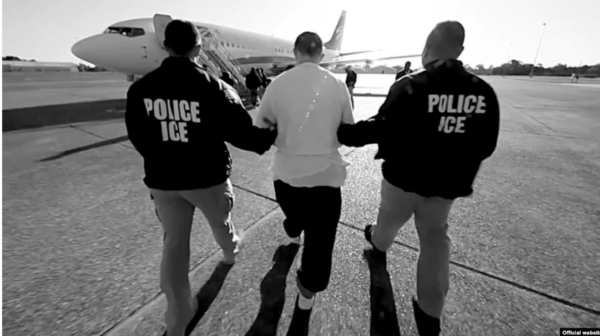
Trump’s return to the White House exposed the vulnerability of the status held by hundreds of thousands of Cubans. In his anti-immigration campaign, the magnate also targeted citizens of the Island, effectively revoking all their privileges. Thousands have been detained in street raids, or when attending court hearings or routine check-in interviews at ICE offices.
Michel was one of them. In October 2025 he was arrested when he showed up for his annual appointment with his immigration officer. That same day he was sent to a detention center in the state of Nebraska, where he had lived for more than a year. He had committed no crimes in either Cuba or the United States, “not even a traffic ticket.” Nor was there a deportation order in his name, his lawyer told him. “I was simply unlucky. My brother, who entered with the same status as me, has never been bothered. They’ve even canceled his appointments,” he told me via Messenger.
After a month, in mid-November, Michel was sent to Havana.
“After the medical check and the interview at the airport, and after they separated some who had pending criminal charges here in Cuba, they gave us a snack and put us on buses, divided by each person’s destination province. We landed in Cuba in mid-morning, and by five or six in the afternoon I was back in my hometown,” he recalled.
A blackout and the coldness of friends and relatives were his welcome upon arriving in the small city of Placetas, 300 kilometers east of Havana. Michel could not count on his mother, who had died in 2021 from COVID-19, nor on his father, who had abandoned him and his brother when they were children. Even his ex-wife had moved to Spain with their young son.
Formally, deportees must have a private address to return to. But not everyone is in a position to take in lodgers in a country with housing problems as severe as Cuba’s (according to the government itself, half a million new homes need to be built and another half-million require major repairs).
Although on paper Michel was returning to a maternal aunt’s home, his destination was an apartment his brother had bought so he would have a place to stay when visiting the Island.
To raise the money to leave the country in 2022, the first thing Michel and his brother had done was sell the house they had inherited from their mother. A couple of years later, his brother bought that two-bedroom apartment.
“They let him have it at a very good price because it needed quite a few repairs, which he planned to do little by little. When I arrived it was practically uninhabitable, full of construction materials. With money my brother and my wife sent me, I fixed up one room—that was my salvation, because it kept me from having to live ‘crashed’ [in someone else’s home] during the two months I spent in Cuba,” Michel recalled from Mexico, the country he traveled to in January of this year.
During his time in the United States, Michel had begun a relationship with Jennifer, a Mexican woman naturalized as a US citizen, whom he ended up marrying in early 2025—and whose child he adopted. They were devastated by his detention. After his deportation to Cuba, Michel’s wife and his brother decided the best thing was to “get him out” to Mexico and decide the next steps from there.
Now Michel lives in Ciudad Juarez on the US/Mexico border, waiting for Jennifer to secure work as a nursing assistant in the state of Texas. “For lack of a better solution, we’ve thought that she could work in the United States and that we’d all live in Mexico. Like that, until we see whether this man [Trump] finishes his presidency or something happens,” Michel wrote.
“Did you ever consider the possibility of staying in Cuba?” I asked him.
“Not a chance,” he replied without hesitation. “After living abroad I couldn’t adapt. It’s very hard to return to blackouts, the heat, and the mosquitoes. Even with money you’re not safe. Who can guarantee you won’t get chikungunya, for example?”
Closed doors
In December, Trump canceled the family reunification program that had benefited Cubans since 2007. And in January, he indefinitely froze visa processing for 65 countries, including Cuba. Earlier, he had closed other avenues for legal migration, such as Humanitarian Parole and CBP One, and suspended Cubans’ right to apply for permanent residency after one year and one day in US territory, as well as citizenship after five years.
During the first year of his second term, the magnate also ordered 1,669 deportations to the Island—double the annual average of his first administration—and 300 more than those signed by Biden in 2024. Hundreds of other Cuban nationals were sent to third countries, most to Mexico, though there were extreme cases such as three Cubans deported to Eswatini and South Sudan, African nations where Havana does not even operate a consulate.
After the January 3 attack on Venezuela, Trump outlined a future in which the number of returns to the Island would be much higher.
“Cuban Americans will soon be able to decide whether to return to Cuba—they’ll have the option to go back. Thousands of Cubans who were expelled (from Cuba) would want to return to their country,” he said.
His remarks were celebrated by the so-called historic Cuban exiles, led by heirs of the pre-1959 upper class, who under the Helms-Burton Act would have the right to recover properties nationalized from their families. But the enthusiasm has not been as unanimous among compatriots admitted under I-220 categories and others who still lack permanent residency.
“With Trump you never know. What if he decides to do to Cubans what he’s doing to Venezuelans, whom they’re now sending back in droves?” reasoned Carlos Manuel (assumed name), a man from Camagüey who last January returned to Cuba with his wife and two minor daughters. His doubts about doing so disappeared when the US Department of Homeland Security announced it would increase compensation for self-deportees from $1,000 to $2,600.
Carlos Manuel will use the family self-deportation money to restart the business that allowed him to emigrate to the United States in late 2024: selling flour and other bakery and pastry supplies.
“I never lost my contacts or sold my house here. Unlike other people, I had somewhere to return to—and now I’m doing it without spending a dime on tickets and with money from the United States government,” he explained.
His case is the exception, however. For many Cubans, emigration meant burning their bridges in an all-or-nothing gamble. And with Trump in the White House, all signs indicate that the number of losers will grow by the day.