
Venezuela and the USA: Suspense, Finger on the Trigger
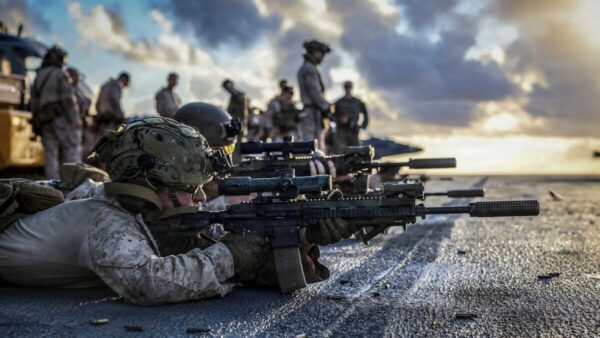
HAVANA TIMES – A climate of suspense hangs over the Caribbean, watching for a possible attack on Venezuela by the powerful air-naval force the United States has deployed in these waters, whose most coveted objective is the fall of Venezuelan president Nicolás Maduro.
“Maduro’s days as president are numbered,” Donald Trump said on CBS’s 60 Minutes on November 2. Exactly one month later, asked by a journalist whether the Venezuelan leader would leave power, he replied: “He will.”
At the end of November, while Washington built up forces and aimed its guns at Caracas, a phone call took place between the two presidents, in which threats and proposals were reportedly exchanged, according to US media. Trump has been evasive. Maduro said it was a “respectful, even cordial” conversation.
Thus, a wide range of options remain—and shrouded in mystery—from a full-scale invasion of Venezuela to the withdrawal of the US fleet, either as the beginning or the outcome of a negotiation.
Gunson, based in Caracas for two decades, notes that “the force deployed by Washington is not only about Venezuela; it’s part of a reorientation of US foreign policy with greater emphasis on the Western Hemisphere and especially the Caribbean basin.”
On December 5, the White House published its new National Security Strategy, dusting off and giving a Trumpian twist to the Monroe Doctrine, formulated two centuries ago under the slogan “America for the Americans,” in which Washington asserts its self-assigned role of hemispheric dominion.
“What Trump seeks is for the United States to again be the country that determines what happens in its near backyard,” Gunson commented.
Aircraft Carriers vs. Speedboats
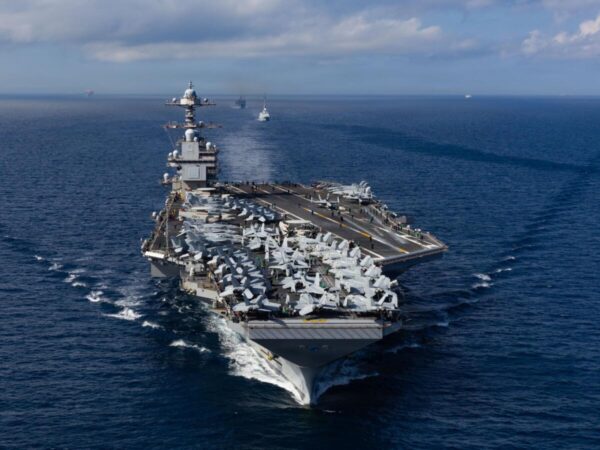
The force in the Caribbean is the largest deployed there in six decades: the powerful aircraft carrier Gerald Ford, 20 warships, dozens of next-generation aircraft, 15,000 personnel, the reopening of a military base in Puerto Rico, and the installation of radars in Trinidad and Tobago, a hostile neighbor of Caracas.
Since September 2, the force has destroyed 23 vessels in the Caribbean and eastern Pacific allegedly used for drug trafficking, killing a total of 87 occupants—demonstrating its ability to hit any target in the countries now in its sights: Venezuela, Colombia, and Mexico.
Among his justifications, Trump has said that with each destroyed boat, they eliminated drugs that could have killed 25,000 US Americans.
Eighty thousand three hundred ninety-one people in the US died of drug overdoses last year, according to health authorities. Fentanyl—the deadliest drug—does not enter the United States through the Caribbean or Venezuela but across the Mexican border, manufactured by cartels using chemical precursors from China.
Maduro: Wanted
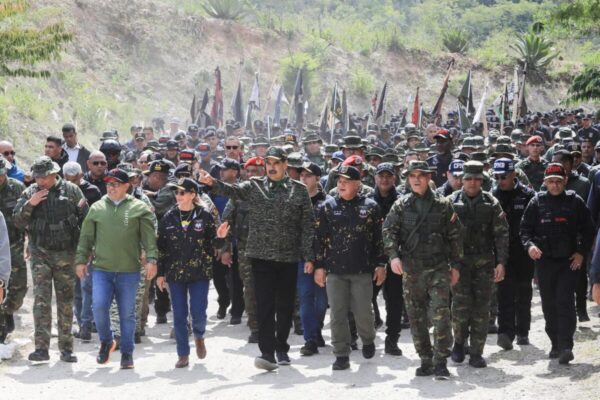
The ousting of Maduro appears as a top objective. Washington deems him illegitimate for allegedly stealing the July 2024 presidential election—won by opposition contender Edmundo Gonzalez—and accuses him of heading the narco-trafficking “Cartel of the Suns,” offering a 50-million-dollar reward for his capture.
But within Trump’s policy of “peace through strength,” he sends contradictory signals about whether he intends to attack or is simply displaying firepower to pressure the Venezuelan government without unleashing the hell of bombs and missiles.
“There is still a lot of uncertainty, and I don’t see clarity from the Trump administration on how to proceed,” Mariano de Alba, associate researcher at the UK-based International Institute for Strategic Studies, told IPS.
The most likely alternatives, De Alba said from London, “are surgical strikes—either against drug-trafficking facilities or military assets—or a narrow agreement.”
In such an agreement, “the Maduro regime makes significant concessions on Trump’s priorities—illegal immigration, drug trafficking, and natural resources—which allows Maduro to stay in power and allows Trump to present the deployment domestically as a success.”
“There is still clear skepticism in the White House about a major military operation in Venezuela, due to the risks involved. And, in addition, the deployment is becoming politically complicated for Trump, with accusations—even from Republican lawmakers—of possible war crimes,” De Alba added.
The US Congress is examining whether military commanders committed war crimes by killing survivors of destroyed “narco-boats,” and the issue has now entered the fierce political confrontation between Trump and the Republican Party, which supports him, and the openly reluctant Democratic Party.
Military analysts say the deployed force is insufficient to invade a country the size of Venezuela—916,000 square kilometers with 29 million inhabitants.
On the other hand, it is far too much force for sinking a handful of small boats, the operation used to justify its initial deployment in August—convincing many that the true target is Maduro himself.

Venezuela, Absorbed in Its Poverty
Meanwhile, after decades of political polarization, economic devastation, humanitarian crisis, and the migration of a quarter of its population, daily life in Venezuela continues with uncertainty, expectation, or indifference toward a possible confrontation with the world’s greatest military power.
The government has made every kind of defensive preparation—from activating Russian-made Pantsir F-1 anti-air systems, Buk-M2E missiles, and lighter Igla-S systems, to handing out rifles to civilians in their sixties newly recruited as militia members.
Through speeches, rallies, and statements, the government and its United Socialist Party (PSUV) insist that the population is on alert and ready to fight if an attack or invasion occurs. For the latter scenario, they have revived the old guerrilla thesis of launching a “prolonged people’s war.”
But many ordinary citizens in Caracas and the states are consumed by other concerns, such as the world’s highest inflation—535% this year according to economist Steve Hanke of Johns Hopkins University—and the unstoppable devaluation of the bolívar against the dollar.
“I can’t go panic-shopping just in case the marines come,” Josefina, a 39-year-old baker with two children from the working-class neighborhood of Alta Vista, told IPS. “Maybe I get nervous, but in our barrio there’s not enough money for stockpiling,” she added, laughing.
A study by the Andres Bello Catholic University in Caracas shows that by 2024—before this year’s punishing devaluation—73% of households lived in poverty due to insufficient income to meet basic needs.

Visions of the Outcome
Trump’s policy is supported by the main opposition leader and 2025 Nobel Peace Prize laureate, María Corina Machado, and her followers, while other opposition groups reject any possibility of attacks—let alone an outright invasion.
Gabriel, a 45-year-old mechanic from Petare, a densely populated area east of Caracas, told IPS: “There are opposition people who want an invasion, but many of us don’t—even if we disagree with Maduro and how he has run the country. We’d even have to fight; the homeland is the homeland.”
Meanwhile, pressure continues to ramp up: days before the Christmas and holiday season began, Trump declared that “Venezuelan airspace may be considered closed,” and half a dozen regional and European airlines have suspended flights to the country—already heavily isolated in terms of communications, transport, and financial activity.
“Life is being made harder for Venezuelans. I don’t see anything good for the population in the short term—they are being further isolated from the rest of the world,” Gunson said. “This affects an economy that was showing faint signs of recovery and is now slipping backward—it could even return to hyperinflation.”
In the event of an invasion, “there is the possibility of chaos and a power vacuum—an even worse situation, including armed forces factions fighting each other. I find it very unlikely that direct US military intervention would lead to a peaceful, quick, relatively painless change,” Gunson stressed.
Regarding the standoff between leaders, Gunson added that “if Trump withdraws without major action, the immediate result is that Maduro is strengthened—at least within the ruling coalition—because he can claim he faced the empire and prevailed.”
De Alba highlighted the internal US political context, with a midterm election year approaching.
In Washington, “at least for now, public opinion is turning against escalation, with strong accusations including possible war crimes. There’s no appetite for an operation that risks American soldiers’ lives,” he noted.
Given that Venezuela is now a chess piece in the US political struggle, De Alba believes “the balance is tilting toward Trump maintaining military and media pressure, seeing whether he can secure an agreement that meets his interests—possibly including Maduro’s departure, or not.”
As the world awaits a decision, one might insert the phrase coined in the 19th century by Prussian field marshal Helmuth von Moltke: “No plan, no matter how good, survives contact with the enemy.”
First posted in Spanish by IPS and translated and posted in English by Havana Times.