
Maduro’s Removal Was Not to Restore Democracy in Venezuela
Sergio Ramirez: Trump sidelined president-elect Edmundo Gonzalez. The lesson for Nicaragua’s opposition: “do not rely on a military intervention”.
HAVANA TIMES – This interview with Sergio Ramírez, exiled in Spain and banished from his country, Nicaragua, by his former revolutionary comrade Daniel Ortega, contains much more than a statement about what has just happened in Venezuela. The episode led by US President Donald Trump prompts Ramirez—author and journalist—to think about his own country and about the painful past that keeps thousands of Nicaraguan exiles scattered across the world. Perhaps now a door will open to that place of which he was once a liberator and from which he is now, like so many others, part of an exile that has not ended.
What memory came to your mind when you learned what was happening in Venezuela?
The invasion of Panama to remove (Manuel Antonio) Noriega in 1989, a gangster turned dictator, an agent of Cuban intelligence and at the same time of the CIA. Only then Guillermo Endara, who had won the elections that Noriega had stolen from him, was sworn in as president. Not now. Edmundo Gonzalez, who overwhelmingly defeated Maduro at the polls, has been pushed out of the picture by Trump.
What consequences do you think all this will have in the future?
First, that democratic opposition forces to a dictatorship—whether on the right or the left—should not trust foreign military interventions as democratic instruments of change. Under the new Trump doctrine, what we see is that the United States will reach understandings with established power structures once the dictator is gone. That is what we should expect in Nicaragua and in Cuba. They remove Ortega and his wife, and Diaz-Canel, and leave their henchmen in place, just as in Venezuela they are leaving Delcy Rodriguez. It is an imperial conception of stability: to not risk experiments with democratic forces.
Trump took several hours to appear and explain himself. What does this dead time mean for Latin America?
While Trump was absent, Secretary of State (Marco) Rubio held a long telephone conversation with Delcy Rodriguez, who then appears calmly seated at the head of the presidential table with her ministers, as if nothing had happened. The anti-imperialist rhetoric may be the same, but what matters are the facts. It was always said that she and her brother Jorge, president of the National Assembly, were negotiating Maduro’s head. The speed with which he was taken out of Venezuela gives room to that assumption.
The reaction after Maduro’s capture
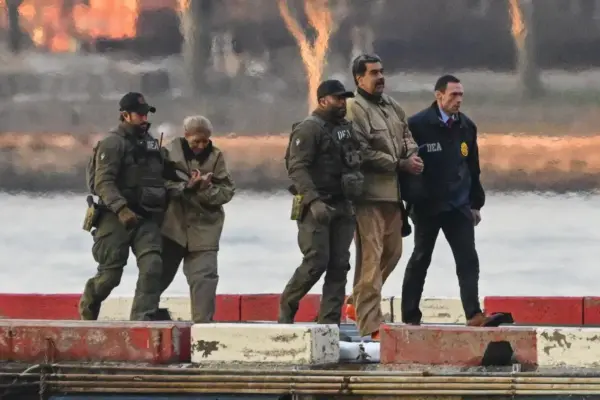
Maduro appeared afterward, in disguise, traveling to New York. What did that moment inspire in you?
Maduro is no hero of Latin American independence—except for a small, out-of-touch left—so as to inspire indignation in me, which does not mean that I legitimize Trump’s imperial act of turning himself into the supreme judge of the world. Maduro was the head of a corrupt and repressive clique of which Delcy Rodríguez herself and her brother—the supposed negotiators—were part; as were Vladimir Padrino, the army chief, and Diosdado Cabello, interior minister. They remain where they are, for now, and Maduro pays for everyone.
What moral consequences does all this have for your own country?
It is a lesson the Nicaraguan opposition—whose leaders are scattered around the world, victims of exile—must learn. One should not rely on a military intervention to remove the Ortegas and hand power to them. When you do not control a political situation, you are expendable.
And for Cuba?
Cuba is in a very deep crisis, one of total exhaustion of a failed model that today brings constant blackouts, the return of epidemics, and shortages of basic foods. Trump will not invade Cuba any more than he will invade Venezuela, because military invasions carry an enormous electoral cost. But I also do not see the United States installing the Miami exiles in government; they will come to terms with those inside, above all with the army, which is also an economic power—without Díaz-Canel, who is totally expendable, a mediocre bureaucrat.
And for the entire world? Can Spaniards and Europe trust that the future also belongs to them?
Europe must build its future without the United States, however hard it is to come to terms with that idea. A democratic and humanist Europe. Trump’s United States will not defend Europe against Russia, and European security is in danger—as the Baltic countries are the first to feel that, just as Poland is at risk if Russia prevails in Ukraine. If the Trump doctrine turns Latin America into a backyard, Russia and China will claim their own backyards.
What does it mean for the American continent that the United States takes charge of a country?
It is the return to the old Monroe Doctrine and to the gunboat policy we already experienced since the late nineteenth century, when McKinley kept Cuba in 1898 and Roosevelt kept Panama in 1901. From then on, the US Navy occupied Nicaragua, Honduras, the Dominican Republic, and Haiti. It is a return to archaic times: raw materials as reasons of state—oil, gold, copper, rubber.
The Venezuelan opposition as seen by Trump
President Trump has sidelined the candidates who won Venezuela’s elections. Is this also a brutal or symbolic gesture?
The intervention to remove Maduro was not carried out to restore democracy to Venezuela. Clearly Edmundo González, the legitimate president, does not appear likely to assume office, and Trump has denied legitimacy to the leadership of Maria Corina Machado, who does have it as leader of the resistance against the dictatorship. It is a warning of what may happen to other countries under dictatorships.
Since this occurred, the US president has made it clear that Maria Corina Machado does not count for him. What did this specific fact inspire in you?
She is a brave woman with real leadership, as we could see throughout the 2024 electoral campaign. She is obviously right-wing, but with a democratic proposal. And now Trump denies her that leadership and sidelines her, surely because someone has convinced him that she could be polarizing if she becomes a key player in a new government vis-à-vis the Chavistas. Or because she won the Nobel Prize.
You have written novels while life, on the other hand, was dealing you very harsh blows. Is this a moment in which the novelist feels inspired by what is happening, or does what is happening frighten you?
As a novelist one learns that what seem like surprises of history are nothing more than repetitions—the eternal turning of the Pythagorean wheel, which is also a Borgesian wheel. One must feign forgetfulness in order to be surprised and not disappointed by that old vendor of ancient wonders that is history.
You live in Spain; you are an exile with many homelands that have welcomed and cherish you. Humanly speaking, what does this storm that broke out last Saturday mean to you?
You know what? At first you might think: this brings me closer to the hour of returning to Nicaragua. Maduro has disappeared; now the spotlight falls on Ortega, who becomes more vulnerable. Now the world will finally pay attention to Nicaragua. But has the dictatorship disappeared in Venezuela? Will the exiles who thought the time had come to return be able to do so? We can already see that they will not. And the waiting period keeps stretching on.
——–
Published in Spanish by Confidencial and translated and posted in English by Havana Times.
*This interview was originally published in the newspaper Clarín under the title “Sergio Ramírez: ‘Maduro is no hero, except for a small and out-of-touch left.’“