
Change in Honduras: US interference and European Backing
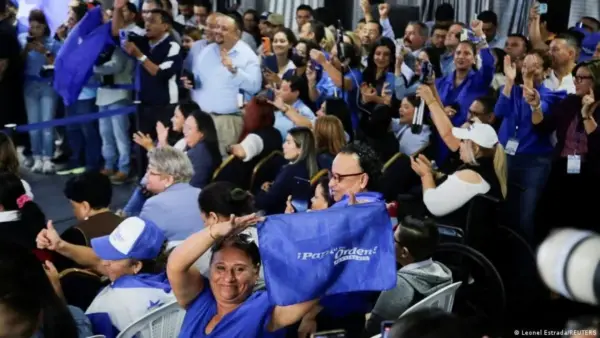
After a razor-thin election, the European Parliament endorses the change in Honduras and calls for a peaceful transfer on January 27.
By Deutsche Welle (Confidencial)
HAVANA TIMES – “Although it is true that there continues to be great political-institutional tension, and that the political environment remains highly polarized, the elections went very well, the electoral results were ultimately respected, and Honduras has a new president, Nasry Asfura. It has new legislators, it is going to have new mayors, both men and women. And we must look forward,” Francisco Assis, head of the European Union Electoral Observation Mission who was in the Central American country from early October to late December 2025, told DW.
After having followed the vote counting and the tension over the narrow margin of less than 1% between Nasry Asfura (National Party) and Salvador Nasralla (Liberal Party), the EU observer mission confirmed that there had been no fraud in the final result.
Regarding the minimal margin and what has been called a “technical tie,” Assis, a Portuguese MEP from the social democratic bloc, comments: “There was no technical tie, there is never a technical tie. In the end there is a winner and a loser. And in Honduras, clearly, the National Party candidate won the elections.”
European support for the new Honduran president
In this regard, a majority in the European Parliament spoke out this week: the vote of the Honduran people must be respected. The touchstone of this resolution was the decree by the outgoing government of Xiomara Castro, of the Libre party, ordering a new vote recount.
Although opinions within the European Parliament vary widely — from the view that this is an attempt by the left to perpetuate itself in power to the claim that there is a concealed fraud — the consensus centers on support for democracy, respect for the will of the Honduran electorate, and a call on all sides for a peaceful transfer of power.
Taking into account, for example, that it was the Honduran electoral system itself that led to this extremely close and tense recount — since there is no second round and whoever wins, even by a single vote, has won — the EU mission will propose recommendations for future electoral processes.
The United States factor
Precisely, respect for the country’s sovereignty has been one of the controversial points, but it did not enter into the European Parliament’s resolution. “People went to vote in a civic manner, without incidents, yes,” Ana Miranda, who took part in the European Parliament’s delegation to the Honduran elections, told DW.
“The problem lies in the prior interference and in the subsequent recount. The interference by Donald Trump is clear, threatening Hondurans with the withdrawal of cooperation funds if they did not vote for his candidate Asfura. In addition, there are those 30,000 votes that have not appeared,” adds the Galician MEP from the Greens/European Free Alliance bloc, referring to accusations from the ruling party that there were missing votes. These two factors would make the legitimacy of the new president questionable from the outset. All the more so given that he belongs to the same party as former president Juan Orlando Hernandez, convicted in the United States for drug trafficking and pardoned by President Trump two days before the elections in Honduras.
What does the European observer mission say about this? “We took note of both actions by the president of the United States,” comments Francisco Assis. “Naturally, it is regrettable that a president of another State should make pronouncements about elections in a neighboring country, in the middle of the electoral silence period. We deeply regret it. Nevertheless, we will never know whether these actions influenced the final result,” he stresses, pointing out that it is an incorrect but typical practice of the current occupant of the White House.
New and old challenges
Be that as it may, and looking ahead, both politicians highlight challenges that Honduras will face in the new term, and others that Europe will have to face in its relationship with Honduras in particular, and with the region in general.
Having accompanied Honduran civil society throughout the process of clarifying the murder of environmental leader Berta Caceres, Ana Miranda sees as a major task for the EU the need to remain vigilant and, on the other hand, not abandon development goals in the second-poorest country in Latin America and the Caribbean.
“Let us recall that Berta’s murder took place under the mandate of Juan Orlando Hernández, who defended his investment agenda even though environmental defenders paid with their lives,” Miranda points out, warning against taking eyes off the projects that were deactivated because of negative impacts on communities.
“Although we have been historical allies of the United States, we are going through a terrible moment. On the other hand, we have always had a good relationship with Honduras, particularly Spain. But several other EU members are willing to strengthen their relations with the region,” says Francisco Assis, distancing European policy from Washington’s expansionary aims.
“Our intention is to accompany Honduras. We will return to Tegucigalpa in March and, based on our extensive experience in electoral observation, we are going to present a project to the new Administration, to introduce some changes in its electoral system, with full respect for the country’s sovereignty,” concludes Francisco Assis.
Published in Spanish by Confidencial and translated and posted in English by Havana Times.