
Laura Fernandez Wins Costa Rica Presidential Election
She is the current president Rodrigo Chaves’s political heir
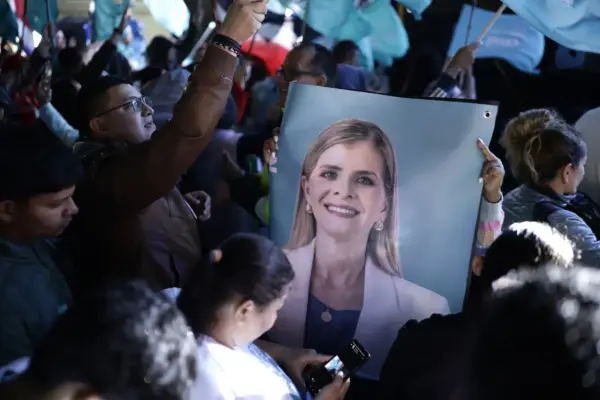
Political scientist Laura Fernandez, 39, becomes the second woman to win the presidential chair in Costa Rica’s history.
HAVANA TIMES – The ruling-party candidate from the rightwing Sovereign People’s Party, Laura Fernandez, became the winner of Costa Rica’s presidential election on Sunday, February 1, 2026, in the first round, with support from approximately half of the valid votes, according to preliminary counts from the Supreme Electoral Tribunal (TSE).
The 39-year-old political scientist is the virtual president-elect of Costa Rica, following a campaign in which she presented herself as the “heir” to current president Rodrigo Chaves and promised a tough approach against crime and insecurity, the population’s main concerns.
With 93.79% of polling stations counted, the Sovereign People’s Party candidate had received 48.33% of the vote, well ahead of second place, held by Alvaro Ramos of the social democratic National Liberation Party (PLN), who had 33.42%. Voter turnout was 69.10%.
Second woman president of Costa Rica
Fernandez, a specialist in public policy and democratic governance, becomes the second woman to win the presidency in Costa Rica’s history, after Laura Chinchilla of the social democratic National Liberation Party, who governed from 2010 to 2014.
The election winner previously served as minister of the presidency and minister of planning in the current Chaves administration. Chaves, a popular right-wing economist, publicly endorsed Fernandez as the figure to continue implementing his agenda.
During Fernandez’s campaign, chants of “Long live Chaves!” were common among her, party leaders, and supporters.
Rodrigo Chaves, from president to minister?
In late January, the candidate participated in the presentation of a documentary titled The Unexpected Ones, which highlights Chaves’s role in building his political movement.
Fernandez has left open the possibility of offering a ministerial post to Chaves, whom she describes as “a brilliant man”, and has followed the president’s line of constantly criticizing the judiciary and the legislature, which he blames for the increase in homicides and violence associated with drug trafficking.
Insecurity and the rise of drug trafficking was one of the main campaign issues, as they are seen by the population as the country’s leading problems, which led to Fernandez’s proposal to establish a state of exception in conflictive areas.
Will constitutional guarantees be suspended?
“I won’t hesitate to make the decisions we have to make to restore peace in Costa Rican households that are full of good people. In my government plan we have proposed the lifting of constitutional guarantees,” Fernandez said on January 26 during a debate organized by Radio Columbia and Universidad Latina.
The ruling-party candidate said that the lifting of guarantees is established in the Constitution and that it would “allow, through a special and extraordinary procedure, the removal from circulation of criminals who have been identified—where they live and how they operate.”
One of Fernandez’s campaign goals was to secure 40 of the 57 seats in the Legislative Assembly, in order to facilitate approval of reforms to the judiciary, toughen laws, and prevent her party’s initiatives from being blocked.
Constitutional reform for consecutive reelection?
Sovereign People’s Party figures such as congressional candidate Nogui Acosta and Chaves’ close advisor, Pilar Cisneros, revealed that one of the party’s objectives is a constitutional reform to approve consecutive reelection.
These proposals have been branded by several of the rival candidates as authoritarian and a risk for Costa Rican democracy, and some, such as the leftist Ariel Robles, have even warned of the danger of an attempt to establish a dictatorship.
“This is a democratic celebration, and we must thank God for our country and for the democratic stability that I will always protect,” Fernandez told the media on Sunday.
Fernandez, who is married and the mother of a young daughter, has promised to continue Chaves administration projects such as Ciudad Gobierno, a complex of buildings for public institutions; a Caribbean marina; several strategic highways; and the expansion of ports and airports.