
Nicaragua: New Constitution Intensified Dictatorial Drift
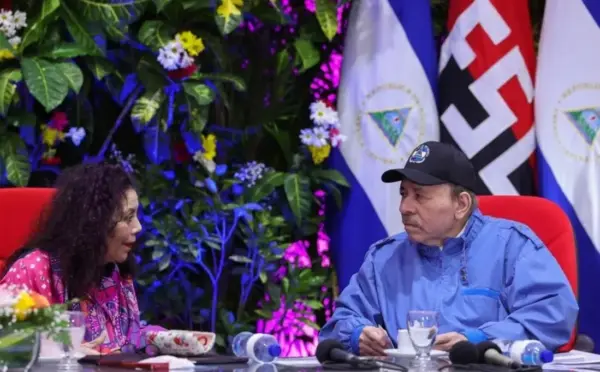
Report points to systematic persecution of political opponents, arbitrary deprivation of nationality, and transnational repression.
HAVANA TIMES — The regime of Daniel Ortega and Rosario Murillo has intensified its authoritarian drift in Nicaragua through the approval of Murillo’s Constitution, the systematic persecution of opponents, the arbitrary deprivation of nationality, and transnational repression, according to the World Report 2026 by Human Rights Watch (HRW), in a chapter on human rights violations in Nicaragua published on Wednesday, February 4, 2026.
The organization notes that the constitutional reform, approved in January 2025, further concentrated power in the Executive, appointing Murillo as “co-president” and granting her the authority to “coordinate” the Judicial and Legislative branches. Meanwhile, Ortega has remained in power since 2007 and can be reelected indefinitely.
The systematic persecution of opponents continued in 2025, “extending even to some government supporters,” HRW warns. As of January 2026, at least 87 political prisoners had been reported.
Deaths in state custody were recorded for lawyer Carlos Cárdenas and opposition figure Mauricio Alonso in August 2025, after weeks of enforced disappearance. At least six political prisoners have died in custody since 2019.
The document also notes that the Murillo Constitution allows the regime to revoke Nicaraguan nationality from people deemed “traitors to the homeland,” a move HRW describes as the “consolidation within the domestic legal order of a practice that began in 2023.”
At least 452 Nicaraguans have been arbitrarily stripped of their nationality, and their assets have been confiscated.
Transnational repression
Human Rights Watch also documents allegations of transnational repression reported by the UN Group of Human Rights Experts on Nicaragua (GHREN), noting that Nicaraguans in exile face surveillance and harassment by Nicaraguan authorities and, in some cases, have suffered violent attacks.
They highlight that at least seven Nicaraguan opposition figures in exile have been killed or attacked since 2018. The most recent was retired Nicaraguan Army major Roberto Samcam, who was murdered in June 2025 in San Jose, Costa Rica.
In September 2025, the GHREN called for “protection mechanisms for exiled populations and the conduct of thorough investigations into the transnational dimension of the threats they face.”
Dismantling of civil society
The report also describes how the regime has “systematically dismantled civil society,” canceling the legal status of more than 5,500 NGOs since 2018—nearly 80% of the organizations that once operated in Nicaragua. At least 58 media outlets have also been shut down.
The new telecommunications law, which came into force in November 2025, requires audiovisual service providers to supply “all information that may be requested,” including georeferenced data. “This provision represents a threat to privacy, personal data protection, and freedom of expression,” HRW emphasizes.
Between 2018 and 2025, 293 journalists fled the country, “the second-highest figure in the region,” the organization stresses.
More than 342,000 Nicaraguans applied for asylum abroad between 2018 and mid-2025, mainly in Costa Rica, the United States, Mexico, and Spain. Another 31,000 people were recognized as refugees.
Indigenous and Afro-descendant leaders have also been targeted. In 2023, police detained leaders of the Indigenous party YATAMA, Brooklyn Rivera and Nancy Henríquez. Henriquez was sentenced to eight years in prison, and Rivera’s whereabouts remain unknown.
International isolation and sanctions
The organization underscores that the Nicaraguan regime deepened its international isolation in 2025. That year alone, it announced its withdrawal from several UN bodies, including the Human Rights Council, the UN Food and Agriculture Organization (FAO), the International Labor Organization (ILO), the International Organization for Migration (IOM), UNESCO, and the UN Refugee Agency.
Previously, it withdrew from the Organization of American States (OAS) in 2023. No international human rights monitoring body has been allowed into the country since 2018.
The UN Human Rights Council extended the mandate of the GHREN, which concluded that there are reasonable grounds to believe that the authorities have committed crimes against humanity. It urged states to bring Nicaragua before the International Court of Justice.
The United States imposed visa restrictions on more than 250 officials for undermining fundamental freedoms, bringing the total to more than 2,000 bans. It also maintains financial sanctions against senior officials and state-linked entities.
In October, the European Union renewed sanctions against 21 individuals and three entities for human rights violations and undermining democracy. The United Kingdom and Canada have also sanctioned 17 and 35 individuals, respectively, for serious human rights violations.
Abortion remains a crime
Nicaragua has maintained a total ban on abortion since 2006, under all circumstances. People who have abortions face prison sentences of up to two years, while health professionals who perform them can be sentenced to up to six years.
This ban forces women and girls to carry unwanted pregnancies to term, putting their health and lives at risk.
In January, the UN Human Rights Committee ruled that Nicaragua violated the rights of two girls aged 12 and 13 who were survivors of rape. By forcing them to continue their pregnancies, the state subjected them to conditions amounting to torture, violating their rights to life and dignity. The committee urged the country to ensure effective access to abortion services for victims of sexual violence.
First published in Spanish by Confidencial and translated and posted in English by Havana Times.