
Rural Salvadorans Fight Plans for a Landfill at the Site of Past Massacres
HAVANA TIMES – Residents of a rural Salvadoran community are fighting the planned construction of a landfill project in their area. In addition to its environmental impact, the project would relocate the remains of people massacred there during El Salvador’s civil war, thereby destroying evidence of future cases of war crimes.
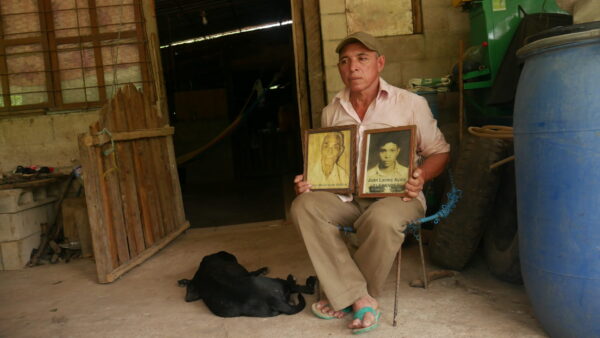
“We believe that some remains have already been found and moved. There used to be several small family homes here, but now, look, they’re tearing everything down, destroying our historical memory,” Felix Lainez told IPS, gazing at the site where the so-called Nonualco Comprehensive Waste Treatment Center is to be built.
The project is located in San Francisco Angulo, a canton (rural settlement) in the district of Tecoluca, in the department of San Vicente, in central El Salvador.
The new center is being developed by a joint venture involving Cyeemsal, a Mexican company with operations in various Latin American countries, and an association of neighboring municipalities. It follows the model of Mides, the largest joint venture in El Salvador,which is also dedicated to waste management.
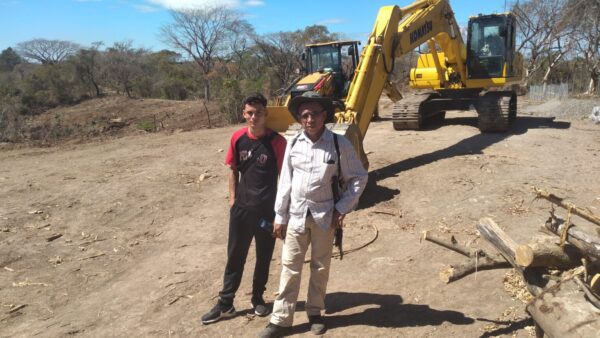
The Nonualco project site, covering two hectares, is currently deserted, although work has already begun on building leveled terraces, as evidenced by the two backhoes parked about five meters away, as well as pieces of felled trees.
Pointing to a now-empty spot, Lainez recalled: “The army hung a man there, from a branch of a mango tree. We knew they buried him there, along with many other people they brought here to be killed.”
Fierce community opposition
The fear is that the construction of the landfill will destroy the remains of war crime victims that might be found on the site.
“A massacre is a crime against humanity, and the remains, – if they can be found and identified – could form part of a subsequent investigation,” Lainez stated.
The backhoe work was at a standstill when IPS visited the area on January 28, due to fierce opposition from the community. They’re currently beginning negotiations with the municipalities involved in the initiative aimed at managing hundreds of tons of waste daily.
Ever since families first learned of the project’s construction in October 2025, they’ve been on constant alert. They’ve set up a checkpoint at the entrance to the settlement to prevent more heavy machinery from entering the site and thus keep the landfill from being built.
“The community went into action, and we’ve managed to stop the work for the time being. We’re negotiating to have no more machinery allowed in,” affirmed Lainez.
But it’s only a partial victory – the project is still on and could restart at any time.
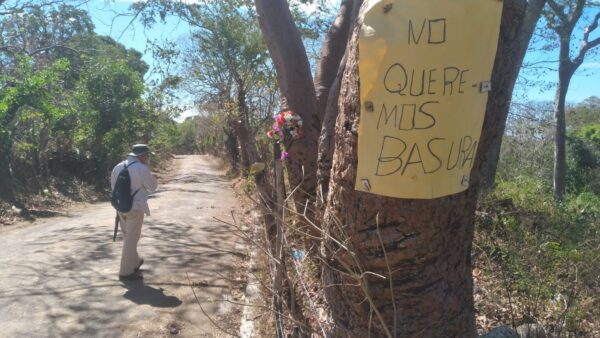
Handwritten signs have been nailed to the trees lining the main street of the village, with messages protesting the project. “We don’t want garbage,” read one, while another held a bouquet of plastic flowers, in memory of those killed in the area.
Community representatives said they had not received any written documents with details of the project, and that they had only been summoned to the Tecoluca mayor’s office once, weeks ago, to be given basic information.
A poster about the project, meant to serve as an invitation to that meeting, stated: “Landfills and garbage dumps are not the same thing. Learn the truth. Come and see the benefits it will bring.” According to the poster, these included: “jobs for local families, social support, health initiatives, and opportunities for local businesses.”
The poster also warned: “This invitation is exclusively for the residents of San Francisco Angulo who want to receive information and engage in dialogue. It’s not for opportunists, people outside the community, nor for agitators.”
With support from environmental organizations, the community filed a lawsuit in December 2025. Their case is now in the hands of the Environmental Appeals Court of the city of Santa Tecla, west of San Salvador, the country’s capital.
It’s estimated that the project will affect some 400 families living in San Francisco Angulo and several surrounding communities.
A war cemetery
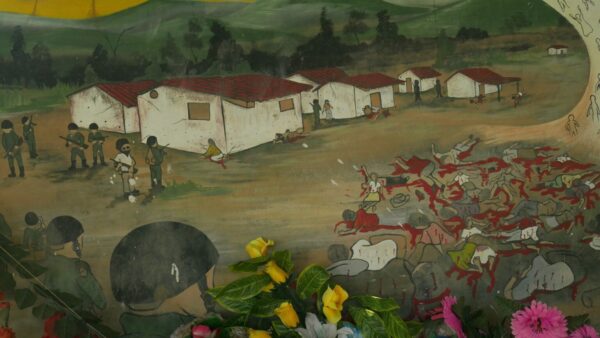
For those familiar with El Salvador’s history, San Francisco Angulo evokes memories of repression and massacres. The Central American country experienced a civil war between 1980 and 1992, and that conflict is estimated to have left a toll of 75,000 dead and more than 8,000 missing.
On July 25, 1981, around 45 people were massacred by the army in San Francisco Angulo. Three months later, on October 30th, another 50 were shot dead in Lomas de Angulo, a nearby settlement.
After the war ended, the remains of many of these victims were found, exhumed, identified, and buried in two large mass graves near the school in San Francisco Angulo. Several murals allude to these painful events.
The worst massacre in the area occurred on June 19, 1982, in Llano de la Raya, another nearby settlement, where some 600 – 800 people were killed, according to reports from human rights organizations.
It’s estimated that a total of 800 – 1,000 people were murdered in cold blood in the district of Tecoluca between 1981 and 1982, during army operations targeting rural families. Living under the burden of a quasi-feudal agricultural production structure, these families had taken up arms against the landowners and were part of the first rural guerrilla groups to emerge in the country.
In the central square of Tecoluca, there is also a monument with the names of a hundred children killed in those operations.
The remains of most of these victims have never been found, including Enrique Alberto Ayala, Felix Lainez’s father, and his brother, Juan Lainez,.
“We still haven’t found them. They’re among the cases of victims whose remains are unknown. I’ve tried to locate them but haven’t been able to. We know they’re in the area, but we don’t know exactly where,” said Lainez, himself a former guerrilla fighter who now works on a local farm.
He added that – like his brother and father – many families in San Francisco Angulo lost relatives in the massacres and are still unable to find their remains. The landfill project on the affected terrain is an insult to the memory of all those victims.
“This whole area is a sacred place for us, our dead are there,” Adonay Ponce, 21, told IPS. He was born in San Francisco Angulo and grew up hearing from his parents and relatives the war stories that took place in the community. Now, as an adult, he’s determined to protect that historic memory.
“We know the importance of memory, the stories our grandparents, our ancestors, have told us, and for that reason we’re fighting to protect this place,” Ponce emphasized. He works as an electrician, but right now is taking advantage of a slowdown at work to join the community struggle.
An environmental struggle as well
Ponce considered the landfill project unfeasible in an area rife with watersheds. Together with Lainez, he showed IPS one of the community’s water sources, located in a wooded area about 164 yards from the planned landfill site.
The water that flows from this spring joins two other streams downstream to form the Salamar River, used by families in the community for water supply and recreation, Ponce said.
“I’m concerned about the issue of water,” he added, “and also the preservation of wildlife.” He explained that deer, iguanas, armadillos, coyotes, and porcupines, among other species, can still be seen roaming the forest in the area.
On January 29, a delegation from the state Attorney General’s Office for the Defense of Human Rights visited the site to learn firsthand about the situation of the families and the conflict in which they find themselves. They inspected the area around the water sources and spoke with residents.
In 2018, the same institution issued precautionary measures to prevent the expansion of a landfill that had been built there previously and had already collapsed, a project that rural families also opposed and managed to stop. The new construction project is a second attempt to bring and process waste in the area.
However, it remains to be seen whether the Attorney General’s Office will rule the same way this time, given that the institution now responds to the interests of Salvadoran President Nayib Bukele. Among other things, Bukele is known as the main promoter of the Terrorism Confinement Center, the mega-prison built near Tecoluca in January 2023.
Although supposedly used to imprison gang members, human rights organizations have denounced the capture and imprisonment there of innocent people, with no connection to these criminal organizations.
“What I want is for our memory to be preserved, for the traces of those massacres not to be destroyed, and I would also like to leave behind a beautiful place to live, without pollution, where my future children will be happy,” Ponce concluded.
First published in Spanish by IPS and translated and posted in English by Havana Times.