
Venezuela Releases 11 of its Nearly 900 Political Prisoners
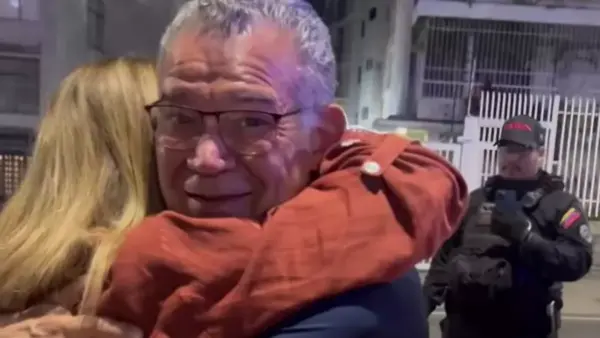
Relatives, activists and opposition figures demand a “total amnesty”.
HAVANA TIMES – The joy felt by the families of Venezuelan political prisoners following the announcement of releases by the president of Parliament, Jorge Rodríguez, has turned into tension due to the lack of concrete results. Of the nearly 900 people held in various prisons across the country, only nine had been released by nightfall: four Venezuelans and five Spaniards, who have already arrived in Spain.
The Venezuelans are Enrique Márquez, former presidential candidate former presidential candidate; Biagio Pilieri, a politician and collaborator of María Corina Machado; the lawyer Alejandro Rebolledo; and military officer Larry Osorio Chía. All four had been held until now in the feared El Helicoide prison, the Caracas headquarters of the Bolivarian National Intelligence Service (Sebin), and their releases were confirmed by the NGO Foro Penal and a report by Realidad Helicoide. Early Friday morning, two additional cases were added, whose identities are still unknown.
The release of Márquez and Pilieri was captured on cellphone cameras by people gathered outside the prison awaiting news of their relatives. Both were able to embrace their loved ones amid great anticipation. Márquez was detained on January 7, 2025, after taking part in the July 28, 2024 presidential election and questioning the victory attributed to Nicolás Maduro by the National Electoral Council.
After his arrest, Interior and Justice Minister Diosdado Cabello claimed that the former candidate had proposed holding an inauguration ceremony for Edmundo González Urrutia at a Venezuelan embassy abroad. His release had been demanded by countless activists and leaders, including Colombian President Gustavo Petro, who described him as a friend.
Pilieri had spent even longer in prison. He was pursued and arrested on August 28, 2024, after participating in a protest rejecting the ruling of the Supreme Court of Justice that validated Maduro’s reelection. The politician was coordinator of the opposition party Convergencia and a former lawmaker, as well as mayor of Bruzual in Yaracuy. Along with leader Freddy Superlano and Machado collaborator Perkins Rocha, he was accused of disseminating the electoral tally sheets produced by the main opposition to prove González Urrutia’s victory.
Hours later, the release of Larry Osorio Chía was announced. He is a second master sergeant in the Venezuelan Army and the brother of Rubén Darío, a retired soldier who worked as a human rights activist with Fundaredes. According to several NGOs, the young man’s only “crime” was his family tie to a soldier who defected to support Juan Guaidó in 2019.
The last Venezuelan released last night was Alejandro Rebolledo, a former Supreme Court justice in exile, who had been imprisoned since returning to Venezuela in 2024 to regularize his legal status after being forced into exile in 2017 and was instead charged with treason and conspiracy against the political order.
In addition, a prominent political prisoner, lawyer and former lawmaker Juan Pablo Guanipa, one of María Corina Machado’s closest collaborators, detained in May 2025, is expected to be released in the coming hours. Cabello accused him of an alleged plot against regional and legislative elections. Although his family hoped he would be home Thursday night, by midnight they acknowledged they would have to wait a bit longer.
Along with the release of these Venezuelans os the release of five Spaniards who are currently flying to Madrid: José María Basoa, Andrés Martínez Adasme, Miguel Moreno Dapena, Ernesto Gorbe Cardona, and the Spanish-Venezuelan Rocío San Miguel, who landed in Madrid shortly after 1:00 p.m. local time.
News of their release was announced Thursday by Spain’s Minister of Foreign Affairs, the European Union and Cooperation, José Manuel Albares, and celebrated by Prime Minister Pedro Sánchez as “an act of justice.” In an early-morning interview, the foreign minister welcomed the “new stage opening in Venezuela” and expressed hope that the “new government continues along that path.”
Albares thanked the “positive step taken by the new acting president” and said he spoke Thursday with those released. “All of them, without exception, were somewhat in shock, because they were informed in real time that they were going to be released,” he said. “They woke up one day thinking they would remain there for an indefinite period, and a few hours later they were at the residence of the Spanish ambassador,” he added. The Spanish government is watching to see whether at least one more Spaniard “may be released in the coming hours or days,” he said, without naming names.
Expectations at Madrid-Barajas Airport were very high around midday, with dozens of Venezuelans and Spaniards waiting for relatives and friends. However, cameras were unable to capture the arrival of the five, who for now have “restrictions” on speaking. According to El País, Rocío San Miguel’s spokesperson said patience was needed regarding the evacuees’ emotional state and that their lawyers must also assess those restrictions.
Minutes later, it was announced that all were already on their way to their places of origin. The group includes two Basques, one Canary Islander, and one Valencian, in addition to San Miguel.
Beyond these specific cases, the remaining prisoners are still waiting. The Committee of Mothers in Defense of Truth said Thursday that “the release of our loved ones has not been carried out, nor do we see signs that progress is being made.” In an Instagram post, the committee urged authorities to “ensure that our loved ones are included within the announced release process.”
“Based on the information we have, we estimate that just over 200 people remain unjustly detained in the context of post-election mobilizations,” the committee said, calling for progress toward “a general amnesty.”
Justice, Encounter and Forgiveness issued a statement warning that, despite the wait, releases “have not yet been fully carried out” and that calm must be maintained in order to confirm cases. “We reiterate that no information, list, or name will be made public until each case has been fully confirmed; that is, until individuals have effectively left detention centers and are in contact with their families,” the group said on X.
The NGO Foro Penal estimates that there were 863 political prisoners, among them 86 foreigners of various nationalities in Venezuelan prisons as of December 29, most detained after the July 28, 2024 presidential election.
In remarks to the media, Rodríguez said Thursday that the releases are part of a “unilateral gesture” by the Venezuelan government, now led by acting president Delcy Rodríguez, his sister. At Christmas and New Year, the Venezuelan government had already announced the release of 99 and 88 detainees following the presidential election, respectively, although prisoner associations were able to verify only 61 of them.
For her part, María Corina Machado shared an audio message on her social media in which she described the releases as “an act of moral restitution.” The opposition leader recalled that although “nothing gives back the stolen years, this day matters” because it acknowledges what she always knew: “that injustice will not be eternal and that truth, even when deeply wounded, eventually finds its way.”
The former lawmaker said this “brings a measure of peace” to families, but sent a message looking ahead: “We will not rest until all prisoners are free and all of Venezuela can embrace in full democracy and freedom.”
Translated by Regina Anavy for Translating Cuba.