
Cuba: Diaz-Canel Has Food for Thought After Venezuela Attack
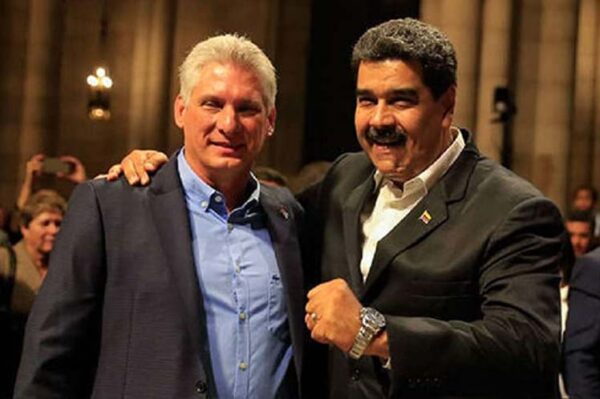
HAVANA TIMES – I don’t know whether he said it merely to sweeten the ears of voters in Florida (we’re not in campaign season and the next elections are still a long way off), but in recent statements about the operation to capture Venezuelan President Nicolas Maduro, Donald Trump did not rule out Cuba remaining on the list.
Cuba has not been a priority for the Trump administration beyond maintaining economic pressure measures, but surely the proximity of his Secretary of State, Marco Rubio, is constantly buzzing in his ear, reminding him that just 90 miles away sits his worst political enemy.
Certainly, in terms of resources Cuba does not have much to offer, but Trump is not someone who tolerates other people’s defiance very well, and he dropped a hint or two.
“Cuba is an interesting case. That system is not good for Cuba. We’ll end up talking about Cuba, because it’s a failed nation,” he said this Saturday, adding that he intended to help both the island’s residents and those who were “forced to leave” and now live in the United States.
What may happen to Maduro and his wife, Cilia Flores—accused in New York courts, among other things, of allying themselves with drug trafficking—hangs in the balance, but at Havana’s Palace of the Revolution, toilet paper is in short supply.
Now that force has been applied against the most powerful hostile government in the region, inertia could trigger a domino effect and continue with the other troublesome targets in the region: Cuba and Nicaragua.
“If I lived in Havana and were in the government, I’d be at least a little worried,” Rubio declared this Saturday in Florida at the same press conference.
Although the “handpicked” Miguel Diaz-Canel hastily put together a demonstration in front of the US Interests Section in Havana, Cubans are divided between those who desire an intervention like the one they’ve just witnessed and those who fear the cure would be worse than the disease.
To tip the balance one way or the other, it is essential to see how events unfold in Venezuela, where opposition leader María Corina Machado claims they are “prepared to take power,” while Vice President Delcy Rodriguez says Maduro remains the president of the nation.
Incidentally, in his remarks Trump disqualified Machado, saying she lacks sufficient popular support, even though the Nobel Peace Prize winner insists that the elected president is Edmundo Gonzalez.
What is clear is that beyond official positions, the images coming out of Venezuela—both inside and outside the country—are overwhelmingly celebratory.
Nor is the economic impact on the island trivial, since it still receives some 30,000 barrels of oil a day from Maduro’s government. Although under Hugo Chávez it received triple that amount, if that tap is shut off, daily life for Cubans—already condemned to long blackouts and shortages of every kind—would become far more chaotic.
The vehemence with which Díaz-Canel reacted contrasts with the calm of Daniel Ortega and his wife Rosario Murillo, and with the apathy of the Cuban people, more concerned with survival than with what happens thousands of kilometers away, even though the impact is almost direct.
Havana’s traditional rhetoric revisited the familiar themes of state terrorism, imperialist aggression, and violations of sovereignty, while also calling for international solidarity with Caracas—which is to say, with themselves in the future—because although they don’t say it, they fear the worst.
For now, among ordinary citizens the concern is how much worse things will get without those barrels of oil, and the question of whether we’ll experience something similar in the coming months. That’s why what happens both to Maduro in particular and to Venezuela in general will be scrutinized closely.
There has also been no emphasis on those who died while trying to protect Maduro, since it is well known that his security detail was made up mostly of Cubans, both military personnel and advisers. So far, there has been no official statement on the matter.
The embassy in Caracas assured that it suffered no kind of attack, and health workers, sports personnel, and collaborators in other sectors also reported no problems.
Trump stated that there would be a continued military presence there after the dictator’s capture, while waiting for them to do what he wants. “If Maduro’s vice president (Delcy Rodriguez) does what we want, there will be no new attacks on the country,” he said verbatim in an interview with the tabloid New York Post.
The federal drug trafficking charges that the Venezuelan leader would face would pale in comparison to those of a hypothetical trial on US soil against Díaz-Canel on human rights grounds—the man who gave the order to attack on the day of the historic July 11, 2021, protests.
Political uncertainty must have him on edge now that his strategic ally is no longer there to support him, even timidly.
So far the dollar exchange rate remains the same, blackouts are just as severe, public transportation is nonexistent, and prices are sky-high—but everything could get worse, and that boiling cauldron could burst at any moment.
From his office or his home, Díaz-Canel—and even Raul Castro—must have reinforced their personal security to the maximum, because they know they could be next on the list and that Trump doesn’t pull his punches.
I normally wouldn’t write a personal insult but Diaz-Canel has never had an original thought in his life. As an American, I don’t see Trump planning an invasion of Cuba or snatching Miguel from his palace bunker. If Trump did get Cuba free, he most likely would reinvigorate the tourism and the island’s infrastructure to a point where Cuba would be importing antique 1950’s cars from the US to support tourism. The Cuban people would have more food, money and opportunities than they would know how to deal with.