
Is Cuba Next?
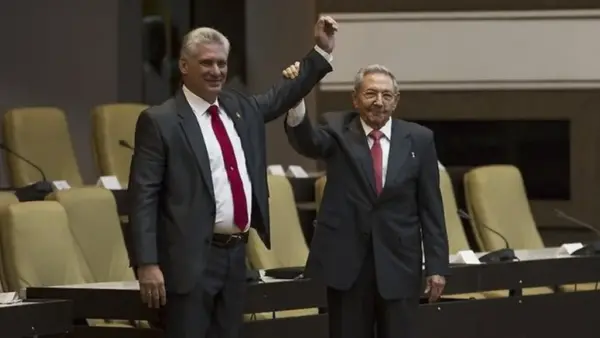
HAVANA TIMES – Something strange; it was cold in Havana. But thousands were marching slowly in front of the US embassy to protest the death of 32 Cubans during the US military operation that captured Venezuelan dictator Nicolás Maduro in Caracas. And the question on many people’s minds was whether Cuba would be the next country invaded by the United States under this new Trump doctrine for the Americas.
“Our brave fighters, with conventional weapons and with no vests other than their morale and their loyalty to the mission they were carrying out, fought to the death and struck their adversaries,” said Cuban dictator Miguel Diaz-Canel in one of the two ceremonies commemorating the Cubans who were protecting Maduro and his wife, Cilia Flores. “Honor and Glory” read the signs in front of the name of each of the dead Cuban soldiers. Their ashes, sent from Caracas, rested on pedestals. These funeral scenes contrasted with the festive declarations from the United States that it had not lost a single soldier or helicopter in the military intervention of January 3rd.
I suspect that the same team of Cuban bodyguards was the one that confiscated our cameras and video tapes and arrested us after interviewing Nicolas Maduro at the Miraflores Palace in 2019. I was traveling with two Cuban producers, and they immediately recognized the accent of their compatriots who, upon realizing they had been discovered, stopped speaking. But, until now, it had never been confirmed that Cuban military personnel were protecting the Venezuelan tyrant, perhaps in exchange for Venezuelan oil and to maintain an international alliance.
After Maduro’s capture, in a hastily arranged press conference at the White House, Trump gave the floor to his Secretary of State, the Cuban-American Marco Rubio. “Cuba is a disaster,” Rubio said. “It is governed by old and incompetent men. Its economy has completely collapsed… If I were in Havana and working in the government, I would be worried. At least a little bit.”
Rubio’s goal has always been to free Cuba from its dictatorship. His parents arrived legally from Cuba in 1956, three years before Fidel Castro seized power. In exile in Miami, as Rubio recounts in his book “An American Son,” the family always professed an anti-Castro stance. Rubio’s rejection of Cuban tyranny is so well known that when a comment appeared on the X network saying that Marco would one day be “president of Cuba,” Trump replied: “That sounds good to me.”
Because the Venezuelan regime has become a protectorate of the United States, and has lost its autonomy and its ability to make independent decisions, Cuba has already stopped receiving Venezuelan oil. This puts the Cuban economy in a very vulnerable position.
And there is strong pressure for Mexico to also stop sending oil to the Cuban dictatorship. For years, several Mexican governments have provided economic and political assistance to the island. But there is no transparency about how many barrels and at what price. Or whether they have been donated.
One of the great contradictions of the MORENA presidents—Andres Manuel Lopez Obrador and Claudia Sheinbaum—has been that they were elected by the Mexican people. However, they do not want the same for the Cuban people. Today, they still openly support the Cuban dictatorship, even though there are political prisoners, murders of opponents, brutal censorship, strong repression, and no multi-party elections have been held for 67 years. AMLO and Sheinbaum are blinded by Castroism and have never understood that it is criminal and violates human rights.
“When were people of Mexico asked if we wanted to donate our oil to a dictatorship?” opposition senator Ricardo Anaya recently denounced. “We are not helping the people of Cuba; we are helping the leaders of the dictatorship to stay in power.”
The expansion of Trumpism throughout Latin America is dividing the continent. Supporting him are the presidents of Argentina, El Salvador, Peru, and Ecuador, as well as the newly elected leaders of Honduras and Chile, while the firm opposition is made up of the leaders of Mexico, Brazil, and Colombia. Cuba, clearly, has been losing allies.
Dictator Diaz-Canel and his clique of repressors are hearing footsteps. The reality is that the US economic embargo cannot be an excuse or justification for a six-decade-long dictatorship.
In a rare exchange of bravado on social media, Trump asked Cuba to “reach an agreement before it’s too late,” to which the Cuban leader responded that “Cuba is a free, independent, and sovereign nation, and no one dictates to it what to do.”
After Venezuela, is Cuba next? “Although Trump’s intentions are unclear, it is obvious that the Cuban regime is now unusually vulnerable,” the respected magazine The Economist recently concluded. “It is impossible to completely rule out the possibility that the United States could use military force (in Cuba).”
I do not agree with a US invasion of Cuba, just as I did not agree with the military intervention in Venezuela. It goes against all international laws and the United Nations Charter. But I do agree with a policy of “maximum international pressure” so that the Cuban dictatorship collapses from within and the Cuban people, and only the Cuban people, decide their future.
It’s about time.
——-
Castro’s government proved to be even more corrupt than Batista’s. Populist politicians, such as Fidel Castro, are experts in manipulating people’s emotions for their own benefit. Cuba deserves to go back to civic democracy!
I am a 67-year-old retired businessman from California, I also have continuing business operations in Mexico. Castro‘s Revolution began shortly after I was born. While I agree that Fidel Castro‘s revolution to remove the corrupt Bautista government was just and necessary, with the benefit of hindsight, it is clear that the Castro was the correct man to lead that revolution, but not the right man to run the country. In fact, Castro was not a true communist at that point, communism did not get solidified in Cuba until the Castro Brothers along with Che Guevara realized that they had an insufficient gross domestic product, and ran around, looking for the deepest pockets to help them out. When communist Russia agreed to finance them with the condition that they could place a few nuclear missiles on the island, that was the point of no return as far as communism was concerned. And the result was the Cuban missile crisis, and Cuba has now exhausted. They’re complete list of anyone who may come in and be their angel. It is a very sad set of circumstances.
I have a great deal of experience in Cuba over the past 10 years, traveling to Cuba for a week and sometimes a little more every month in that time. I have many friends there as well,and every single Cuban person I’ve met, has been courteous and kind always very humble, and I love the people there. I have read a lot and studied this problem in depth, and I have concluded, that, for all of the various circumstances that Cuba has faced, its main enemy is its own corrupt, communist government, the US sanctions, have gone on for so long, trying to support a policy that has obviously failed, but the fact is, as far as electrical generation equipment, industrial equipment, farm, equipment, food, transportation equipment, etc., etc., Cuba has always been free to deal with almost the entire world, I have three friends who have done business with the Cuban government for more than 20 years, bringing containers of food, mostly meat and fruit from Argentina to Havana, from the outset of that business relationship, Cuba has always owed them millions of dollars. Never paying their bill on time, and re-ordering more product, only to be told that they would need to pay their past due bill first, and pay for the next containers in advance. And if that happened, they would resume business on 45 day terms. This cycle has gone on for more than 20 years. When I first heard this story, I asked if they were not worried that the Cuban government would just leave them hanging for whatever the bill was and by from someone else, my friend laughed and said there is no one else that will do business with them, they have screwed everybody else and we are the last ones. My point being is even in times. When Cuba had money and a cash flow, they did not pay their bills, nor did they maintain their power, infrastructure, water, distribution, road, maintenance, insect eradication, garbage pick up, etc. etc. etc.. all the while the Castro nephews were flying around in private jets going shopping in South American countries and having a grand old time. Cuba has been financed by both Russia and China, to the tune of billions of dollars, only to have the Cuban government come back years later after not paying their bill and renegotiate or restructure their debt, promising to pay down the road. I don’t think either Russia or China is dumb enough to do that again.. The truth is, while I am hoping that the United States, will just make the hour and a half operation to remove that government the hard way, the truth is that either Russia or China, could simply walk in and do that, claiming that they are collecting the collateral for their loans that the Cuban government has defaulted on over the years. In any case, for the sake of the Cuban people, I hope that things change sooner rather than later, and that the existing Cuban communist government is removed permanently, so those people are free. Also, in my opinion, once the Cuban communist government is removed, and a new, freely, elected democratic government is set up and stable, I hope that the living communist, government leaders, will be returned to Cuba to stand trial for their crimes and incompetence , and be judged by their own people. It worked out perfectly for Saddam Hussein, and for all the damage they have done over the years by posing as a legitimate government, all the time spreading and supporting communism outside of Cuba, I believe they deserve the same fate as their buddy Che Guevara. That would be true justice.