
Lech Walesa Gives Welcome Advice to Cubans Who Want Change
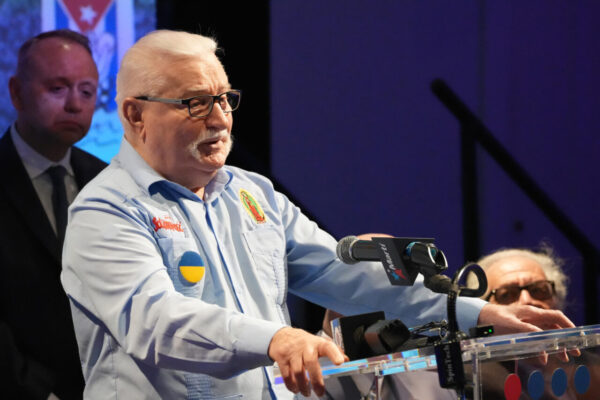
HAVANA TIMES — If anyone knows firsthand how hard a transition from a communist dictatorship to a democracy can be, it is Lech Walesa, the first president Poland had after shaking off the domination exercised over that country by the now-defunct Soviet Union.
Walesa led the movement that contributed to the end of the communist regime in his country in 1989 and later won the first free elections in that nation in more than 40 years.
The Nobel Peace Prize laureate spoke this Thursday in Miami to Cuban émigrés and warned them about how complex the task ahead will be if they ultimately manage to rid themselves of the dictatorship established on the island more than 60 years ago.
At the Cuban Diaspora Museum he urged islanders to take advantage of the political moment represented by Donald Trump, although he warned that the US president will not bring them freedom.
“You need to take advantage of Trump because he is moving in the right direction but remember that he is moving in the direction of US interests, not Cuban interests. So, you need to be prepared for all of this to converge,” he said.
What does this mean? That we must take advantage of Trump’s strangulation policies to achieve change on the island, but afterward great challenges will come in rebuilding a deeply divided nation.
In some way, Walesa drew a parallel with what happened in his country, which benefited from the presence of a Polish pope, John Paul II, but later had to face many challenges to heal its political wounds.
In other words, it will depend to a very large extent on what Cubans themselves can do from within, because although the US head of state is not known precisely for his patience, taking armed initiative carries an enormous political cost and, if it were to materialize, it would be because no other alternative is seen.
I believe there are two key dates on this itinerary proposed by the president and his Secretary of State Marco Rubio: May 20, for its significance as the date that inaugurated the Republic after independence from Spain, and July 11th, which marks the cry of Freedom in the throats of the majority of residents in the archipelago.
If nothing happens after that latter date—when the country is supposed to be completely paralyzed by the lack of supplies—then it is possible that the military option will be placed on the table.
The 82-year-old Polish leader also warned that although there is the possibility of a rapid victory, a civil war must be avoided at all costs.
The fall of communism in Eastern Europe at the end of the 1980s had global repercussions, and among them was also the unprecedented economic crisis in Cuba, which depended on the former Soviet bloc, and which opened the door to social and political tensions that could culminate in an internal conflict in a context of extreme polarization.
Although the regime skillfully uses fear of external intervention to justify its repression and consolidate control, the option is not ruled out; however, the ideal would be not to reach that extreme and to achieve change without the participation of foreign agents.
The future will inevitably pass through forgiveness, which is not synonymous with forgetting, because in the end the vast majority of those who go out to parades, to shout insults at US Charge ‘d Affaires Mike Hammer or even to strike blows in the midst of peaceful demonstrations like those of July 2021, are victims of the indoctrination and terror imposed by the governing entity in Cuba over recent decades.
Desperation has led the regime this past week to imprison young influencers from Holguín, Kamil Zayas and Ernesto Ricardo Medina, leaders of the independent social media project El4tico, for their customary interpretation of what constitutes propaganda against the constitutional order (that of the Communist Party of Cuba) and incitement to commit crimes.
Cuban law provides for up to eight years in prison for the first “offense” and another year for the second, and this is yet another exemplary action with which the regime seeks not only to take off the air those who daily expose its dictatorial methods through supposedly anti-Cuban viral videos, but also all those who use social media to criticize the government of Miguel Diaz-Canel.
It is by no means an isolated case. Likewise, for publishing their personal opinions about the disaster they experience daily, Lara Crofs, Yulieta Hernández, Yoandi Montiel, and Sulmira Martínez—among many other young people—are or have been imprisoned for the sole “crime” of saying what they think.
Diaz-Canel and his inner circle never tire of demanding condemnation over the capture of Nicolas Maduro in Venezuela, but they forget that it is ethically unacceptable to maintain an active political dialogue and cooperation with a regime that systematically persecutes its citizens.
Returning to the hypothetical transition: if right now the ruling elite claims that there are exiles willing to show solidarity and governments eager to help, all that aid would multiply a thousandfold if the world understood that Cuba had reached true liberation.
The hatred sown over recent decades will be the fundamental obstacle to moving forward, because the wounds are there—many of them very deep, marked with the blood of relatives and friends—a far more harrowing scenario than that experienced by Walesa’s Poland in the late 1990s, and perhaps that is why change here will not be lived like the song of a bird that, after the storm, sings again at dawn.
However, to move forward justice must be done, but forgiveness must also be granted, because in the end we are all puppets on this well-staged set where our stomachs, our feelings, and our freedom are manipulated, and words must cease to be weapons and instead become bridges that unite rather than divide.
Hopefully transformation will arrive in the most peaceful way, like a soft murmur that caresses the skin of a weary world—exhausted on every level—and thus we will have a less complex task when we try to rebuild ourselves from our ashes and, in a collective embrace, understand that only together can we elevate the art of coexistence to its highest expression.