
Prelude to a Homecoming in Cuba
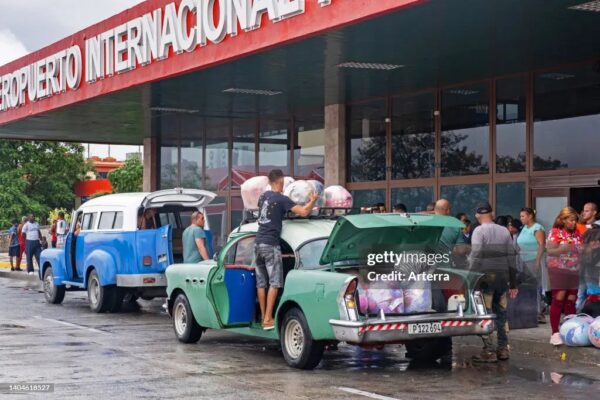
HAVANA TIMES — Three years had passed since the last time I had been on the island. My parents, my brother, my nephews and nieces still live there, along with countless memories from my childhood and youth.
The last time I had traveled to Cuba, you could already feel that breeze of sadness that, on this occasion, would turn into hurricane-force winds. Blackouts were beginning to become part of everyday life, and astronomical prices were putting to the test the math skills and ingenuity needed to survive on the meager resources available to wage workers and pensioners.
This time, those difficulties were compounded by the unsanitary conditions of the streets, turned into garbage dumps, and by the constant lament of those suffering the aftereffects of the chikungunya virus—an epidemic that left virtually no one untouched in recent months. It has become common to see people with swollen feet and hands who no longer know which home remedies to take to ease the physical pain. This, in a country where pharmacies are empty and medicines are brought in by emigrants returning laden with pills and food for their families.
My first impression upon arriving at Santiago de Cuba airport was striking. There, in utter disorder, newly arrived passengers crowded over one another trying to be the first to cross the threshold of the immigration booths, where officials with robotic souls carried out their work at a pace very different from that of the throng determined to reach the other end of the hall, where another line awaited: security control.
To make matters worse, when I finally managed to move to the next level, one of the two X-ray machines used to examine carry-on luggage broke down and a new odyssey began. The two lines became one, and men, women, and children tried—unsuccessfully—to negotiate their turns. An atmosphere of mixed odors invaded my senses and, for an instant, I feared fainting amid the storm of sweat, perfumes, and mosquito repellent.
“Don’t get your hopes up,” a woman behind me said. “Now comes baggage claim. The last time I was here the power went out and we had to wait three hours to leave.”
Fortunately, there is still electricity. Almost unconsciously, I touch the image of the Virgin of Charity and pray that she helps me get out of the arrivals hall as quickly as possible.
Within an hour I must catch the Viazul bus that will take me to Las Tunas. If I miss the bus, I am royally screwed.
Luckily, I manage to get out to the parking lot with my luggage before the coach arrives.
Surprisingly, the temperature is pleasant in this fiery land, where the usual thing is for sticky humidity to pierce your skin like a mantle of fire.
I sit on a curb because, there—as at the exit of any airport—there are no benches or waiting areas. To my right, in front of the arrival door, another crowd gathers: those anxiously awaiting their relatives, taxi drivers in need of work, and the occasional vulture ready to fleece the few tourists traveling alone in search of a mythical Cuba.
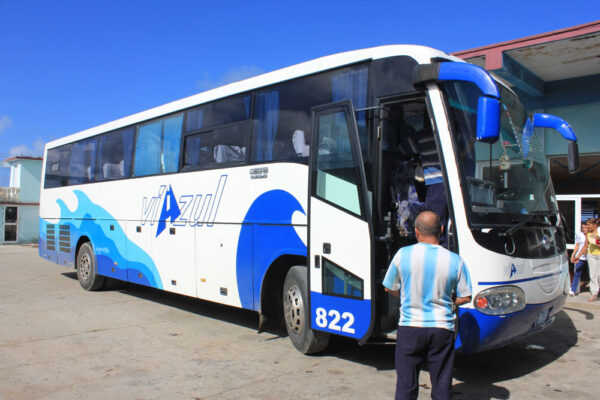
At last, after an hour’s wait, my bus arrives. I board almost before the driver confirmed my ticket, as if he didn’t care whether the four passengers there had paid for the trip or were simply stowaways.
Half an hour later, after a brief stop at the Santiago de Cuba terminal, the vehicle refuses to continue. A water hose has burst and we were stranded. The drivers try to repair it, but the effort proves fruitless. We have no choice but to wait for another bus to come to our aid and, there—like a prelude to what this journey will mean, I remain inert, without the strength to complain, but without any spirit for optimism either.
While the new bus takes its time arriving and night begins to fall over our souls, I understand that this journey will not be just a trip from one city to another, but a passage through the visible and invisible cracks of a country that endures between fatigue and hope. Every delay, every breakdown, and every line seems to announce that returning is not simply coming back but facing what hurts without ceasing to love what remains. And so, sitting in the midst of uncertainty, I accept that all this has been nothing more than the prelude to what it means to return home.