
Venezuela: Maduro’s Party Sets Barriers to Machado’s Return
and resistance to an Amnesty Law
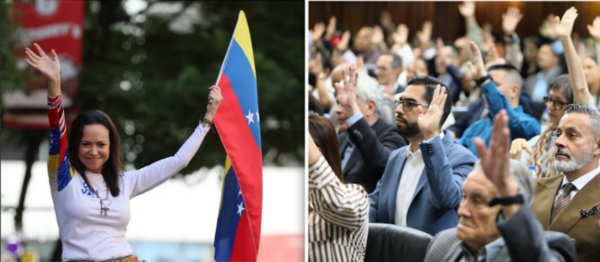
Piero Trepiccione warns that if obstacles to the Amnesty Law persist, progress in restoring trust will stall. Remiro says chavismo (Maduro’s party) wants to maintain political control through repression.
HAVANA TIMES – While interim president Delcy Rodríguez cordially receives US Energy Secretary Chris Wright in Miraflores and gives him a guided tour of oil facilities in the east of the country, militants of chavismo (Maduro’s party) in Parliament are showing resistance to the restoration of civil liberties and respect for human rights—conditions necessary to begin a democratic transition in Venezuela.
Through debate over the Amnesty Law, the United Socialist Party of Venezuela (PSUV) has made clear, for example, that it is not willing to allow opposition leader Maria Corina Machado to return to the country so easily, as she still faces the risk of arrest. Likewise, there is no sign they will erase with a stroke of the pen the illegal political disqualification against her so she could run in future presidential elections.
“If people expect the Rodríguez siblings and Diosdado Cabello to deliver a clean, neat, and perfect transition process, everyone is being naïve,” recently said former Secretary General of the Organization of American States (OAS), Luis Almagro.
Political scientists consulted by Efecto Cocuyo agree with Almagro: the road to transition will not be easy because chavismo is playing to remain in power longer. The opposition and civil society therefore face the challenge of reorganizing and applying internal pressure—not only on the interim government but also on the White House.
Maintaining Control
“It’s expected, it’s no surprise—it’s the natural behavior of chavismo, which comes from a hyper-repressive phase. Its political control was based on repression against dissent and still is. They have been able to act authoritatively for many years and believe they can keep doing so. They are clear that the priority for the US is its economic agenda, regardless of whether there is democracy in Venezuela or not,” argues political scientist Luis Remiro.
In an ordinary session on February 12, the National Assembly began the second debate on the Amnesty Law for Democratic Coexistence, but only reached Article 6—of 13—due to disagreements between the PSUV and the Liberty Parliamentary Group (UNT, Unión y Cambio, and Lapiz) when addressing Article 7.
Article 7 establishes that the law covers “any person who is or may be prosecuted or convicted for their alleged or proven participation in crimes or offenses committed within the framework of the events subject to amnesty, provided they submit to the courts or do so after this law enters into force.” According to Iris Varela, political prisoners must accept the crimes they supposedly committed and ask forgiveness in order to be granted amnesty.
Deputy Luis Florido (UNT) recalled that, under Article 49 of the Constitution, every person is innocent until proven otherwise; therefore, by submitting to the courts they would have to admit to crimes they did not commit. PSUV deputy Carolina García added: “Those in exile cannot arrive amnestied.” This applies to Machado—who faces criminal accusations for supporting US intervention—and to other politicians such as Leopoldo Lopez and Julio Borges, among many others.
“The most hardline chavismo—Cabello, Freddy Bernal, Iris Varela, among others—have made clear they are the main resistance to the start of a transition while maintaining a survival discourse. Let’s say the US may allow certain excesses such as repression or the denial of full freedoms to political prisoners as long as the economic agenda is not altered, so it seems Machado continues to be left out of a transition process,” Remiro warned.
For now, the PSUV majority in the National Assembly chose not to steamroll approval of Article 7 as written, seeking consensus. Some analysts attribute this to oversight demands that the legal instrument be approved unanimously; others see it as a chavismo strategy to legitimize whatever is approved there.
Amnesty for All
NGOs such as Justicia Encuentro y Perdón and Justicia y Proceso Venezuela argue that people persecuted for political reasons who have been victims of political disqualifications not stemming from a final judicial sentence should be included in the Amnesty Law—something chavismo also rejects.
Political disqualifications have been chavismo’s tool to prevent opposition leaders from running for office. Article 65 of the Constitution establishes that disqualification from elected office must derive from a conviction for crimes committed while holding public office, issued in a final judgment. However, lawyers and NGOs have denounced that those imposed by the Office of the Comptroller General have been discretionary, arbitrary, and in violation of due process because those affected were not even granted the right to a defense.
The most recent case was Machado’s, who could not run as a presidential candidate in the 2024 elections after appearing disqualified for 15 years by the Comptroller’s Office. If amnesty were granted, the Vente Venezuela leader could run in future elections—precisely what chavismo does not want.
In addition, the Simon Bolivar Law punishes with disqualification from holding public office for up to 60 years (Article 13) as an accessory penalty to a judge’s conviction—deemed unconstitutional by jurists.
“Amnesty is either for everyone or it isn’t—it must be general. It cannot remain discretionary; it’s not serious and does not move toward political pluralism, democratic alternation, or transition. Disqualifications tied to political maneuvers, by executive orders, must stop to allow electoral competitiveness. Otherwise, democracy is limited against any adversary who could be real competition,” political scientist Piero Trepiccione stressed.
According to a post-Nicolas Maduro poll published by the Financial Times, Machado has 67% voting intention versus 25% for Delcy Rodriguez—hence chavismo’s rejection of opening any crack that could favor the opposition leader.
“When you generate an amnesty backed by law, the first thing that must be set aside is arrogance and the imposition of criteria. Humility from the actors is necessary for a process of this nature to have the desired impact of ending hatred and resentment, restoring trust and pluralism. Amnesty should not be approached that way,” Trepiccione said.
Remiro notes that conditions still do not appear in place for Machado to return to the country, and she even risks being left out of an electoral process if one is called within the estimated year-and-a-half timeframe. In an interview with NBC, Delcy Rodriguez warned that if Machado returns to Venezuela she must answer for calling for foreign invasion and requesting international sanctions.
Building Muscle
Given Machado’s still enormous popularity, analysts say the interim government will try to buy more time to generate wear and tear and convince US President Donald Trump—through oil policy—that they are the best option to keep governing. During his visit, the Energy Secretary reiterated that Washington does not recognize Rodriguez as the legitimate ruler and that the path of transition remains.
Faced with chavismo resistance, analysts say the opposition, unions, professional associations, and other actors face the challenge of rearticulating internally to intensify mobilization that can generate pressure for democratic change.
“The opposition lacks internal, territorial muscle to influence decisions, so its role right now is to expose that the government is unwilling to grant a general amnesty or transition. In that sense, mobilization is important—the rebuilding of the opposition’s territorial muscle in general to increase that capacity to influence, beyond accusations that they want to set the country on fire,” Trepiccione said.
Accused precisely of wanting to “set the country on fire,” chavismo ordered the re-arrest of Primero Justicia leader Juan Pablo Guanipa, who had left his cell to lead a motorcycle caravan through Caracas demanding the release of all political prisoners. Guanipa is currently under house arrest and banned from speaking publicly.
The student movement—particularly the Federation of University Centers of the Central University of Venezuela (FCU-UCV)—has remained in the streets with the same demand. After leading a march in Caracas on Youth Day, February 12, FCU-UCV president Miguel Ángel Suarez reported harassment by unidentified individuals in a vehicle that night.
“The transition is not impossible, but it depends greatly on opposition reorganization—even beyond Maria Corina Machado. Pressure has to be internal. Grassroots coordination for resistance is necessary, taking advantage of the window opened by recent protests for political prisoners to generate pressure, as happened previously with the 2024 election campaign effort that later dissolved under repression,” Remiro concluded.
First published in Spanish by Efecto Cocuyo and translated and posted in English by Havana Times.