
Havana Can’t Take it Anymore
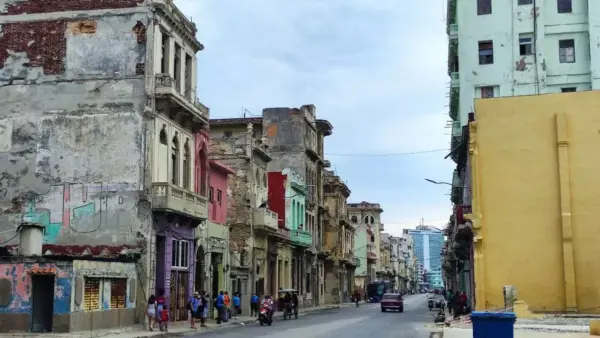
“This was the first time I’ve heard people openly criticizing the government in front of me, a foreigner”
HAVANA TIMES – “Volver … que veinte años no es nada” (“Returning … for twenty years is nothing”) goes the song. But arriving back in Havana (from London) after a gap of twenty years is a shock.
The city was always crumbling, that was part of its charm. But the view over the rooftops of Central Havana now resembles a war zone, its pock-marked concrete drained of all color except for the shining golden dome of the Capitolio, restored with Russian money. Along the iconic facade of the Malecón, with its once picturesquely faded pastel colors, many buildings have collapsed altogether like jagged missing teeth, while others have been brutally replaced by giant international hotels. The micro-brigade housing that sprouted so hopefully along the coast to the east in the 1980s is now badly in need of repair.
There were always power cuts and they never kept to the published timetable. But now, at least in the part of Central Havana where I was staying, the lights go out every single evening for at least five hours, and usually for several in the daytime as well. This is deeply demoralizing. As is the sight of the towering new Iberostar Hotel in the Vedado, with all its lights blazing, while below it the whole surrounding district is plunged in darkness.
Ever since the dollar was legalized and the country opened up to tourism in the early 1990s, there has been a growing rift between tourists, who can have things, and Cubans who cannot. It often appears that all the resources of the state are being thrown at tourism, in a kind of national prostitution. This divide has now reached a level that is frankly ugly. It’s not much fun for the tourists either, unless they have the hides of rhinos, which some obviously do. They hire the famous old Chevrolets and Buicks that have been done up to gleam in fabulous colors, and parade up and down the Prado in them, waving their arms in triumph and hooting their horns. No wonder the once utterly lovely Parque Central is now swarming with hustlers, like the worst of Venice.
But the effect is much more damaging than that, distorting the whole economy. A dollar, originally intended to be equal to one peso, is now worth over four hundred, so that the money Cubans earn – the average salary is about 6500 pesos a month – is effectively worthless and prices are insane. Unlike in the “Special Period in Times of Peace” of the 1990s, there is food available. But a single tangerine from a barrow on the street will cost you 600 pesos. An old man sits under a tree in the Vedado, eating a cake he has begged from a fancy cafe, while behind him another man rummages in a heap of rubbish piled against the wall of a dilapidated but still graceful home. Inside the cafe, Cubans are welcome, but the prices are pegged to the dollar so that a pizza costs nearly 2000 pesos, ten times the usual price.
All this, combined with the sorry state of the streets, where paving stones jut in the air, holes gape in the ground and sewage runs down the gutters, means that it is no longer safe to walk alone after dark. Twenty and even thirty years ago tourists were already the target for robberies. Here my comparison has to be with forty years ago, when, as a young, fair-haired foreign woman, I could take two buses home to a distant suburb at three in the morning with absolutely no fear. It was the safest place in the world. The change doesn’t only affect tourists. An elegant lady outside one of the few cinemas still open advises me to go to the 2pm show as otherwise I’ll have to leave in the dark. “Ah, how I used to love to sit in the cinema,” she sighs, echoing my thoughts exactly.
I should say that these were my impressions on first arrival in Havana as a tourist and that I soon adapted enough to be able to enjoy again the endless beauty of this city and the natural, quiet courtesy of its citizens away from tourist hotspots.
The great difference on this occasion was the attitude of Cubans themselves. They have always grumbled, played around with every new adversity with sharp, black humor, that old blitz spirit. But this was the first time I’ve heard people openly criticizing the government in front of me, a foreigner. “It’s all Fidel’s fault, he destroyed our industry,” says Milagro, an old woman sitting on a doorstep in a blackout. “They’ve forgotten Che,” wails her friend Ilsa, beside her, “They’re hypocrites who send their children abroad to be educated.” “We’re too weary to go on strike, we just keep each other laughing,” says a mother trying to cook with arthritic hands in another power cut. A taxi driver tells me that people would protest but “We can’t afford to go to jail on top of everything else.” A shop boy compliments me on my Spanish and I reply that I worked here before he was born: “Ah, so you caught the good times” “Yes” “That’s all over now, isn’t it?” Two young men in a local cafeteria agreed that “Everything is destroyed.” “So is there any solution?” I ask. “Get rid of the Communists” answers Yoel, quick as a flash.
*A visitor’s observations from London.
Translated by Translating Cuba.