
Cuba on the Brink: Protests and Pot-Banging Over Blackouts
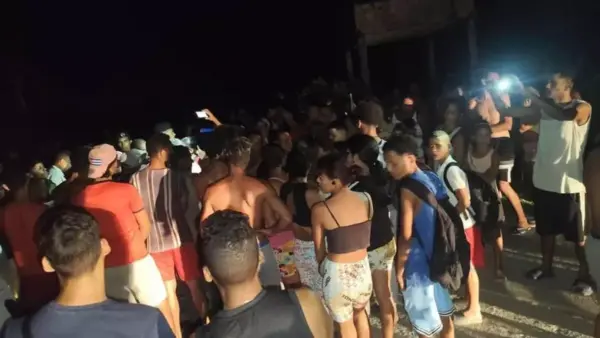
HAVANA TIMES – On the night of December 8 and the early morning of December 9, 2025, Cuba experienced a new wave of protests and pot-banging demonstrations triggered by prolonged blackouts, amid a worsening energy collapse and growing desperation.
Power cuts, which in some areas exceeded 12 hours, sparked demonstrations in Havana neighborhoods and in central and eastern Cuba.
Facebook videos shared by journalist Mario J. Penton show residents of Marianao, Centro Habana, Alamar, Lawton, and La Lisa out in the streets, banging pots, lighting bonfires, and shouting slogans demanding electricity, food, and freedom: “We want electric power, dammit!”; “Enough of putting up with this,” “Freedom!”
Journalist and professor Jose Raul Gallego reported on his Facebook page that tension in Marianao was particularly high and that the Police ultimately backed off when people began throwing bottles.
Some videos show that during the Marianao protests, electricity finally returned to the area. “They restored it right away,” a local resident told 14ymedio.
At the University of Camagüey, according to journalist and activist Jose Luis Tan Estrada, a student protest was reported, and in Baracoa, Guantanamo, similar demonstrations took place.
“With tonight’s pot-banging, this is already the second one at the University of Camagüey. A few weeks ago there was another,” Tan Estrada added.
On Saturday, December 6, residents of the El Marañon neighborhood in Las Tunas province took to the streets to demand that scheduled blackout times be respected. For more than a week they had received only 25 minutes of electricity per day.
The Cuban Observatory of Conflicts (OCC) recorded numerous protests in November across the country, driven mainly by demands relating to the nationwide arbovirus epidemic, as well as electricity, food, and civil liberties.
Meanwhile, authorities continue to describe the island’s energy situation as “very complex.”
Omar Ramirez Mendoza, deputy director of the state-run Electric Company (UNE), explained to the official outlet Cubadebate that the lack of fuel has kept between 900 and 1,000 MW offline for days, and that the simultaneous shutdown of several thermoelectric plants has deepened the deficit even further.
Over the weekend, outages nearly doubled available capacity: according to official figures, they reached 1,981 MW on Friday, 2,086 MW on Saturday, and 2,084 MW on Sunday—numbers that make it impossible to meet even the country’s minimum demand, which exceeds 2,400 MW.
On December 3—less than a week ago—the western part of the National Electric System (SEN) was completely disconnected, affecting several provinces.
As of October 2025, Cuba had 32 photovoltaic parks in operation, out of the 55 planned for the year. These 32 parks contributed 715 MW to the SEN; however, the government’s major bet on solar energy has not managed to reduce blackout durations.
According to Cuban economist Jorge Piñón, an energy expert at the University of Texas at Austin, “there is no short-term solution to Cuba’s energy challenges.”
Piñón believes that “renewable energy sources must be at the center of a detailed strategic plan for the energy transition,” but he argues that “the recent efforts with solar parks will not work,” calling them a deficient strategy that will end up, like so many other projects, as mere “fairy tales.”
To make matters worse, the Antonio Guiteras thermoelectric plant—the country’s largest generating block—will undergo maintenance in early 2026, which could impose new strains on the system.
While authorities speak of gradual improvements on the way, the daily reality is stark: an unprecedented electricity deficit keeps millions of Cubans in the dark, 44 deaths have been officially acknowledged from an arbovirus epidemic that the government has not been able to contain, and more than 200 stores sell essential goods in dollars—a currency to which only a minority of Cubans have access.
First published by El Toque and translated and posted in English by Havana Times.
I am there 5-6 x per year and go inland and talk with people… govt is not blind… they 100% know and they don’t care… it’s about staying in power and spending money on AI from China to help stay in power.
I spent 17 days in Havana in November 2025. This was not my first visit to Havana (12 th time) and I always rent an apartment and cook most of my own meals. Coming back to the apartment at around 4 pm to prepare to cook, the power went out every day at about 4.15 pm. The power did not come back on until around 11. Pm this happened “every” day. Many tourists prefer renting an apartment rather than staying at the high priced hotels and it is a very important opportunity for the Cuban people to earn some income. The tv runs propaganda daily about how great the revolution was for Cuba. How blind can a government be, how can they close their minds to the unbelievable poverty all around them and to the reality of what the revolution has “actually done” to Cuba. Unless, or until this government stops desperately clinging to power to maintain their own privileged positions this country is doomed.
I think that it is time for the Cuban communist government to wake up and admit they complete and utter incompetence, every day they are complaining about their failing tourism, industry, and lack of foreign investment, but let’s get real who’s going to invest tons of money, or even a few thousand for a vacation in a place where the people in charge are not even smart enough to keep the lights on!