
Cubans (Who Can) Carry Out Their Own “Energy Revolution”

HAVANA TIMES — Installing a home photovoltaic system—with panels, batteries, and inverters, including payment for specialized labor—usually costs between $2,000 and $4,000 in Cuba, or the equivalent in national currency. As much as a small house in any provincial capital. Or twenty years of average state wages.
However, the price does not seem to be an obstacle for a growing number of families who are opting for this technology for their homes or private businesses.
They do so with the aim of freeing themselves from the blackouts the country has suffered since 2019. Over the past three years, these outages have increased to levels comparable only to the great economic crisis of the 1990s.
Outside Havana, the situation has stabilized into two possible scenarios: one of “normality,” in which power cuts hover around 12 hours a day; and another of “contingency,” in which families have only three or four hours of electric service per day. It is during this latter scenario that the so-called “system collapses” occur—blackouts that have left the entire country in darkness for several days or up to a week.
That is why, when Roberto decided to alternate his retired life between Cuba and the United States, he devoted his first preparations to securing his own sources of energy. After nearly 40 years living in Florida, he confessed that he “was not in a position to adapt to Cuba’s darkness and heat.”
“I’ve gone through all the phases of this story. First, I brought in a plant [portable generator] from abroad that turned out to be a headache because of the difficulties of getting fuel and maintaining it—in one year I changed mechanics three times, because they all left the country. Then I had an EcoFlow [battery bank]. And finally, I ended up with solar panels, which are what really solved things for me. My system is 3 kilowatts, and it supports lighting and the use of the refrigerator, the television, and other essential household appliances,” he explained.
A private company that provides services in the city of Holguín, where he lives, supplied and installed the equipment and will also provide the warranty.
December was supposed to be better
Until a few weeks ago, the Cuban government insisted that by this December the country’s electrical situation would be “much better.” This belief was based on projects such as synchronizing unit number 4 of the Carlos Manuel de Céspedes thermoelectric plant in Cienfuegos, which was to return to service after a year of repairs.
According to the Ministry of Energy and Mines, that generator would be capable of contributing 158 megawatts to the system, increasing national electricity production by 10%. But on December 16, a breakdown of the turbine—the most important piece of equipment in the unit—abruptly derailed those plans. The incident occurred while the machinery was being started up for the first time in months. So far, authorities have not dared to predict a timeline for resolving the problem. To make matters worse, the plant’s other block (number 3, with the same design capacity) has been operating intermittently for weeks due to technical problems.
The difficulties at the Cienfuegos thermoelectric plant mark the close of a year that had begun under the sign of a supposed recovery of the national electric power system. At the start of 2025, a broad investment program in photovoltaic energy was launched that aimed to add more than 1,000 megawatts to generating capacity this year alone, through 52 large solar parks. At the same time, work was being carried out at thermal and natural gas plants to improve efficiency, which was expected to result in fewer blackouts.
Twelve months later, the situation is even more difficult. Social media erupted on December 18 when Prime Minister Manuel Marrero told parliament that during 2025 the government had allocated US $1.15 billion to “rescue” the electric system. Despite this purported investment, the deficit in generating capacity—the imbalance between electricity produced and electricity demanded—continued to grow. This year it will close at around 55%. Put more simply, during peak demand hours the electric industry manages to cover less than half of the country’s needs, which for Cubans living outside Havana means an average of 12 to 18 hours without power per day.
Everybody for themselves
The naval blockade imposed by the United States against Venezuela has further darkened the outlook facing the island. Ninety percent of its electric industry depends on fossil fuels, more than half of which are imported. Until now, Venezuela covered the bulk of those shipments from abroad, but the Trump administration’s campaign has focused on cutting off shipments. Not by chance did its first seizure target a ship carrying oil bound for Cuba.
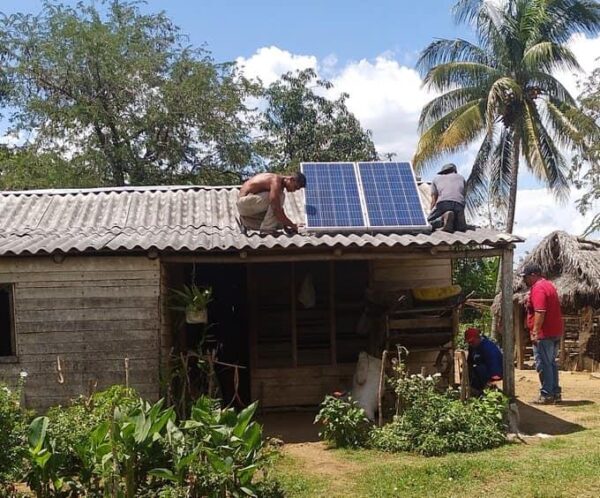
“Here, the only thing we have in abundance is the sun, so you can be sure this ‘panel fever’ is here to stay,” said Osvaldo Ariza, an electrical engineer from Holguín who, together with several colleagues, organized a brigade months ago to install these systems. Since then, they have not stopped working. Their most common clients are people who want a stable energy source for their homes, although they have also installed panels for several private businesses. “Private businesses have until the end of 2028 to generate half of the electricity they need from renewable sources. Those who can try to get ahead in that process—and at the same time get rid of blackouts,” Ariza explained.
The outlook suggests that Cuba could become very similar to the country Osvaldo’s father-in-law knew during the years he provided medical services in Haiti. “Because the electric service there is so bad, everyone figures it out however they can. Some people have generators, some have panels… and those who have neither of those options are left to make do with the power that comes through the public grid, which amounts to only a few hours a day.”
As an implicit acknowledgment that blackouts will continue to shape Cubans’ lives, a couple of months ago the government began selling photovoltaic systems to health and education professionals at subsidized prices and with payment facilities. This is a program about which few details have been provided, but according to a recent note, in the eastern province of Holguín alone it has already benefited 1,031 families.
Extrapolated nationwide, its reach would be around 10,000 workers—an effort worthy of applause but clearly insufficient.
“Before, those who could save or had family abroad made an effort to buy a television or some other appliance. But for some time now, the goal has been a photovoltaic system or at least a battery bank,” said Osvaldo, who is fielding more and more inquiries from potential clients. Meanwhile, importers and small private businesses compete with offers that are still out of reach for most people but becoming a little cheaper day by day. In the cities, the solar panels on the roofs of some houses mark the “fiefdoms” of the winners in today’s Cuba.