
Water Leaks in Cuba, Shortage in Homes
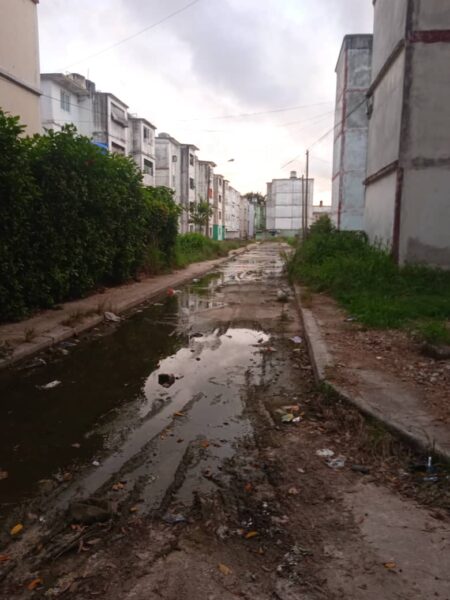
HAVANA TIMES – On the streets of Cuba, the water missing from taps floods the asphalt. It is a daily, exasperating paradox that hundreds of Cubans face. While many people suffer from a severe shortage of drinking water, thousands of liters of this precious resource are lost without control, seeping through a web of broken pipes and turning into foul-smelling streams that run downhill. This is a systemic problem and proof of an issue that remains unresolved to the point of being normalized as part of the urban landscape.
A photograph of any given day
The scene repeats itself with only minor variations across the island. In the Havana municipality of El Cerro, water gushes out onto Armonía Street, flooding the roadway and creating a stream that residents must navigate just to enter their homes. Paradoxically, inside those homes, families ration every drop stored in tanks and plastic containers with military rigor. “Many times the water fails to come on the day it’s supposed to. The saddest thing is that the streets are flooded. Why don’t they fix the leaks?” demands Asiel Lopez, a resident of the Palatino neighborhood.
A similar scene plays out in San Miguel del Padron, where a social media user documents a leak on Gabriel Street that, he claims, has existed “since I was a child.” With resigned sarcasm, he comments: “Any neighborhood in Cuba that doesn’t have a street with leaks is not a neighborhood that earns respect.”
The persistence of leaks is not a recent development. The problem has deep roots stretching back decades. As far back as the 1970s, the ICAIC Latin American Newsreel, directed by Santiago Alvarez, used its critical lens to point out systemic failures. Reports from the time showed and denounced, among other things, “the leaks that turned the streets of the Marianao municipality into rivers.”
These journalistic broadcasts, compiled years later in the documentary Noticias (1991) by Lorenzo Regalado, revealed something fundamental: what was presented as isolated problems or failures of “mid-level officials” was, in reality, a systemic and structural failure. The so-called “constructive criticism” from within the system demonstrated its own failure when it collided with an unchanging reality: the problems were never fully resolved.
The vicious circle of decay
The collapse of water infrastructure is multi-causal, a Gordian knot where decades of underinvestment, mismanagement, and material constraints are tightly intertwined.
The first problem is the existence of obsolete infrastructure and the lack of maintenance. Experts point out that Cuba has turned its back on its hydraulic infrastructure for nearly 40 years. The system depends on pumping stations and motors that, due to countless leaks, must operate almost 24 hours a day just to maintain minimal pressure in the network, accelerating their wear and tear.
Authorities acknowledge that in Havana between 40% and 50% of the pumped water is lost—a figure that at times reaches 70%. This means that out of every ten liters that are treated and pumped, up to seven never reach a tap. Repairs are usually temporary and of low quality. There is also an operational disconnect between the Water and Sewage companies and the Road repair company. A street may be repaired to seal a leak, and weeks or months later the asphalt must be torn up again to fix a new break, in an endless cycle that consumes resources and patience.
The consequences are inevitable
The impact of leaks goes beyond the simple waste of water. They trigger cascading crises that affect national life on multiple levels.
Standing water in the streets becomes an ideal breeding ground for mosquitoes, increasing the risk of spreading diseases such as dengue and the Oropouche virus. There is also the constant danger of contamination of drinking water sources.
On the other hand, the constant flow of water undermines the foundations of streets and sidewalks. Leaks and potholes have a symbiotic and destructive relationship: water opens holes in the asphalt, and the holes, in turn, further damage pipes.
In addition, the resulting water scarcity forces families to spend enormous sums of money on a resource that should be public and accessible. On the informal market, the price of a tanker truck of water can reach 25,000 Cuban pesos (more than 55 dollars), equivalent to several months of a state salary.
The severe inability to resolve a visible and tangible problem also undermines the credibility of institutions. Neighbors express their frustration as they watch other projects—such as hotels—take priority while their streets are flooded.
The current crisis
The situation in 2025 is particularly dire, described by the government as “very complex.” More than three million Cubans—nearly a third of the population—are directly affected by water shortages. In Santiago de Cuba, the country’s second-largest city, some residents receive water only once every 15 days, while some eastern communities have gone as long as five months without regular service.
Drought, a cyclical factor in Cuba’s climate, exacerbates but does not by itself explain the emergency. Reservoirs such as the Zaza dam are at a minimal fraction of their capacity. The crisis is, above all, one of infrastructure and management. Momentary solutions, such as the delivery of water by tanker trucks, often border on the absurd: tanker trucks have been documented delivering water while, ironically, leaking from their own tanks.
The solution that never arrives
Despite official recognition of the problem and announcements of multimillion-peso investments—five billion pesos were mentioned for more than 300 projects, the public perception is that results never materialize.
The real obstacle, analysts point out, is that the solution requires massive, comprehensive, and sustained investment, not isolated repairs.
Cuba’s water leaks are more than technical breakdowns; they are symptoms of a broader state of affairs. They speak to the chronic postponement of maintenance, the gap between rhetoric and reality, and the normalization of dysfunction. Every flooded street is a reminder that the country is wearing down, drop by drop, while its inhabitants learn to live with the paradox of abundance in public spaces and drought in their homes.