
Cuba Still Awaits the Unlikely Miracle of Fish
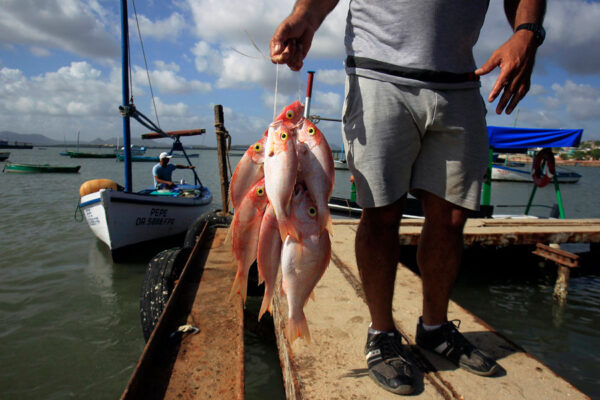
HAVANA TIMES — More than two years after Vice Prime Minister Jorge Luis Tapia Fonseca urged Cubans to raise fish at home for their own consumption, the idea continues to generate more jokes than family lunches.
Comedians and influencers have made sure of that, periodically sharing memes and reels about the proposal, which left one of the few officials who still enjoyed a measure of public prestige looking ridiculous.
What is striking, however, is that the proposal itself was not devoid of logic. In many Asian countries, small-scale aquaculture provides significant volumes of high-quality protein at low cost. It is a model the United Nations has spent decades attempting to replicate in the rest of the developing world. Even in Cuba, the World Food Program has coordinated projects along these lines.
The problem with Tapia’s idea lay in the very same factor that has doomed virtually every food-production initiative promoted by the Cuban government in recent decades. The authorities offered only the idea. Those interested were expected to secure the resources to carry it out, without government support or even basic tax incentives to encourage foreign or private investment.
The same thing had previously happened with pig farming and rice cultivation, two activities that suffered dramatic declines in the second half of the 2010s. Authorities had slashed fuel and other resource allocations almost to zero without offering alternatives to producers. What did not fail to materialize — as later with aquaculture — were political exhortations to produce more.
Despite the Bans
In 2018, the most recent comprehensive study of marine fishing resources carried out in Cuba revealed that 79.6% of those resources were “overexploited” or “collapsed.” The article, published in the Cuban Journal of Fisheries Research, also warned about the continued use of inadequate fishing gear and the violation of seasonal bans. Of the nine zones into which the archipelago’s 57,400 square kilometers of coastal shelf are divided, all of those on the northern coast showed alarming levels of overexploitation.
The country’s first fishing law, enacted in July 2019, did little or nothing to change that reality. Lacking funds for ecosystem-recovery or environmental-education programs, the authorities’ only remaining options have been to toughen penalties for illegal fishing and expand moratoriums. One of the latest was the ban on the Creole grouper, whose capture was fully prohibited for five years in December 2024.
The measure seeks to rescue the species from the “collapse state” identified by specialists, but doing so removes from Cuban kitchens a fish with numerous popular recipes and even recognition in gourmet cuisine.
Not even state-run fishing companies have escaped the crisis. Their catches — the most significant in terms of volume — are primarily destined for export, with lobster and shrimp as flagship products. Since 2019, their exports have fallen by 73% by 2023, the most recent year for which official statistics are available. Only high international prices helped soften the blow to some extent.
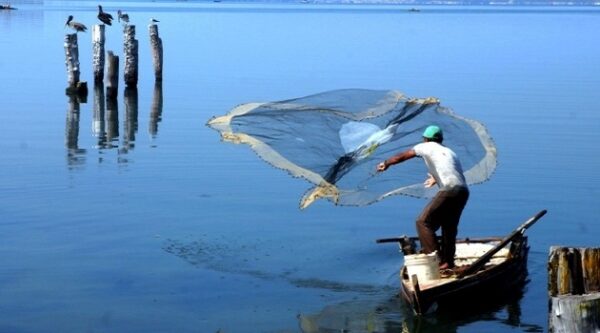
In the Absence of the Sea…
Four times a week, Raciel boards the train that leaves Camagüey before dawn toward the coastal municipality of Santa Cruz del Sur. That is how another of his workdays begins, stretching until six or seven in the evening, when the train returns to the city with dozens of fishermen like him.
Very few of them make the trip all the way to the coast. Most head instead to reservoirs such as La Jía and Jimaguayú, in the southern part of the province. Originally built to irrigate sugar cane and rice, over the years they also became productive aquaculture sites.
Together with a neighbor, Raciel devotes the first months of each year to fishing in these reservoirs. Until May, Cuba goes through the so-called dry season — the period of least rainfall — during which reservoir levels drop due to evaporation and irrigation. The receding waters make fishing easier. These are ideal months for catching species such as tilapia and clarias (catfish), which are in high demand and represent an important source of income for small-scale fishermen like Raciel.
The only issue is that his work operates in the gray zone of “illegality.” Raciel and many of the fishermen who ride the Santa Cruz train have permits for “sport fishing,” which authorizes limited catches theoretically for recreational purposes. The 2019 fishing law made it easier to obtain such documents in hopes of establishing some control over thousands of informal fishermen.
“As such, we are not authorized to fish for sale. Even going to the reservoirs is complicated because the fish there have been ‘stocked’ by workers from the state fishing company, who are the ones supposed to catch and process them. But with the level of hunger out there it is almost impossible to enforce full control. At most, the police check our papers now and then and make sure there isn’t too much trafficking of marine species, which are the ones for export,” Raciel explained.
Although Cubans traditionally preferred saltwater fish over freshwater species, the country’s economic crisis long ago forced those preferences to be set aside. “People buy whatever there is. And fish is cheaper than other proteins,” he added.
A pound (460 grams) of catfish commonly sells for under 250 pesos on the informal market. The same amount of ground chicken costs at least 260 pesos, chicken meat from 370 to 400 pesos, and pork over 650 pesos. Such differences matter in a country where the legal minimum wage is 2,100 pesos (under $5 USD) per month and the average monthly wage closed out 2025 at around 6,700 pesos. ($14 USD).
Even so, the trade in aquaculture species depends on the annual stocking that provincial fishing companies are supposed to carry out. Stocking requires investments that many companies cannot afford. And catches by fishermen like Raciel, which do not generate revenue for them, do nothing to improve their situation.
The idea of expanding small-scale aquaculture sought to ease this scenario by multiplying small ponds on farms and in household patios. It was an idea aligned with international forecasts that only aquaculture (marine and freshwater) will be able to sustain global fish consumption in the future.
With an overexploited coastal shelf, Cuba could find in aquaculture an opportunity to alleviate its severe food shortages. But doing so requires resources the government is in no position to provide — either from its own funds or through others’ investment.