
The Cuban Gov. Without Maduro: Nervousness and Repression
By Yenys Laura Prieto (El Toque)
HAVANA TIMES – A sign of the Union of Young Communists burned in full view on Cuba’s Central Highway. The video of the intentional arson quickly went viral on social media. The images, recorded in Güira de Melena, join a series of symbolic acts rejecting state propaganda in a context of deep crisis.
Meanwhile, President Miguel Diaz-Canel has insisted in several speeches on sacrifice and the defense of the Revolution, recalling a war-focused tradition inherited from Fidel Castro that seeks to hold the population together around the idea of a permanent threat. Added to this is the fact that in recent hours repression has intensified. At least two young people were arrested for their social media posts, as well as several activists. It was also made known that the intellectual Jose Gabriel Barrenechea was sentenced to six years in prison after participating in a peaceful protest in November 2024.
On the other hand, activists and independent journalists identified State Security officers involved in arrests, interrogations, and forced exile of dissidents during the livestream of the funeral of the 32 Cuban military members killed in Venezuela. Among them, artist Hamlet Lavastida pointed to “Darío,” responsible for his arrest and subsequent expulsion from Cuba together with writer Katherine Bisquet.
Journalist Laura Vargas also recognized agents “Juan Carlos” and “Guillermo,” who harassed her before forcing her to leave the country. These complaints underscore a systematic pattern of repression against those who exercise freedom of expression on the island. After the first denunciation, new testimonies have come to light.
At the same time, the humanitarian crisis is worsening. Food shortages and unaffordable prices in national currency contrast with the regime’s proselytizing priorities, which continue allocating resources to organizing events such as the international congress “60 Years After the Tricontinental,” which brought together more than 200 guests.
A few days ago, the United States Government’s donation for families affected by Hurricane Melissa was received by the Catholic Church in Santiago de Cuba, avoiding the direct intervention of the State. Official propaganda insists on describing the assistance as a “political maneuver.” But the truth is that the affected families need urgent help beyond speeches. Testimonies from eastern Cuba reflect the precariousness of several communities engulfed in extreme poverty after decades of state neglect.
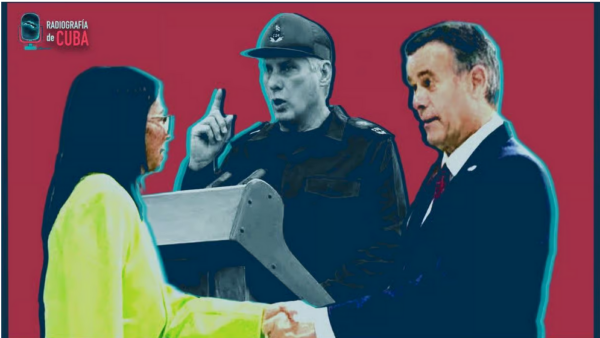
The island’s foreign policy has not gone unnoticed either. While the Cuban regime maintains its discourse of “solidarity” with Venezuela, the United States is intensifying its influence in Caracas. This week a high-level meeting was held between the CIA director and interim president Delsy Rodríguez. Inside Cuba, authorities reinforce a narrative of war and sacrifice to combat an external enemy, minimizing their own responsibility for the economic crisis and political repression — factors that have fueled the growing mobilization of civil society to demand rights.
The militarization of daily life, as well as the insistence on collective sacrifice, reveal an ethical and political dilemma running through all Cuban society.
First published in Spanish by El Toque and translated and posted in English by Havana Times.