Wildfires and the Unsustainable Forestry Model in Chile
Where is Gabriel Boric’s environmentalist government?
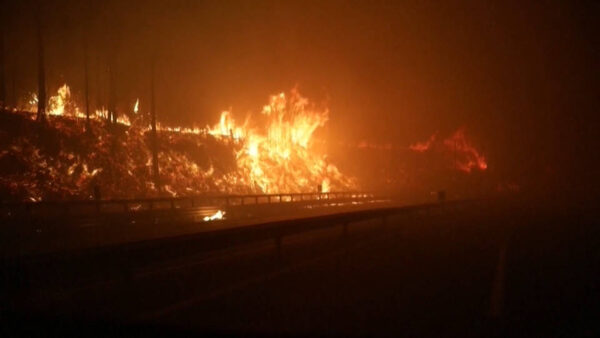
HAVANA TIMES — In light of the tragic wildfires in south-central Chile, which have forced thousands of people to evacuate and have left at least 20 people dead so far, it has once again become evident that these environmental catastrophes are no longer exceptional events but have become recurring. We must take serious responsibility and act proactively in response to structural causes that go far beyond the question of intent in the spread of the fire.
The state of catastrophe declared by the President at dawn for the regions of Ñuble and Biobío is, without a doubt, the correct measure to confront the immediate emergency. However, as long as there is no serious discussion about the forestry model that has been in place in the area for decades —based on the monoculture of pine and eucalyptus, highly flammable and risky in the context of the climate crisis (high temperatures and strong winds)— we will continue covering our eyes and focusing mainly on criminality or security concerns, while ignoring the deeper causes.
It is difficult to understand how a government that portrayed itself as Chile’s first environmentalist administration has done so little on this matter in recent years, after repeating during the campaign its commitment to the environment, to water as a public good, and to climate justice. That is why, when observing the response to this emergency —and especially what has not been done in four years— an uncomfortable and unavoidable question arises: where did that environmental commitment go?
President Gabriel Boric can argue that in October 2025 he launched the 2025–2026 Action Plan for the Prevention, Mitigation and Control of Forest Fires, with an investment of more than 160 billion pesos (a significant increase compared to previous seasons. However, it is evident that this plan, no matter how many resources it incorporates, is incapable of stopping fires of this magnitude. The problem does not lie in a lack of budget, but in the absence of political will for real prevention that includes a debate on the unsustainable forestry model.
As a result, the extractive forestry model —inherited from the Pinochet dictatorship and deepened during democracy— remains intact. The government has not taken concrete measures to halt the monocultures of pine and eucalyptus, which continue to occupy millions of hectares in the country’s south-central region. These fast-growing exotic species consume water excessively and act as true torches in a scenario of chronic drought and global warming.
This is particularly disappointing for those of us who supported this government —in my case, from within the Broad Front— to see that, after the devastating fires of February 2023, the President raised the need to “debate the forest industry model”, but in practice nothing has been done about it. A historic opportunity was lost to repeal the law on Forestry Development, whose validity has only encouraged the expansion of monoculture, prioritizing investment over ecosystem protection and limiting the discourse on prevention to operational measures, without addressing structural causes.
While firefighters risk their lives amid hell and families lose everything, the so-called environmentalist government seems reduced to declaring states of catastrophe, deploying the Army and appealing to individual responsibility (“99% of fires are caused by humans”). It is true that human negligence plays a key role, but isn’t it also structural negligence not to have transformed into a model that we know fuels these catastrophes?
The point is not to blame President Boric exclusively, but to demand coherence from someone who presented himself as an agent of transformation. A government that calls itself environmentalist cannot limit itself to fighting fires once they appear; it must prevent them by dismantling the conditions that make them possible. That implies questioning extractive forestry and moving toward a productive matrix that does not sacrifice entire territories for the profit of a few.
In his defense, the President may mention that his government pushed —since October 2023— a bill on the prevention of forest and rural fires, which remains stalled in the Senate. While this initiative represents a necessary step in terms of prevention and shared responsibility (especially for private actors and forestry companies), it is tremendously insufficient if it does not address the extractive forestry model that exacerbates mega-fires at their root.
Achieving this requires a serious long-term plan, beyond campaign slogans. Calling oneself “the first environmentalist government” remains an empty slogan if it does not translate into a real and urgent shift toward transitioning away from the current forestry model. Until that profound change occurs, these enormous wildfires will not merely be warnings, they will be our future.