
Venezuela: Amnesty Law for Political Prisoners Announced
Delcy Rodríguez also said the feared Helicoide prison is to close
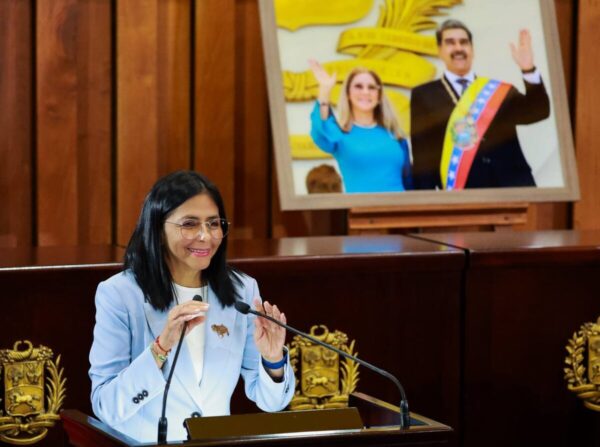
Rodriguez said the proposed law excludes those charged with or convicted of homicide, drug trafficking, and human rights violations.
HAVANA TIMES — Acting Venezuelan president Delcy Rodríguez announced that she will present to the National Assembly a general amnesty law to release political prisoners detained from 1999 to the present, a period that covers consecutive Chavista governments.
“I want to announce that we have decided to promote a general amnesty law that covers the entire political period of political violence from 1999 to the present,” Rodríguez said at the opening ceremony of the judicial year at the Supreme Court, broadcast on the state channel Venezolana de Televisión (VTV).
Rodriguez tasked the Commission for Judicial Revolution and the Program for Coexistence and Peace with presenting the bill to the National Assembly in the “coming hours,” as well as offering the legislature their “maximum collaboration” for its approval.
“Let it be a law that helps repair the wounds left by political confrontation, by violence, by extremism; that helps redirect justice in our country and helps restore coexistence among Venezuelans,” she added.
She called on the country’s political prisoners, including those who have already received release measures, to ensure that “revenge, retaliation, and hatred do not prevail.”
Rodriguez indicated that this proposed law excludes those prosecuted or convicted for homicide, drug trafficking, and human rights violations.
Proposal from the Committee of Mothers for the Truth
Various NGOs have insisted for years on a general amnesty for all political prisoners, while also submitting several draft laws. The most recent was proposed last Tuesday by the organization Surgentes and the Committee of Mothers for the Truth.
The NGO and Committee text included 12 articles and proposed amnesty for “all those people who have been persecuted — social activists, journalists, members of victims’ committees, military personnel, and people persecuted or deprived of their liberty in the context of post-election mobilizations.”
At the beginning of the month, a parliamentary faction in Venezuela also put forward an amnesty law intended, it argued, to bring “relief” to the families of people “who are unjustly detained.”
Currently, according to the NGO Foro Penal, there are 711 political prisoners, but the Venezuelan government has denied that people are detained for these reasons, stating that those arrested committed crimes, mostly related to terrorism.
The last time an amnesty law was enacted in Venezuela was in December 2007, when the late president Hugo Chávez (1999–2013) pardoned people involved in the 2002 coup attempt against him.
In 2016, the Parliament — then controlled by the opposition — approved an amnesty law that was declared unconstitutional by the Supreme Court, which is aligned with Chavismo, and it was never implemented.
In August 2020, Venezuelan president Nicolas Maduro granted, by decree, 110 pardon measures to opposition members, union leaders, and social actors accused of various crimes, ahead of legislative elections held in December of that year — an event in which most of the opposition did not participate.
First published in Spanish by Efecto Cocuyo and translated and posted in English by Havana Times.