
The Counter-Reform in Cuba
It was not the reformers who suggested allocating a disproportionate portion of state investment to building empty hotels in the midst of the crisis.
By Ruben Padron Garriga (Joven Cuba)
HAVANA TIMES — Reform, revolutionize, stay where we are, return to the past… the debate of the moment once again revolves around these options, this time revived by the remnants of Stalinism, which in recent years have added a small number of followers to their ranks.
The term “centrist” has now been transmuted into “reformist,” but with the same objective: to eliminate anyone who does not uncritically reproduce the party line message of returning to the past. And although this idea continues to be painted as revolutionary, it only takes a brief look to see that it is a conservative class trying to preserve its status and privileges.
Some of its most public faces say that “reform” is what brought us here. That it was the “reformists” who turned us into the country we are today, with people “dressed up as beggars” asking for money in the streets, with no medicines in pharmacies, and with a population that has shrunk by more than a million in recent years.
However, the reform they so often point to as the cause of our ills — and which they call to counteract — exists only in the twisted minds of those who want to see it, or who want to use it to frighten others.
A reform, conceptually speaking, requires an integral character, with clear actions, timelines, and procedures. Ideally it should be preceded by consultation with experts and citizens and followed by evaluations and adjustments that allow distortions to be corrected quickly along the way.
Therefore, what has been done in Cuba have not been reforms, but isolated measures, most taken in moments of desperation and because no other remedy remained.
That is what happened with the expansion of the private sector, promoted in the Guidelines of the Sixth Communist Party Congress in 2011 and their 2016 update, later ratified in the 2019 Constitution.
Something similar occurred with the so-called 2021 “Monetary Ordering,” which eliminated the CUC but failed to achieve sustainable currency unification and instead led to a multiplicity of exchange rates — formal and de facto — along with greater partial dollarization of the economy. The same happened with the authorization of some small and medium private businesses, in the months following the July 2021 protests that shook the Island, amid desperation caused by shortages of food and basic goods, in a context where the state clearly dominated formal distribution channels.
But none of these measures — while they have changed many life dynamics — have untied the Gordian knots of Cuba’s internal economic policy, which remain intact: the lack of autonomy and bureaucratization of state companies, and, in parallel, the obstacles and excessive controls weighing on the private sector.
As a consequence, we have an increasingly meager national production, a market dependent on imports of finished goods, and galloping inflation that daily erodes Cubans’ purchasing power.
The Enterprise Law was one solution to the first knot, and it remains indefinitely postponed. In the last session of the National Assembly it was not even discussed. Meanwhile, the private sector continues subject to the whims of decrees that appear and are then shelved, and to currency markets that are proclaimed but arrive filled with fine print and restrictions.
On the other hand, the so-called plan to “correct distortions,” supposedly in implementation for a year — and which in some way constituted an attempt at reform — when it was finally published received so much criticism from economists and citizens that the government itself was forced to open a popular consultation to, literally, correct distortions… in a plan meant to correct distortions.
Another claim raised these days is that those of us who advocate for comprehensive economic reform fail to give that reform concrete content. But, to cite just one example, in 2025 La Joven Cuba published a dossier in which nine economists with multiple worldviews collaborated, making highly varied proposals.
That material put forward concrete actions such as eliminating ministerial subordination of enterprises; establishing dual pricing systems; redirecting public investment from tourism toward agriculture, manufacturing, and energy infrastructure; reducing taxes on food producers; removing intermediaries and granting them soft credit, among others. Likewise, there were many proposals in journals such as Economía y Desarrollo or Ekotemas, published by state institutions, there are many others.
So it is false that today’s problems in Cuba stem from the proposals of those now labeled reformists. The voices of the counter-reform want to fight against a non-existent reform. The problems we have — in addition to an external economic war we cannot control — stem precisely from not implementing reforms in an integral way and instead taking desperate measures when the water is already at our necks.
Even in the language of Cuba’s most visible politicians there are enough examples of reformist discourse. When Miguel Díaz-Canel speaks of a “change of mentality” or of “doing things differently,” what is he referring to? But of course, our counter-reformists are not brave enough to confront people with political power; they prefer to attack intellectuals and journalists, whom they assume have less capacity to defend themselves.
It was not reformists who suggested allocating a disproportionate share of state investment to building empty hotels in the midst of crisis; nor did they propose dollarizing state stores where basic goods were sold, while supply in Cuban pesos practically disappeared.
Nor were we the supposed “centrists” who halted the Enterprise Law, nor who carried out a deeply flawed Monetary Ordering at the worst sanitary (Covid) and economic moment. All this with the complicit silence of the supposed ultra-revolutionaries; for them, at the time, all of that was “within the Revolution.” Some even labeled critics “counterrevolutionary.”
And here I will analyze the last point of their crusade. They repeat that Revolution is the best alternative to reform. And yes, the slogan Reform or Revolution? sounds very nice and radical at an “encounter of emancipatory paradigms.” But those who raise the banner of Revolution in Cuba almost never fill it with content or form. What revolution are they talking about? Because the 1959 Revolution built a new State, institutionalized, with a new Constitution and representation — as a State, not as a Revolution — in multilateral bodies.
So do they want to eliminate the current State? Revolution of whom against whom? Revolution to change what and how? These are questions whose answers evade any real discussion.
Even the author of the phrase Reform or Revolution, Rosa Luxemburg, although she assumed revolution as the ultimate goal, also recognized the role of reform in improving the living conditions of the masses. And her work must be understood in a context where the end of capitalism seemed imminent — something history proved was not so. Mechanically transplanting decontextualized phrases from her thought into today’s Cuba is an act of intellectual dishonesty.
Even the German thinker, emphatic about reform’s limitations, understood it as the political school of the proletariat and a bulwark against the barbarism of unregulated capitalism — which, though it did not solve the problem, created better conditions for its eventual resolution.
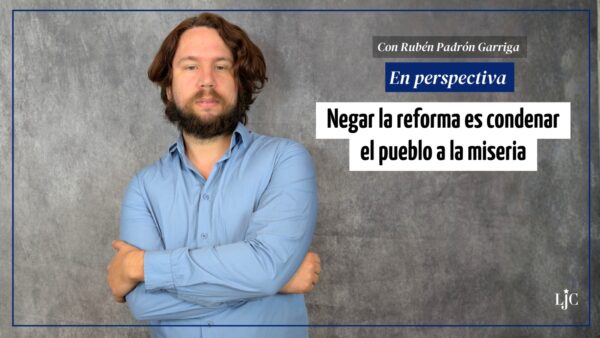
Therefore, denying reform today in the name of ideological purity, when no truly revolutionary alternative exists to offer, is not defending socialism — it is continuing to condemn the people to misery under the cynical disguise of resistance.
Meanwhile, openly reformist governments such as Lula da Silva’s in Brazil or Morena’s project in Mexico — despite their limitations and contradictions within capitalism — have, through public policies, wage increases, and social programs — classic tools of reform — tangibly improved living conditions for broad sectors of the population. Should they then be condemned for “not being revolutionary?
The counter-reformists also say that in the face of problems, the answer is “more socialism.” But they do not specify: which socialism? The one we copied from Eastern Europe that devolved into authoritarian capitalism? Or the Asian model that, through reforms, has managed to perfect itself and turn Global South countries into economic powers displacing Western ones?
It is paradoxical that Vietnam celebrates preparations for its Congress by consolidating its Doi Moi policy and displaying sustained macroeconomic results, while the Communist Party of Cuba has been forced to postpone its own, because the crisis is so severe it has nothing credible to show for triumphalist headlines.
In Cuba’s current state, doing nothing — or acting slowly, disjointedly, and reactively — is the worst option. There is consensus across the population, even within part of the political leadership, that the same actions cannot yield different results. The question is where we move and how. And empty labels like “toward socialism” are useless if that path is not filled with content.
But to act also requires consensus and democratic mechanisms for decision-making. Otherwise, everything devolves into factional warfare. And the truth is that attempts from within institutional spaces to “revolutionize” (so as not to say reform) the “revolution” (so as not to say the State) have also failed. The proof lies in spaces created or permitted for this purpose, such as La Comuna or Los Pañuelos Rojos (The Commune or the Red Bandanas). Even with their sanitized selection — which de facto excluded social democrats, Trotskyists, and other uncomfortable expressions within Cuban progressives — they could not sustain articulation, much less drive changes in domestic policy.
Therefore, economic reform also requires political reform. This does not necessarily mean transitioning to a multiparty model under the current conditions, but it does mean opening spaces for participation and deliberation — not merely “consulting” citizens, but creating sustained mechanisms to link their proposals to decision-making. But of course, this does not appeal to those very comfortable today making policy from their offices or their cars with the windows rolled up.
So those excluded, ignored, and affected are left only with social media or independent media to audit and point out the disastrous results of implemented policies. And yes, we will continue proposing reform as the only path to restore, amid growing international adversity, a measure of hope and dignity to the Cuban people.
The alternative — remaining where we are — is to sink into the abyss, more slowly or more quickly, but without salvation. The worst thing that can happen to a supposedly revolutionary discourse is that it becomes the justification for the conservative or stagnant policies that have brought us to this point.
If one seeks a historical analogy, the neo-Stalinist counter-reform resembles, in logic, the Catholic Church’s Counter-Reformation against the Lutheran Reformation. It was not merely a theological dispute, but a power operation to preserve authority, discipline dissent, and fix the limits of what could be said.
The difference is that our counter-reformists have no fear of reprisal. So they resort to their contemporary equivalent: lies, defamation, and manipulation, hoping the State will activate its repressive mechanisms against the supposed reformists.
They do not seek debate, but silence. And they do so because in the realm of ideas, arguments, and practical evidence, they clearly lose. So they bet on shifting conflict from public reason to political sanction.
But Cuba cannot afford to keep exhausting itself in factional skirmishes. While all this unfolds, there are people with only two hours of electricity a day — and a fascist waiting for the Cuban political system to collapse under its own weight, or from external pushes.
If the goal is truly to “defend socialism” or simply to save the country, the path does not lie in manufacturing internal enemies to return to the past, but in assuming responsibilities, debating viable solutions, and opening space for changes that can help build a future where we move from mere survival to the promised well-being.
First published in Spanish by La Joven Cuba and translated and posted in English by Havana Times.