Venezuelan Students Demand Release of Political Prisoners
protests in numerous cities
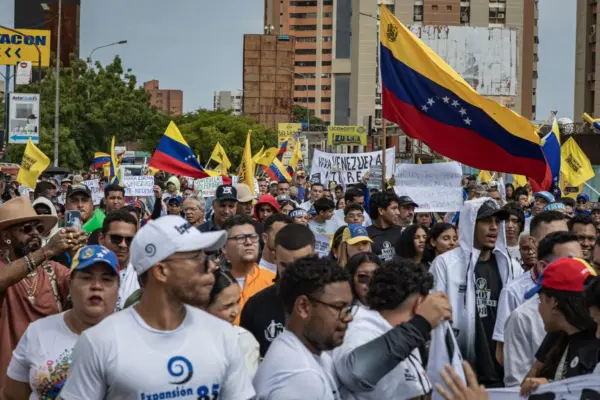
Venezuela’s Parliament, controlled by Chavismo, postponed the final debate needed to approve the amnesty law.
HAVANA TIMES — Venezuela’s Student Movement marched on Thursday, February 12, 2026, in several cities across the country to demand freedom in their nation and for all political prisoners, on the same day the second debate on the amnesty bill promoted by the interim government had been scheduled.
On the occasion of National Youth Day, hundreds of people gathered at the Central University of Venezuela (UCV), the country’s main university, where student leaders and citizens mobilized both inside and outside the campus in Caracas, in what represents one of the largest opposition demonstrations in just over a year.
“Not one, not two — all of them,” chanted demonstrators, referring to the political prisoner release process that began on January 8, through which the NGO Foro Penal has verified 431 releases as of February 10, while estimating that more than 600 remain imprisoned.
Miguel Angel Suarez, president of the Federation of University Centers of the UCV, said they will continue pressing “until all civil and political rights are restored,” while calling for “an end to persecution” and for “guarantees” that would lead the country toward a “democratic transition.”
Students from the Simon Bolívar University and Andres Bello Catholic University also took part in the march, along with activists and relatives of political prisoners, who carried photos of detainees and banners with messages such as: “This February 12 is not war to the death, it is peace” and “Shut down the torture centers.”
Hiowanka Avila, sister of prisoner Henryberth Rivas, detained since 2018, called for “all cases to be taken into account” for the amnesty and warned in statements to EFE that the current bill “is excluding more than 400 political prisoners.”
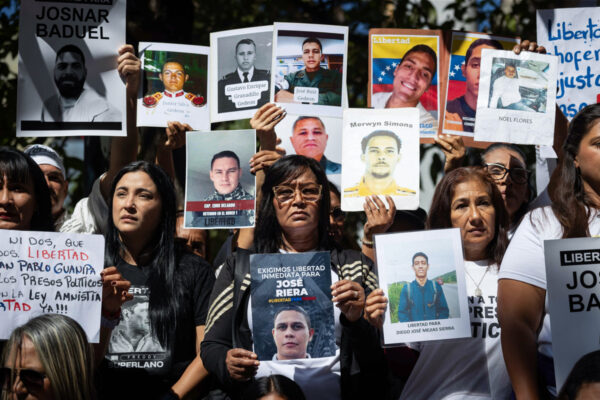
In Maracaibo, capital of Zulia state, students from the University of Zulia (LUZ) also marched and demanded to be included in the amnesty debate.
Yeissel Pérez, president of the Federation of University Centers of LUZ, questioned the fact that youth leadership was not invited to the public consultation on the bill, in which academics, NGOs, and relatives of political prisoners did participate.
The student leader said students have “a lot to contribute” and hopes that “spaces for debate will be opened” to everyone.
On social media, marches were reported in states such as Monagas (east), Tachira (west, bordering Colombia), Trujillo (southwest), Cojedes (central), and Aragua (north).
Youth Day is celebrated in Venezuela on February 12 to commemorate the historic Battle of La Victoria in 1814, during the war of independence.
It is the first protest call since January 9, 2025, when the last demonstration took place — before opposition leader and Nobel laureate María Corina Machado went underground — in Caracas.
These protests are taking place as US Energy Secretary Chris Wright tours facilities operated by Chevron in Venezuela.
Final Debate on Amnesty Law Postponed
Venezuela’s Parliament, controlled by Chavismo (in power for 27 years), postponed until next week the second and final debate required to approve the amnesty law for political prisoner cases dating back to 1999, due to disagreements over an article requiring those prosecuted or convicted to appear before the courts.
During the session, the National Assembly approved up to article six of the Law of Amnesty for Democratic Coexistence.
Discussion stalled at the seventh point, whose draft states that amnesty applies to all persons who are or may be “prosecuted or convicted for their alleged or proven participation in crimes or offenses committed,” provided they “are in compliance with the law or submit themselves to the law after the regulation enters into force.”
Opposition lawmaker Luis Florido, from the Libertad faction, said the article should be modified because, in his view, requiring individuals to appear before the courts implies labeling them as guilty if they are under judicial proceedings.
Chavismo lawmakers, meanwhile, argued that the Constitution establishes that individuals must be present in criminal proceedings.
Pro-government deputy Jorge Arreaza, leader of the commission in charge of the bill, proposed postponing “discussion of the remaining articles to avoid falling into unnecessary debates” and to “maintain the necessary climate of conciliation.”
He also said he hopes the regulation can be approved in the next session.
The commission’s vice president, opposition lawmaker Nora Bracho, also proposed postponement in order to “continue debating and discussing this article (seven).”
Among what was approved during the Thursday, February 12, 2026 session, the future law grants “a general and full amnesty for crimes or offenses committed and occurring within the framework of the events and time period” established in the text, with the aim of “promoting social peace and democratic coexistence.”
This amnesty bill is part of a “new political moment,” announced by interim president Delcy Rodríguez, in the context of a prisoner release process that began on January 8, 2026.
Published in Spanish by Confidencial and translated and posted in English by Havana Times.