
I Also Want to Be Messi
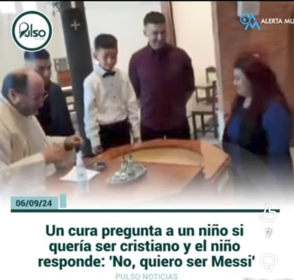
HAVANA TIMES — A child’s baptism went viral when, asked by the priest whether he wanted to be Christian, the child replied: “I want to be Messi.” Of course, everyone laughed at the response of the child about to be baptized—the priest included—along with those of us who watched it on our screens.
Right after seeing it, I said to myself: “I also want to be Messi.” But, to my regret, I remembered that the context into which I was received in this physical existence—where I was raised and where I still live—would not exactly laugh. They would probably punish me. Because in my socialist homeland, the common good takes total precedence over the individual, and therefore desiring the latter is not very well regarded.
In Cuba, mental patterns have to be very well settled, clearly defined. There are many enemies out there who want to invade our invaluable Sovereignty—from politics, which permeates everything (very few matters escape it; even friendship can be included, and love as well), down to that cell of society that can be large or small, such as the family. You are not (born) to want anything. You are here to fulfill your social duty, and God forbid you question even a bit. “Otherwise (if it doesn’t suit you), you have to rise up and overthrow Fidel like he did Batista,” they used to say to those before my generation. For those of us who came later, the response was less bellicose: “You have to leave here.”
That last option became the final decision. No one overthrows anyone; everyone tries to leave however they can. Those of us who couldn’t or don’t have the courage to go and live somewhere else feel happy when we hear that people make it. We mourn, of course, for those who remain trapped in the seas and the jungles.
And it may not seem like it, but in reality living in a world where you are not allowed to be what you decide to be is tremendously difficult. Some people cannot manage it and even prefer not to continue living physically. Even so, the dynamics of history itself are not immutable. For those who leave, for those who cannot leave, for those who want circumstances to change, and for those for whom it suits that nothing be transformed—new events occur. Inside and outside the territory where we live.
It is most likely that changes can indeed happen. Perhaps not in the way one would have liked them to happen, but in some way they will. And perhaps changes not so subtle—things that, for many on the Island, were not so obvious at the time—such as being able to sell your house and your car. Or being able to have a snack bar in front of your house, when for your entire working life that was illegal. Who knows if the changes might be as radical as being able to belong to a political party when there are many parties in the country. Or being able to publish a feminist magazine without it having to belong to the FMC (Federation of Cuban Women, of course part of the Communist State).
Building a society and a culture where those patterns do not conceive of existence in such a rigid way is one of my dreams. So much so that if asked whether you want to be Christian, you could answer without fear: “I want to be Messi.” No one would be hurt by it. Because it would be understood with complete certainty that the other is not a threat or a danger. Wanting to be—within a freedom that respects others—should not be an offense to anyone.
Read more from the diary of Lien Estrada here at Havana Times.