The Daily Challenge of Cuba’s Trashed Streets
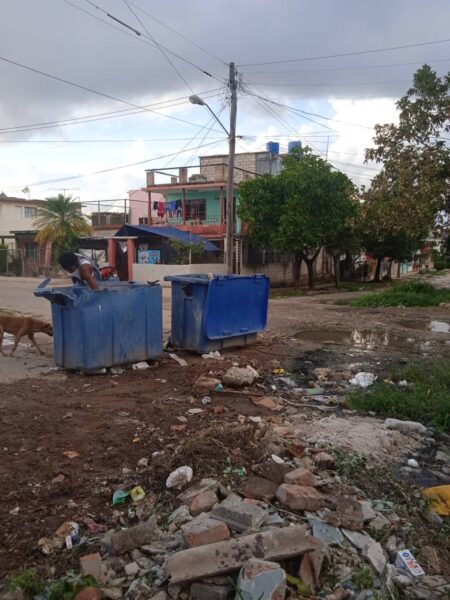
HAVANA TIMES – The workday begins with a scene that is repeated daily: mountains of accumulated garbage on the corners, sidewalks and yards, drowning any idea of urban order. Torn bags, food waste, discarded furniture and dead animals make up a landscape that no longer surprises, but that continues to be alarming. The sanitation problem has become a constant fact of urban life.
Far from fulfilling their basic function, the streets present a panorama of enormous deterioration. Deep potholes, extensive cracks, and impassable sections force pedestrians and drivers to improvise new routes. After every rainfall, the uneven surfaces turn into puddles of stagnant water that remain for days, weeks, and months, fostering the proliferation of mosquitoes and increasing the risk of disease. The lack of drainage and maintenance exacerbates a situation that directly impacts public health.
The accumulation of solid waste is due to multiple factors: irregular garbage collection, scarce resources, broken equipment, and poor urban sanitation management. Meanwhile, the population is forced to live with sources of contamination just a few meters from their homes. Children play near makeshift dumps, the elderly struggle to walk on damaged sidewalks, and people navigate obstacles to reach their destinations.
Beyond the health consequences, unsanitary conditions affect our quality of life and emotional well-being. Walking through the city becomes an exercise in constant alertness, where foul odors, flies, and dirty water are part of the everyday environment. The contrast is even starker in a country renowned for its natural beauty, but where the urban spaces are marked by neglect and disharmony.
Despite this scenario, individual gestures of responsibility persist: neighbors sweeping in front of their houses, people placing stones or boards to help cross flooded streets, community initiatives aimed at mitigating the problem. However, these actions aren’t enough to solve a situation that requires structural and sustained responses.
The unsanitary condition of the Cuban streets is neither an isolated nor a temporary fact of life. It’s a visible reality that demands urgent attention, efficient planning, and institutional will. Meanwhile, the population continues to adapt to an adverse environment, with the vague hope of someday being able to live in a safe, dignified, and habitable space.
Read more of Safie M. Gonzalez’ diaries here in Havana Times.