
A 25-Story Hotel Rises on Havana’s Malecon Amid Tourism Drop
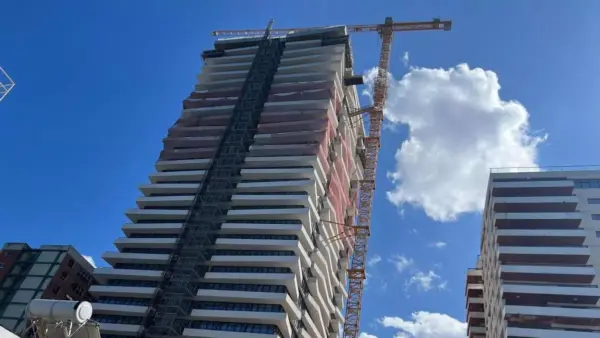
Its construction is being handled by the French company Bouygues and it will have 520 luxury rooms.
HAVANA TIMES – After more than three years of construction, the tower rising at 1st and B Streets, in Havana’s Vedado neighborhood, continues to grow like a foreign body in the midst of a district falling to pieces. The 25-story building is visible from several blocks away and already dominates the coastal strip near the Malecón. The structure appears almost finished on the outside, but the interior remains a flurry of work.
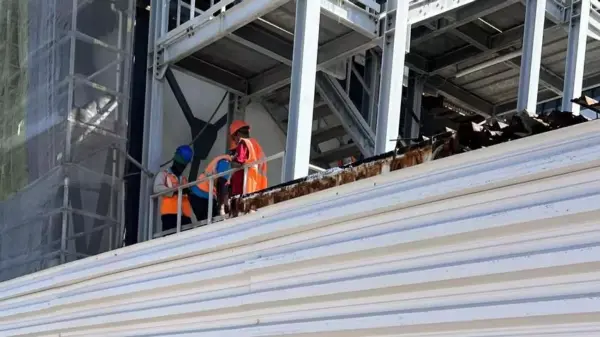
A technician on site told 14ymedio that “the foreign part is from some French company,” and that Indian workers are also involved, though—he said—“more as laborers.” “They’re leaving in December because their work is done,” he added. The architectural dossier for the project confirms that the French construction firm Bouygues—the same one behind most of Cuba’s luxury hotels—is listed as the main builder of the tower. This explains the presence of French and Indian workers on-site.
Bouygues Bâtiment International, a discreet protagonist of Cuba’s hotel boom, has accumulated a history of controversy. The most recent episode was documented by this outlet after Hurricane Melissa. While more than 76,000 homes remain damaged and thousands of families still await assistance, the Antilla Modular Plant, operated by Bouygues, continues running at full capacity to manufacture complete room modules destined for luxury hotels. Added to this was official censorship, as even state media were warned to “forget about” the plant after attempting to investigate its activities.
Unlike other hotels openly promoted by the military conglomerate Gaesa, this tower lacks announcements, billboards, or any public indication identifying its investor, builder, or future operator. The architectural project, announced years ago by the firm that designed it, describes a four-star hotel with about 520 rooms, common areas distributed across a three-level base, and high-standard services including a pool and panoramic terrace.
The technician interviewed by 14ymedio estimates that the project still has “a year and a bit more” to go. Workers are now in the phase of tiling bathrooms and floors, although “all the technology, electricity, and elevators” still remain. One thing he repeated several times was that the building will have “cutting-edge technology, like the Tower K,” one of the state investment program’s flagship projects. “In terms of modernity,” he said, “there’s Tower K and then this one.”
When asked what the hotel will be called, the answer was as predictable as it was unsettling: “No one knows the name; they’ll reveal it when it’s finished.” It is striking that, despite its size and visual impact in the area, no official news outlet has published updates, timelines, or details about the building.
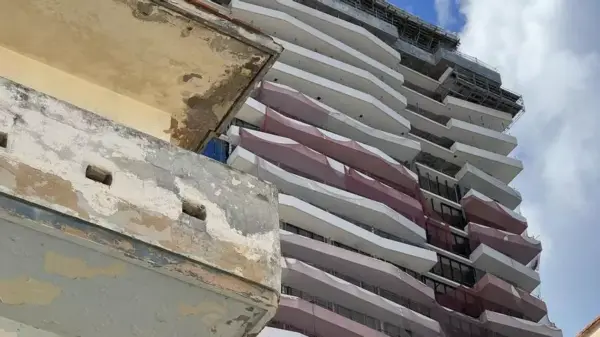
Aware of the contrast, a neighbor walking past the building laughed and said: “Tremendous, asere.” The man, who provided no further details, was referring to the paradox of watching a luxury hotel rise while the rest of Havana collapses. The tower at 1st and B goes up with cranes, foreign labor, and no shortage of materials, while the surrounding houses show crumbling façades and propped-up balconies.
Just steps away, buildings have leaks and large cracks. In a nearby garden, two men slept on the dry grass. The scene, harsh and everyday, reflects the chasm between the official discourse about the “blockade”—supposedly responsible for the destruction of the national economy—and the unstoppable fever for erecting luxury tourist projects at a moment when hotel occupancy is barely 20%.
The skyscraper at 1st and B advances in front of a neighborhood unable to maintain basic infrastructure. A project that brings in Indian and French workers while many Cubans search for ways to survive. Modernity arrives, but not for everyone.
First published in Spanish by 14ymedio and translated and posted in English by Havana Times.
I have previously left a post regarding the building of new hotels and this post will more or less say the same.
Yes, tourists now demand a high specification from their hotel and the rooms that they stay in.
However most tourists visit Cuba, especially Havana, for the the history that Havana has.
I will NEVER understand why the government has not spent the millions of dollars spent on these new plain looking hotels, on some of the fantastic hotels of the past.
These hotels are full of history and the character of them surpasses anything you can get from these new modern structure’s. Just look at Miramar and the hotels that look as if they could be anywhere in the world.
Then look at the Inglaterra Hotel at Parque Centro. A hotel full of character that has been left to go to ruin. Everything is run down with this hotel and the staff are totally disinterested. With a fraction of the cost of building new hotels this hotel could be brought up to modern services and amenities. Other hotels, The Lincoln, where i had the pleasure of staying in the room that Juan Fangio stayed and kidnapped. This hotel is in the process of modernisation but has been going on for years. Will it have the amenities that guests demand….hopefully yes. Other hotels full of history, The Riviera, The Ambos Mundos, Hotel Savilla and many other hotels FULL of character but have not been brought into the modern world. Concentrate on modernising one of these hotels at a time instead of having several “on going” projects
I have been a regular visit to Cuba for 22 years and it saddens me to see the decline of tourism and frustrating to see what could be done to bring tourists back to Cuba. To this day i still enjoy a cocktail on the roof top bar of Ambos Mundos but sad to see that i am the only person enjoy my cocktail
Utterly ridiculous !!!!
What sort of person would want to book a room in this hotel that overlooks crumbling buildings in a city which lacks electricity and food for the poor.
This monstrosity would be a perfect Trump Hotel as part of ending the embargo, leased or managed.
Cuba should understand his Administraton’s transactional dynamic and use it creatively.
The Vietnamese let the Trump Corporation name and build a golf resort near Ha Noi 50 years after the war ended. Many people did not like this misuse of farm land but national economic and security interest (e.g. the China threat) won the day.
https://www.nytimes.com/2025/05/25/world/asia/trump-vietnam-golf-project.html?unlocked_article_code=1.J08.nWo9.XRBxuyqywyks&smid=nytcore-ios-share&referringSource=articleShare