
Cuba Again Linked to Drug Trafficking
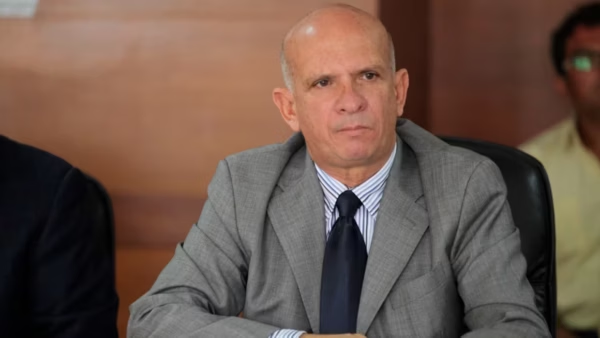
These are serious accusations, even if they may be viewed with suspicion given the precarious position of the person making them.
HAVANA TIMES – The Cuban government insisted on December 7th that it maintains an active and responsible fight against drug trafficking and the illegal use of drugs, after once again finding itself caught up in accusations of ties to that scourge.
Foreign Minister Bruno Rodríguez reminded social media users of the old argument that Cuba has signed various bilateral agreements with several countries, as well as multilateral instruments. But many are calling for much greater transparency, because this involves a direct accusation from someone closely linked to the Venezuelan regime: former intelligence chief Hugo “El Pollo” Carvajal, imprisoned in the United States, who implicated Cuba this week in a letter addressed to US President Donald Trump.
In a three-page letter published by the US outlet Dallas Express and dated December 2, 2025, El Pollo dissects the criminal machinery of the Venezuelan regime and in passing accuses the Cuban dictatorship of being its mastermind.
“I personally witnessed how Hugo Chavez’s government became a criminal organization now directed by Nicolas Maduro, Diosdado Cabello, and other high-ranking regime officials,” says the former general, who was extradited from Spain in 2023 after evading it for several years.
He refers to the Cartel of the Suns, asserting that it was part of a plan suggested by the Cuban regime to Chavez in the mid-2000s, carried out with assistance from the Revolutionary Armed Forces of Colombia (FARC), the Colombian National Liberation Army (ELN), Cuban agents, and Hezbollah.
He also highlights the role of the Smartmatic electoral process-automation system, as well as counterintelligence and espionage activities targeting the United States.
In Cuba’s case, these are serious accusations, even if they may be viewed with suspicion given the precarious position of the person making them — a prisoner possibly seeking mercy.
“The Cuban intelligence service showed me its networks inside US naval bases on the East Coast. They boasted of having sent thousands of spies over decades, some of whom are now career politicians,” Carvajal claims in the letter.
While obtaining a deal to get him out of prison or reduce a potential life sentence in the United States might be a motive to doubt the truthfulness of the accusations, they are not entirely far-fetched.
Amid an intensifying military crisis involving Venezuela, rising regional tensions, and growing US military pressure in the Caribbean, Carvajal’s statements reinforce Trump’s intentions to finally end the Maduro regime.
The Cuban government quickly responded on Thursday — without mentioning the letter or Carvajal’s name — rejecting any connection to drug trafficking in an unusual press conference aimed at containing the political impact of these explosive claims, with statements from high-ranking officials of the Interior Ministry and the Justice Ministry.
Even so, listing border-control actions and presenting figures on seized contraband and individuals punished for drug-trafficking activities does not erase the suspicion that Cuba may have tried to influence its neighboring nation through a strategy of using cocaine as a geopolitical weapon against the United States — because in the war with the northern neighbor, anything goes.
Defending the Cuban government’s international image on this issue has become increasingly complicated since the famous Case No. 1 of 1989, which we recently revisited in these pages.
Carvajal goes further still, alleging that Cuba not only helped devise the strategy but also infiltrated spies into US naval bases and provided weapons, documents, and intelligence cover enabling criminal structures to operate from Venezuelan territory.
For the moment, these are accusations without concrete evidence — and the official narrative relies on exactly that. But conversations that occur in the highest government circles “behind the scenes” can never be proven; it becomes the prisoner’s word against that of those he accuses.
That Havana attacks Washington whenever possible is no secret, but the topic of drugs has always carried an extra degree of sensitivity — especially when chemical substances are now wreaking havoc among young people on the island.
To this must be added the fact that the Communist Party’s Central Committee is closely monitoring the movements of the US fleet in the Caribbean, fearful that at any moment the first cannon shot aimed at Venezuela could be fired — with direct repercussions for Cuba. If Trump decides to take that bold step, they fear Cuba would be next on the list.
The direct involvement of Cuban intelligence in Maduro’s government is undeniable, given that his entire personal security apparatus is overseen from Havana. And whether or not what El Pollo says is true, the shadow of doubt lingers, because this is a country that even trained guerrilla fighters from other nations in order to export the “Revolution.”
As noted earlier, proving any of this is practically impossible, but the reasonable doubt is already in the air.