
Machado Is Working Toward a Transition in Venezuela
in coordination with the US government
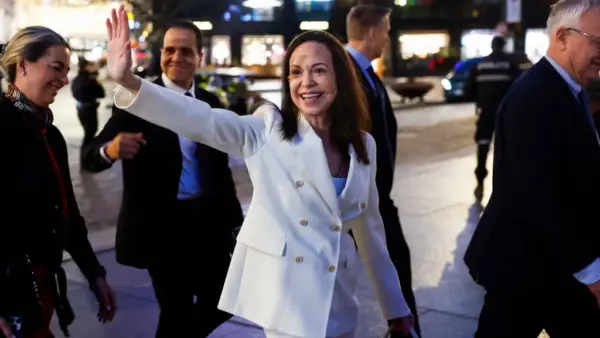
The Venezuelan leader said her country has already been invaded by Russian and Iranian agents, terrorist groups, and cartels.
HAVANA TIMES – Venezuelan leader and Nobel Peace Prize laureate María Corina Machado said on Thursday, in an extensive and heavily attended press conference in Oslo, that the Venezuelan opposition is “working hard” with the US government to explain in detail its plan for a transition, but she denied being involved in the operations the Trump administration is conducting in the Caribbean.
“We are not involved at all in decisions or operations related to other countries’ national security. That’s to say, each country has its own right to legitimate defense, and when they feel their national security is at stake, they act accordingly,” she said.
She also admitted that they are working hard not only with the United States, but with other governments in Latin America and Europe, to explain the plans the opposition has for its “first 100 hours and the following 100 days” in power in a country facing “a multidimensional crisis.”
In her view, this is “not only a humanitarian crisis, but also a financial crisis, a public services crisis, and a security crisis, all at the same time.”
Machado asserted that Venezuela “has already been invaded” by Russian and Iranian agents, terrorist groups, and cartels that operate freely in collusion with Nicolás Maduro’s “regime.” She therefore urged cutting off the flow of financing that sustains a very powerful system of repression, and she called on “democratic countries” to block the revenues that support “the regime’s repressive structure.”
The opposition leader, who traveled to Oslo secretly yesterday to receive the 2025 Nobel Peace Prize after months in hiding, told the BBC that she will return to Venezuela despite knowing “exactly the risks” involved.
“Of course I’m going to return. I know exactly the risks I face. I will be wherever I am most useful to our cause,” she said in an interview with the BBC released today.
“Until recently, the place where I believed I had to be was Venezuela; the place where I believe I must be today, on behalf of our cause, is Oslo,” she added.
The opposition leader spoke after appearing last night on the balcony of a Norwegian hotel, where she was greeted with shouts of “brave” from a crowd that then sang the Venezuelan national anthem.
“During more than 16 months I have not been able to hug or touch anyone. Suddenly, in a matter of hours, I have been able to see the people I love most, touch them, cry, and pray together,” she added.
Machado has long denounced the government of Venezuelan President Nicolás Maduro as “criminal” and has called on Venezuelans to unite to overthrow him.
“The Venezuelan government says that I am a terrorist and that I must spend the rest of my life in prison, and they are pursuing me,” she said. “So leaving Venezuela today, under these circumstances, is very, very dangerous,” Machado admitted.
“I only want to say today that I am here because many men and women risked their lives so that I could reach Oslo.”
She was barred from running in last year’s presidential elections. Then she handed over leadership of the candidacy to Edmundo González Urrutia. Maduro obtained a third six-year term, according to the Electoral Commission, but the results were widely dismissed nationally and internationally due to the government’s refusal to release the tally sheets, highly favorable to Gonzalez (67 to 30%), something it had committed to before the elections.
“We need to address this regime not as a conventional dictatorship, but as a criminal structure,” Machado said, accusing Maduro’s regime of being financed by criminal activities such as drug trafficking and human trafficking. She reiterated her calls for the international community to help Venezuela “cut those flows” of criminal resources.
Maduro, for his part, has always denied having ties to drug cartels.
When asked whether she would support a US military strike on Venezuelan soil, given Washington’s recent attacks on suspected drug-laden vessels, Machado did not answer directly. Instead, she accused Maduro of “handing over our sovereignty to criminal organizations.”
She said that she and her team are prepared to form a government in Venezuela and that she offered to meet with Maduro’s team to seek a peaceful transition, but “they rejected it.”
Last month, Venezuela’s attorney general said Machado would be considered a fugitive if she traveled to Norway to collect her prize, claiming she was accused of “acts of conspiracy, incitement to hatred, and terrorism.”
According to the BBC, the details of her trip to Oslo were kept so secret that even the Nobel Institute did not know where she was or whether she would arrive in time for the ceremony, which was attended on her behalf by her daughter, Ana Corina Sosa.
According to The Wall Street Journal, to escape Venezuela Machado disguised herself, passed through 10 military checkpoints without being detected, and escaped in a wooden boat from a coastal fishing village. The plan took two months to prepare, according to the paper, which cited a person close to the operation.
A Venezuelan network that helps people flee the country reportedly assisted in her escape.
In Venezuela, official media did not report on the award. The morning and midday editions of the two main private television stations also made no mention of the ceremony, held at 8:00 a.m. Venezuelan time.
The event—attended by opposition members and Latin American presidents—was also not covered by the state media conglomerate headed by Venezolana de Televisión (VTV), which did broadcast images of rallies in the Norwegian capital that President Nicolás Maduro himself praised.
Ironically, VTV has mentioned the Nobel, particularly in reference to criticism from Chavismo, whose top leaders have dismissed the award granted to Machado, claiming it is “stained with blood.”
A quake in Colombia—felt on the Venezuelan border—the signing of a decree to boost non-oil exports, the death of a white lion cub born in the city of Maracay, and even Leonardo DiCaprio’s recognition as artist of the year by Time magazine were among the news items highlighted by one of the private newscasts.
In another outlet, coverage focused on the presentation of the Productive Economy Council, the flight of two U.S. F-18 fighter jets over waters of the Gulf of Venezuela, and the anticipated approval of a law to withdraw the country from the Rome Statute and thus leave the International Criminal Court.
EFE confirmed that in several newspapers circulating in the country, the news did not make the front page. The same was true on the website of the country’s main private radio network.
Nevertheless, in various digital media outlets, mostly of the opposition, Machado’s speech—read on her behalf by her daughter, Ana Corina Sosa—was highlighted.
For his part, the president of the National Assembly, Jorge Rodríguez, criticized on Tuesday the awarding of the prize “to a person who asks for Venezuela to be invaded,” while Interior Minister Diosdado Cabello said on Monday that it is an “auction” awarded to “the highest bidder.”
First published in Spanish by 14ymedio and translated and posted in English by Havana Times.