
How and When Human Rights Became a Wrong in Cuba
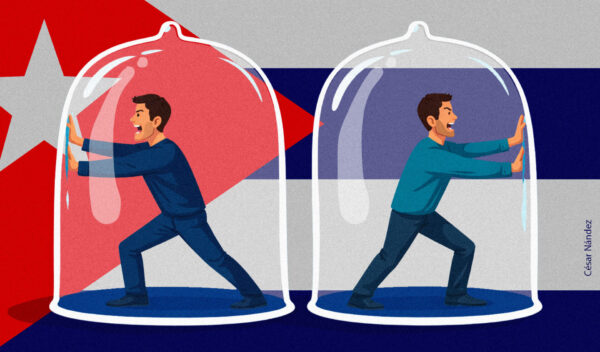
The structural vulnerability imposed by the Cuban regime has turned citizens into hostages of the state and permanent victims of systematic human rights violations.
By Michael Lima Cuadra (lationamérica21)
HAVANA TIMES – I was in eighth grade at a junior high school in Havana when I first heard the term “human rights” in the 1980s. I heard it clandestinely, through the short-wave signal of Radio Martí in the voices of Gustavo and Sebastián Arcos Vergnes, founders of the Cuban Committee for Human Rights. That powerful idea changed the course of my life. It shaped my political awareness, fueled my questions about the totalitarian system around me, and pushed me to challenge the pillars of Marxism that the regime demanded we accept without hesitation.
That discovery carried a price. By the time I finished junior high school, my expediente acumulativo—the record used to measure a student’s ideological “combativeness” and loyalty—already contained more than sixteen citations for ideological deviance (diversionismo ideologico). The regime used that label to punish any behavior, preference, or attitude deemed contrary to official values. Simply mentioning an article of the Universal Declaration of Human Rights was enough to receive a citation. That file, transformed into a political weapon, permanently barred me from entering university. It was then that I understood a fundamental truth: powerlessness in Cuba begins in the classroom, where the State controls education to prevent the emergence of free citizens.
What struck me most about the concept of human rights was its essential premise: that we possess inherent dignity and inalienable rights by virtue of being human—rights superior to any ideology or narrative of national sovereignty. This vision stood in stark contrast to that of the Cuban regime, whose political design reduces citizens to a voiceless mass, expected only to obey the interests of the Communist Party. The ideal of the “New Man” demanded dissolving the individual into the collective and renouncing one’s own judgment. This ideological design is not accidental; it is the first cornerstone of structural powerlessness.
As we recently marked International Human Rights Day, it is worth recalling that this deliberately constructed powerlessness, refined over more than six decades, has enabled some of the hemisphere’s worst documented violations. Paradoxically, it was the Cuban delegation led by diplomat Guy Pérez-Cisneros, ambassador to the UN from 1948 to 1951, during Cuba’s brief constitutional democratic period, that helped draft the preamble to the Universal Declaration stating that human rights can be fully exercised only under the rule of law. Today, Cuba embodies exactly what it once warned against.
After the pro-democracy protests of July 11, 2021, levels of surveillance, harassment, and social control reached heights unseen in decades. In 2025, the Cuban Observatory of Human Rights documented over 200 repressive acts in a single month, and data verified by Prisoners Defenders based on UN Working Group findings showed that Cuba has had more confirmed arbitrary detentions than any other country in the world since 2019. Mass repression is no accident; it is the foreseeable consequence of a system where judicial powerlessness is absolute.
Cubans live under a system in which the State simultaneously acts as judge, police, and executioner. The absence of an independent judiciary eliminates due process and normalizes arbitrariness. When there is no justice, abuse ceases to be the exception and becomes the rule.
The report Torture in Cuba (2022), prepared by fourteen civil society organizations, shows that Ministry of the Interior officials—including State Security agents—enjoy total impunity. Military courts routinely close investigations through definitive dismissal, shielding those who employ arbitrary violence. The case of Lieutenant Yoennis Pelegrín Hernandez—whose gunshot killed young Diubis Laurencio Tejeda and injured five other demonstrators in La Güinera—is emblematic: he was acquitted on grounds of “legitimate self-defense” and, according to a Cuban activist, merely transferred to another unit.
This same logic permeates the 2022 Criminal Code, which contains 32 provisions criminalizing fundamental rights such as expression, assembly, and association. Decrees 35 and 370 suffocate citizens’ voices on social media. Without civil liberties, Cubans are legally defenseless before the State.
Powerlessness also deepens the country’s humanitarian crisis. After Hurricane Melissa—damaging 45,000 homes and leaving more than 700,000 people in need—the State imposed barriers, monopolized donations, and, as it has for decades, continued refusing to register independent NGOs capable of assisting the most vulnerable. In Cuba, even hunger must first pass through the filter of political control.
Repression also manifests in everyday life, particularly in the workplace. Amnesty International documented in 2017 that simple critical comments or friendships with dissidents were enough for nurses, social workers, and tour guides to be fired and politically blacklisted, preventing them from working again. The result is ostracism or exile. Without economic freedom, the citizen is entirely subject to the State’s political blackmail, especially because the State remains the country’s principal employer.
In the political sphere, powerlessness is total. The Constitution declares socialism “irrevocable,” the Communist Party is the only legal party, and for twenty-five years, opposition figures attempting to run in municipal elections have been harassed, detained, or even killed, as in the case of Oswaldo Payá. Without genuine electoral mechanisms, powerlessness becomes destiny.
The structural powerlessness of the Cuban people—legal, political, economic, and social—is the root of all the human rights violations the country endures. When citizens lack independent courts, a free press, autonomous civil society, and competitive elections capable of replacing those in power, they are completely exposed to State arbitrariness. This powerlessness is not incidental: it is the cornerstone of authoritarian control. It has even influenced allied regimes such as Venezuela, where security structures have adopted methods of surveillance and repression inspired by the Cuban model, as documented by the UN Independent International Fact-Finding Mission (2022).
In this context, the recent visit to Cuba by UN rapporteur Alena Douhan revealed a dangerous misunderstanding. By attributing human rights violations suffered by Cubans to U.S. sanctions, while reportedly avoiding meetings with activists and victims, her assessment diverts attention from the true source of abuse. The Report on the State of Social Rights in Cuba (2025) shows that only 3 percent of Cubans blame the embargo for their problems, while disapproval of the government’s performance has reached 92 percent. It is not external sanctions that imprison demonstrators, deny family visits, impose prolonged isolation, or subject political prisoners to physical and psychological torture—it is the regime itself.
While citizens across Latin America can mobilize, form parties, and elect governments, Cubans remain trapped in a system designed to prevent any form of change. And as long as that system remains intact—without the rule of law, independent justice, or civil liberties—repression, poverty, and humanitarian crisis will remain inevitable.
The real solution does not lie in complacent diagnoses that echo the regime’s narrative, but in restoring to Cuban citizens what has been taken from them: rights, protection, freedom, and the genuine possibility of shaping their own future. Supporting the Cuban people’s legitimate aspiration to live in democracy is not a political gesture. It is a universal moral imperative.
*Michael Lima Cuadra: Researcher and director of Espacios Democráticos, an NGO dedicated to promoting solidarity in Canada with human rights defenders and civil society in Cuba. Master in Latin American History from the University of Toronto
Wow! So well said. Human Rights must be observed world wide and authoritarian regimes, such as the one in Cuba, must be called out for what they are – violators of such human rights. The UN has for too long turned a blind eye to the human suffering in the island that is caused by the regime.
I agree with the article. But I still wonder how Cuba might have worked out if there had not been a constant and unrelenting effort by the US to cause regime change? What once might have been dissent and listened to was, instead, regarded as potential efforts by the US agencies to overthrow the option created by the Revolution. This is not intended as an excuse, but a call to let countries learn and evolve independently.
The Cuban regime is doomed, and they know its power over the people is coming to an end. To the wonderful people of Cuba, don’t give up in your pursuit of freedom and peace; you are winning!