
Venezuela, a Tense Wait and See
What happens in Venezuela in the coming weeks could shape the United States’ relationship with our region for the remainder of Trump’s term.
By Juan Pablo Glasinovic Vernon (El Mostrador)
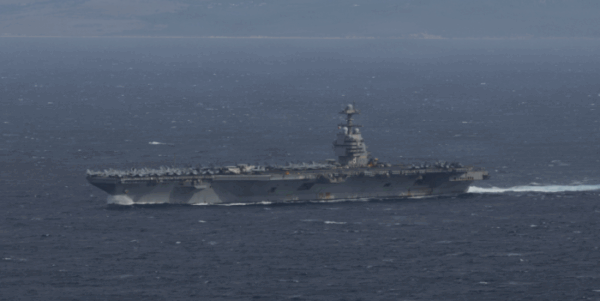
HAVANA TIMES – Since August, a fleet of more than a dozen US warships has been deployed off the coast of Venezuela, including the aircraft carrier Gerald R. Ford and F-35 fighter jets stationed in Puerto Rico. This deployment amounts to some 15,000 personnel as part of the “Southern Lance” operation, officially aimed at combating drug trafficking.
Let us not forget that the Trump administration has designated several cartels as terrorist organizations, recently including the “Cartel of the Suns,” to which Maduro allegedly belongs, according to US authorities. This designation allows the use of military means to fight them. In this context, in recent weeks at least 22 vessels have been destroyed in both the Caribbean and the Pacific, with around 80 people killed (presumed drug traffickers, according to the United States).
This is the largest US military presence in the region since the 1989 invasion of Panama. Although the official purpose is to confront narco-criminality and no intention to invade has been declared, the concentration of forces raises doubt.
At first, many thought it was more of a media maneuver—largely cosmetic—but as the weeks have gone by, uncertainty about its real scope and consequences has taken hold. This has intensified with the arrival of the aircraft carrier, the most powerful in the US fleet.
As we know, aircraft carriers move accompanied by an entire flotilla and are essential to maintaining the United States’ rapid-reaction operational capability in various parts of the globe. Therefore, unless there is the possibility of a conflict, the usual dynamic is that they remain in constant motion. Under ordinary circumstances they do not stay parked in the same area for long, and the cost of doing so affects the broader scheme of global deployment and US defense and security policy.
On November 29, the pressure increased with Trump’s announcement of the unilateral closure of Venezuelan airspace—that is, no aircraft can fly over Venezuela without risking attack. Several international airlines (Iberia, TAP, Latam, Avianca, Plus Ultra, Turkish Airlines, Gol) suspended flights following this measure, leaving the country even more isolated. Along with this, Trump warned that ground actions could begin “very soon.”
This has heightened nerves, especially within the Maduro regime. What does the Trump administration want? To send a signal that if there are no changes—both criminal and political (Trump accuses the Venezuelan regime of being a narco-government)—it might intervene militarily? Is it a pressure tactic to push for changes that might even lead to a negotiated transfer of power, or an outright ouster of Maduro? And what kind of military actions could the United States undertake? Selective bombing on land, or some operation to capture or neutralize Maduro, Cabello, and other senior chavista leaders?
Venezuela is not Panama. It is a large country that also has significant military capacity. For this reason, any attack could not only be costly in human terms, it could also drag on and expand—despite the fact that Trump himself came to power promising to withdraw the United States from all conflicts not directly tied to its own security or its competition with China.
What seems evident is that maintaining a fleet off Venezuela must yield some kind of result, and thus far—beyond destroying a few boats allegedly belonging to traffickers—there is nothing to show. Would the Trump administration be willing to pull out its aircraft carrier after a few weeks without any tangible outcome? What is happening behind the scenes?
Most analysts, me included, agree that the likelihood of some action has increased, and that a US withdrawal without any result is becoming less and less probable.
The Trump administration is trying to send several signals—some already underway. First, the militarization of the fight against drug cartels. As mentioned, several boats with their crews have already been destroyed both in the Colombian Pacific and in the Caribbean and Venezuelan waters.
Another signal is to demonstrate that our hemisphere is a primary security interest for the United States. Marco Rubio, Secretary of State, said his country has “every right to operate militarily in its hemisphere” and rejected Europe’s right to question the legality of US actions in the Caribbean. Rubio insisted that the operation aims to disrupt narcotics trafficking and dismantle transnational criminal organizations, rejecting any external interference in US defense policy.
In other words, this is a revival of US regional diplomacy that persisted until the Cold War: viewing this hemisphere, and particularly Latin America, as the area of its unquestioned influence. If a few months ago Washington forced Panama to remove Chinese companies from port concessions on both sides of the canal, in this case they would be escalating to push out Chinese, Russian, Cuban, and Iranian influence from an oil-producing power with significant regional weight despite its accelerated decline in recent years.
In the event of armed actions, what would Latin America’s reaction be? Among the Venezuelan diaspora—now representing almost one-third of the country’s population—support for an intervention is high, at 64%. Inside the country the percentage would drop to 34%, though it is harder to know; and undoubtedly, the possibility of being victims of such attacks increases reluctance.
In the rest of the region, an October 2025 survey shows that 53% of Latin Americans support a US military intervention in Venezuela to remove Nicolas Maduro. At the government level, the ongoing shift to the right is increasing Maduro’s isolation and reducing official opposition to an intervention.
Colombia, Brazil, and Mexico, at the recent CELAC-EU summit in Santa Marta, Colombia, in early November, signed a declaration proclaiming the Caribbean a zone of peace, though they failed to bring the rest of the region on board. In the event of a US armed attack on Venezuelan territory, a military response from these countries is all but ruled out, though they could offer logistical and material support to Venezuela, as well as political backing—distancing themselves from the United States, freezing any strategic rapprochement, and potentially privileging other defense alliances, such as incorporating China and Russia into that realm.
Within the United States itself, a CBS News/YouGov poll from November shows that 70% of US Americans oppose military action in Venezuela and, more importantly, that three-quarters of respondents believe any military intervention should first receive congressional approval.
What happens in Venezuela in the coming weeks could shape the United States’ relationship with our region for the rest of Trump’s term. A surgical operation that removes Maduro and restores democracy could have a domino effect in Cuba and Nicaragua, radically altering the regional political landscape. In an optimal scenario, three dictatorships could cease to be dictatorships.
But this would require several factors aligning and minimal bloodshed. If that does not happen, things could get tangled and end up worse, not to mention the precedent of intervening in a sovereign state—a precedent the United States could no longer criticize in others (although in the emerging new order, paradigms have shifted).
Finally, there is a small chance of another scenario: that this is another bluff or trick by President Trump to extract concessions of various kinds and send messages within a larger game to several audiences, including his domestic base.
Wait and see.
—–
First published in Spanish by El Mostrador and translated and posted in English by Havana Times.