
Relics in Havana: A Story Frozen in Time
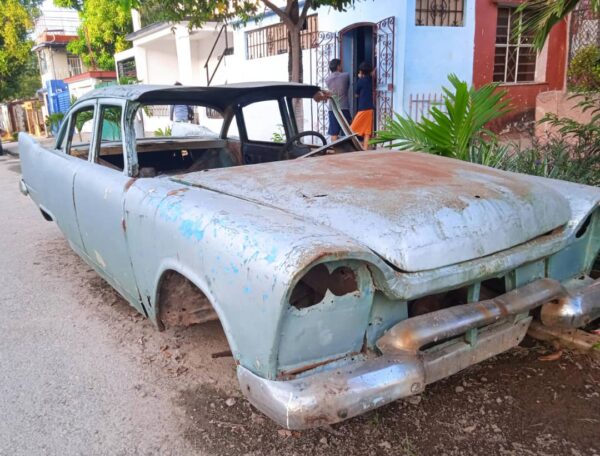
HAVANA TIMES – On 160th Street in the municipality of La Lisa, Havana, two almendrones remain motionless. Resting in their immobile bodies is more than half a century of urban history. They are mid-20th-century United States automobiles, probably manufactured between the late 1940s and1950s, which arrived in Cuba during a period of intense vehicle imports and expansion of the national automotive fleet.
Before 1959, Cuba was one of the Latin American countries with the highest number of US automobiles per capita. Havana, in particular, modernized at the pace of the automobile: new avenues, gas stations, and repair shops accompanied that process. Models from companies such as Chevrolet, Ford, Plymouth, and Dodge were part of the everyday landscape. No one could have foreseen then that those same cars—designed for a limited lifespan—would have to adapt to a completely different context for decades.
With the interruption of trade with the United States in the early 1960s, the automobile ceased to be a renewable good. From that moment on, a singular process began: existing cars were preserved, repaired, and transformed in order to keep running. Thus emerged a mechanical culture based on the reuse of parts, the adaptation of engines, and the transmission of knowledge from generation to generation. Each almendrón became an individual solution, shaped by necessity and ingenuity.
For decades, these vehicles played an important role in urban and suburban transportation. They circulated as collective taxis, family cars, and work vehicles. In neighborhoods like La Lisa, far from the city’s historic center, they were part of daily life: taking children to school, transporting goods, and connecting residential areas with industrial and commercial zones.
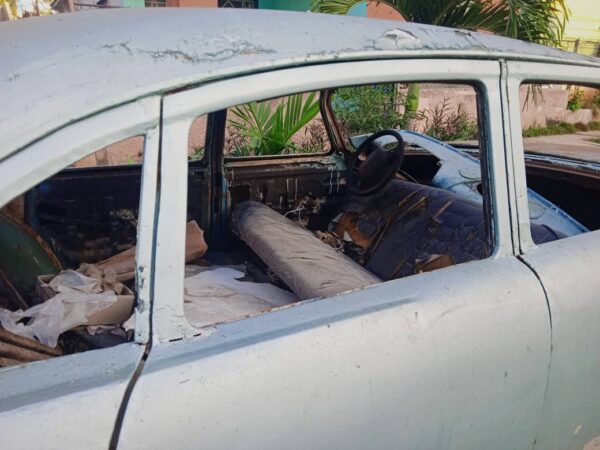
These cars that today remain abandoned on 160th Street in La Lisa show the decline of that cycle. The worn paint, spreading rust, and missing elements indicate that they can no longer fulfill their original function. Their immobility is not the result of sudden abandonment, but of the gradual exhaustion of a model of mechanical survival that for decades achieved the improbable.
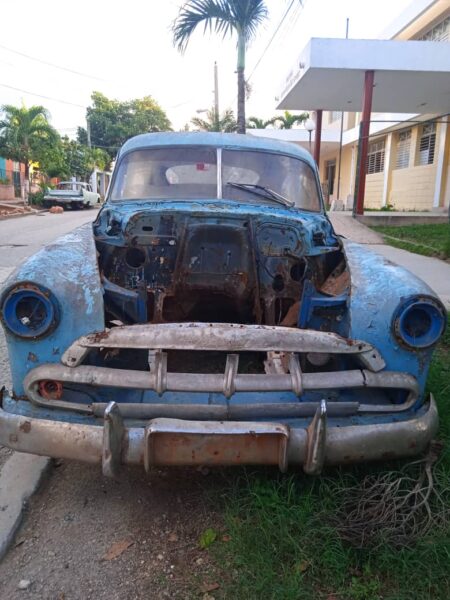
Nevertheless, their presence retains historical value—not as museum pieces or idealized objects, but as material remnants of a prolonged stage of urban life. Through their deterioration, these cars allow us to read about the country’s economic, social, and technical transformations. They are documents exposed to the elements visible to anyone passing down the street.
They do not even interrupt traffic. They are simply there. And in that discreet persistence, they remind us that history is not always preserved in archives or monuments, but also in ordinary objects that remain as witnesses to a time that still weighs on the city.