
Trump to Lunch Today in Private with Maria Corina Machado
after he praises Maduro’s replacement Delcy Rodríguez
Acting president Delcy Rodriguez, described by Trump as a “fantastic person,” announced a new political moment in Venezuela on Wednesday and said that 400 people have been released from prison.
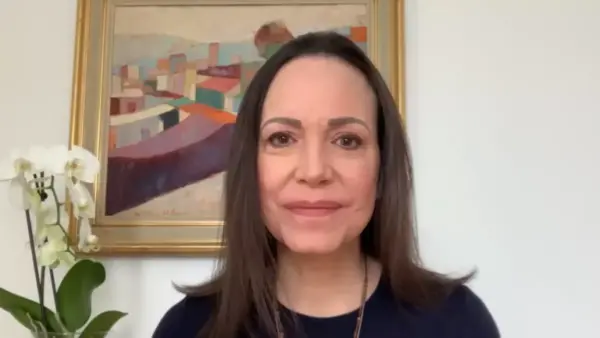
HAVANA TIMES — US President Donald Trump and Venezuelan opposition leader and Nobel Peace Prize laureate Maria Corina Machado will have lunch this Thursday at the White House to discuss the situation in Venezuela after the capture of Nicolas Maduro.
According to the US president’s official schedule, the lunch will take place at 12:30 p.m. Washington time in a private dining room at the White House and will be held behind closed doors, without press access.
The meeting, the first between the two, will take place less than two weeks after the United States deposed Maduro during an attack in Venezuela on January 3, in which Maduro and his wife, Cilia Flores, were aducted and transported to New York to stand trial on drug-trafficking charges.
During her visit, Machado will be accompanied by a large group of collaborators grouped in the Comando Con Venezuela, whose most visible figure is the former mayor of El Hatillo, David Smolansky, well connected with Senator Rubio’s circle and with Republican members of Congress from Florida such as Maria Elvira Salazar and Carlos Gimenez.
Also in Washington this week is Leopoldo Lopez, former mayor of Chacao and founder of the opposition party Voluntad Popular, while Juan Guaido, recognized between 2019 and 2023 by part of the international community as interim president of Venezuela, has given numerous interviews to US media from Florida, where he now resides.
The meeting comes one day after the president praised the acting president, Delcy Rodríguez, following a phone conversation. “Today we had an excellent conversation, and she is a fantastic person. In fact, she is someone we have worked very well with,” Trump said in the Oval Office. The call was “long,” indicated the Republican leader, who added that they discussed “many issues” and that he is “getting along very well with Venezuela.”
According to sources consulted by EFE, former Venezuelan ambassador to the United Kingdom Felix Plasencia is also in Washington to work on the new relations between Washington and Caracas that led to that conversation.
Later, Trump reiterated the same message on his social network, where he wrote: “This morning, I had a very good call with the Interim President of Venezuela, Delcy Rodríguez. We are making tremendous progress as we help Venezuela stabilize and recover.” In the conversation, he said, they discussed “many issues, including oil, minerals, commerce and, of course, national security.”
“This partnership between the United States of America and Venezuela will be spectacular FOR EVERYONE. Venezuela will soon be great and prosperous again — maybe more than ever!” he added.
Shortly afterward, Rodríguez herself confirmed the information and announced the beginning of a “new political moment” in her country, after stating that more than 400 political prisoners have been released.
“The message is a Venezuela opening up to a new political moment that allows for understanding from divergence and from political and ideological diversity,” declared the acting president from Miraflores, speaking to national and foreign journalists flanked by her brother and Interior and Justice Minister Diosdado Cabello.
However, she conditioned this new stage on it being carried out with “respect toward others” and “toward human rights.” “Messages of hate, intolerance, violent actions will not be permitted,” she concluded.
Delcy Rodríguez stated on social media that the conversation with Trump was “productive and courteous.” “We addressed a bilateral work agenda for the benefit of our peoples, as well as pending issues in the relationship between our governments,” she noted.
The call took place after authorities from both countries announced last week that they had begun an “exploratory process” to reestablish formal diplomatic channels.
Rodríguez also said that the “process of releasing persons who were deprived of liberty” remains “open,” attributing it to Maduro since — she said — “it began this past December with 194” releases. “As of today,” she added, “we can say that they now total 406 releases expected in these days.” According to her, this “arduous” process is being led by Cabello.
In December, the Ministry for Penitentiary Services announced the release of 88 people on Christmas Day and another 99 on January 1, of which local NGOs verified about half. From last Thursday until 2:30 p.m. local time this Wednesday, the Unitary Democratic Platform (PUD), which groups the majority opposition, had verified 100 releases.
For its part, the NGO Foro Penal confirmed 72 releases as of 1:50 p.m. local time this Wednesday. On Tuesday, Jorge Rodriguez made the “lists” available, although they have not yet been made public, something NGOs, activists, relatives and political parties are demanding.
Among those freed is a group of 19 journalists and media workers, out of a total of 24 that the National Press Workers’ Union (SNTP) had counted as detained. According to the union’s list, five journalists remain deprived of liberty, among them former opposition deputy Juan Pablo Guanipa, a well-known ally of Nobel laureate Maria Corina Machado.
One of those released is Roland Carreño, also an activist of the opposition party Voluntad Popular, who was detained on August 2, 2024. This was the second time, as he had already been arrested on October 26, 2020 and released on October 18, 2023, following an agreement signed at that time between the Maduro government and the PUD in Barbados.
Meanwhile, the archbishop of the Venezuelan city of Barquisimeto (west), Monsignor Polito Rodriguez, welcomed the recent releases of political prisoners, but said that “many others are still missing.” “It would be a gesture of reconciliation and justice for them to be released as soon as possible,” said the prelate during the massive gathering for the 168th procession of the Divina Pastora, patron saint of Barquisimeto, capital of Lara state.
Outside some of the prisons where political prisoners are held, relatives and activists maintain vigils demanding full freedom for all of them, which as of January 5 the NGO Foro Penal counted at 806.
First published in Spanish by 14ymedio and translated and posted in English by Havana Times.