
Nicaragua Eliminates “Visa-Free Entry” for Cuban Citizens
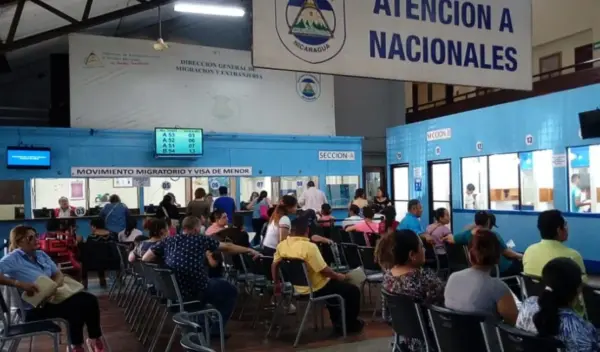
The decision comes amid an escalation of tensions between Cuba and the United States, and one month after the capture of Nicolas Maduro in Venezuela.
HAVANA TIMES — The regime of Daniel Ortega and Rosario Murillo has eliminated “visa-free entry” for Cuban citizens, which it had established in 2021 as a “humanitarian measure” and which enabled a wave of Cuban migration that used Nicaraguan territory as a springboard toward the United States.
The elimination of visa-free entry was ordered on February 8, 2026, by the director general of Immigration, Juan Emilio Rivas, and leaked to the local press and confirmed hours later by the Interior Ministry.
Rivas’s text emphasizes that “as of this date all citizens and nationals of the Republic of Cuba holding ordinary passports changed their migratory category from A, visa-exempt, to category C, consultative visa without cost.”
It also orders that this provision be communicated to the Foreign Ministry “so that, the consular representation of Cuba in Nicaragua” and all Nicaraguan consulates abroad may be notified.
The measure was also communicated to the National Institute of Civil Aeronautics for its dissemination and “immediate application” among airlines and Nicaraguan land and maritime transport companies.
Applications for consultative visas will be processed by the Interior Ministry through the email address [email protected] and carry no cost.
“Once the consultative visa is approved, the interested party will be notified so they may go to the nearest Nicaraguan consular office abroad, where the approved visa will be stamped,” the Interior Ministry reported.
Escalation of Tensions Between the USA and Cuba
The elimination of visa-free entry for Cuban citizens comes at a moment when the United States government has Cuba’s regime against the ropes and one month after the capture of Venezuelan dictator Nicolas Maduro, one of Ortega and Murillo’s principal allies in the Americas.
The escalation of tensions between Cuba and the US, along with Washington’s oil siege against the island — now in its worst crisis in decades — is gradually paralyzing life in Cuba: from public transportation to hospitals, from gas stations to factories and universities.
Cuban president Miguel Díaz-Canel stated on Thursday, February 5, 2026, in an unusual television appearance, that since December 2025 the country had not received fuel from abroad due to US pressure, and he confirmed that energy production using diesel and fuel-oil engines had been paralyzed.
He also announced the implementation of an emergency plan to try to subsist without petroleum from abroad, although he said details of the program would be revealed in the following days.
Amid the escalation of conflict between the US and Cuba, governments in the Americas and Europe have issued warnings to potential travelers, threatening tourism, a key sector of the island’s economy.
Countries among the main sources of tourism to Cuba — such as Canada, the United States, and Spain — have in recent weeks pointed to the critical situation the country is facing.
Nicaragua: A Springboard for Cuban Migrants
The Nicaraguan regime established visa-free entry for Cuban citizens in November 2021, citing a “humanitarian” situation following the COVID-19 pandemic. The following month the country recorded the arrival of 6,178 Cubans, according to Immigration data.
During the time the measure was in force, many thousands of Cubans used Nicaragua as a “springboard” to migrate to the United States — a situation that led the US to impose a series of sanctions against officials and entities linked to the Ortega-Murillo regime for facilitating irregular migration.
In February 2024, the United States expanded its visa-restriction policy to include operators of air, land, and maritime transport companies that facilitate migrant flights to Nicaragua, aiming to curb irregular migration to the US.
One month later, in March 2024, it adopted new measures to “impose visa restrictions on executives of charter flight companies” that facilitate irregular migration to the United States via flights to Nicaragua.
In November 2025, the US State Department announced visa revocations and migration restrictions against Nicaraguan businesspeople accused of facilitating irregular immigration to US territory.
First published in Spanish by Confidencial and translated and posted in English by Havana Times.