
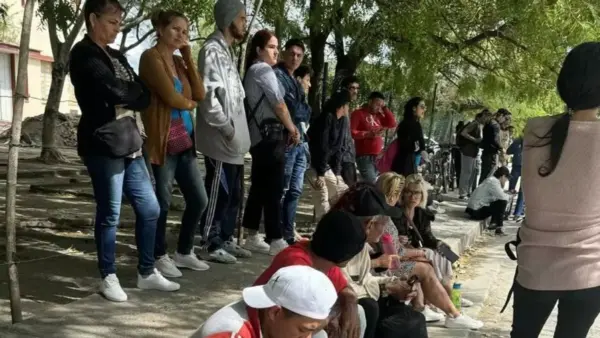
People Gather Outside the Holguin Court to Support Rebels
The creators of the critical videos of El4tico
Kamil Zayas and Ernesto Ricardo Medina face charges of “propaganda against the constitutional order” and “incitement to commit crimes”.
HAVANA TIMES — More than 50 people, including relatives, friends, and activists, have been gathered since the early hours of this Thursday outside the Provincial Court of Holguín, where a hearing is being held in the case of the young creators of the independent project El4tico. The hearing responds to a habeas corpus appeal admitted by the court itself on behalf of Kamil Zayas Perez and Ernesto Ricardo Medina, detained on February 6.
Coinciding with the growing number of people gathered outside the court, internet outages occurred in the area, interrupting the flow of messages and reports from the scene of the gathering while Zayas and Medina remained inside the building.
On its Facebook page, the Holguin Provincial Prosecutor’s Office justified its decision to open criminal proceedings against the platform’s creators. They are accused of “propaganda against the constitutional order” and “incitement to commit crimes” through posts that allegedly encouraged the population and members of the Armed Forces and the Ministry of the Interior to change the constitutional order and that “defamed State institutions.” The statement notes that Medina and Zayas are being held under the precautionary measure of pretrial detention while “investigative procedures continue to obtain evidence.”
The court day was preceded by a new act of harassment. Activist Yanet Rodriguez Sanchez, who filed the habeas corpus appeal on behalf of the detainees on February 9, attempted to leave her home this morning to head to the court but was prevented from doing so by state security police. At least two police patrol cars and a motorcycle were stationed in front of her house, and two plainclothes agents blocked any attempt to go to the Court.
Rodriguez has also received intimidating phone calls and messages in recent hours. Since Thursday morning she has remained cut off from communication and arbitrarily confined in her home, a form of de facto detention that Cuban authorities routinely use to prevent activists from participating in public demonstrations.
The admission of the habeas corpus petition by the First Criminal Chamber of the Holguín Provincial Court constitutes an unusual event within the Cuban judicial system, where such appeals rarely succeed when detentions have a political background. On the Island there is no real separation of powers, and the courts—like the rest of the public institutions—operate under the “guidelines” of the Communist Party, the only legal party.
The contrast with other recent cases is evident. In Havana, for example, the habeas corpus petition filed on behalf of Ankeilys Guerra Fis, a 23-year-old detained since January 14, 2026 and held incommunicado in Villa Marista, the central headquarters of State Security, was denied. Guerra was violently arrested in his home over alleged critical expressions on social media. The court rejected the appeal citing a lack of data on the alleged crime, case number, or exact place of detention—information the authorities themselves systematically refuse to provide.
In Holguín, relatives and associates of Zayas and Medina have expressed concern both over the lack of official information and over the detention conditions of the young men at the province’s Criminal Investigation Unit headquarters, a center popularly known as “Everyone Sings,” due to the violent interrogations reportedly carried out there. During the operation that culminated in their arrest, State Security agents confiscated computers, mobile phones, cameras, and other work equipment used by the youths to produce audiovisual content critical of the country’s political and social reality.
Thursday’s hearing compels the Provincial Prosecutor’s Office to formally present the charges—if any—justify the legality of the detention and explain the conditions in which the detainees are being held, as part of the judicial review derived from the habeas corpus petition. The process has drawn the attention of human rights organizations, independent journalists, and activists inside and outside the Island, who consider the case a direct violation of freedom of expression and due process.
In recent hours, messages of solidarity have multiplied on social media under the hashtag #WeAreAllEl4tico, calling for the youths’ immediate release and denouncing judicial arbitrariness. In contrast, party authorities—including the first secretary of the Communist Party in Holguin, Joel Queipo Ruiz—joined a campaign of public vilification, calling the El4tico youths “mercenaries” and “traitors,” among other insults common in official discourse.
Outside the court, the atmosphere remains peaceful, though charged with tension and expectation. Relatives—including Doris Santiesteban Batista, Ernesto’s wife—continue waiting for news from inside the judicial building, hoping the day will mark a turning point in a case that once again highlights the use of Cuba’s judicial system as a tool of political control and punishment of dissent.
First published in Spanish by 14ymedio and translated and posted in English by Havana Times.