
Energy Crisis Threatens What Remains of Tourism in Cuba
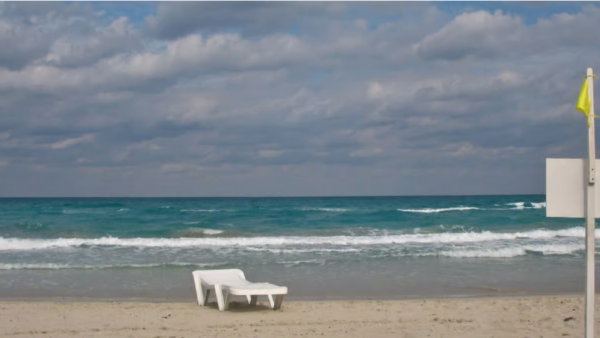
The government finds it increasingly difficult to maintain the bubble in which it has tried to isolate tourism from the rest of the country.
By Raul Medina Orama (El Toque)
HAVANA TIMES — Over the last two decades, many residents of Caibarién—a city on the northern coast of Villa Clara—looked at the hotels multiplying on the islets of Cayo Santa María, Las Brujas, and Ensenachos as the best possible places to work. In a Cuba where almost no state job offers prosperity, the tourist facilities—most owned by Grupo Gaviota S.A., part of the military business conglomerate Gaesa—drew their main labor force from the nearby municipalities.
But now, in the middle of the “high season”—when more foreign visitors are supposed to arrive in Cuba fleeing winter in the Northern Hemisphere—several hotels have closed, and an undetermined number of workers face uncertainty about what will happen to their jobs, amid the implementation of a “multisector contingency plan” announced by ruler Miguel Diaz-Canel.
A person who works at the reception desk of the Valentín Perla Blanca hotel received the news with surprise in early February 2026. Overnight, inventories were being taken at the facility “because they removed the few guests who were there” in order to close the hotel as soon as possible. She must stay home waiting for things to “improve,” while other workers will be relocated to hotels that continue operating.
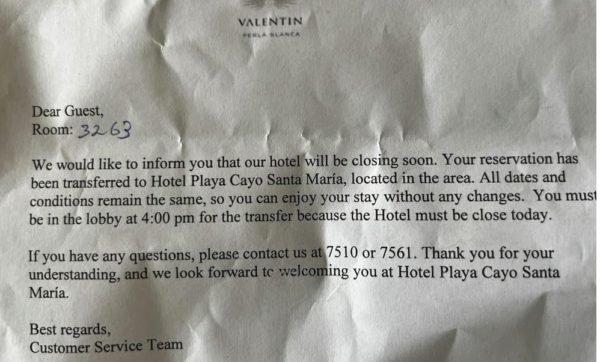
According to a document published by Diario de Cuba, guests received the following notice: “Your reservation has been transferred to Hotel Playa Cayo Santa María, located in the area. The dates and conditions remain unchanged, so you may enjoy your stay without modifications.”
According to Canadian tour operator Transat, as of February 6, 2026, the hotels Sol Cayo Santa María and Meliá Buenavista in the Villa Clara tourist hub had also closed.
“They’ve closed the hotels with lower occupancy as an energy-saving measure. Guests have been relocated to those with more clients,” a person who asked to remain anonymous for fear of losing their job in the marketing area of one of the resorts still operating told elTOQUE.
At elTOQUE, the identities of contacted workers are protected to avoid reprisals from Gaviota, an entity belonging to the Armed Forces that contracts with various international chains to manage hotels.
A “Locomotive” Without Fuel
The so-called “contingency plan” has added another chapter in recent weeks to Cuba’s long national crisis—a collapse unfolding in slow motion but relentlessly over the past five years. In January, blackouts affected most of Havana daily and could last a full day or even two in the rest of the provinces, according to complaints received by this outlet.
Without fuel to run generation plants or transport hotel staff, the Cuban government finds it increasingly difficult to maintain the bubble in which it has tried to isolate tourism from the rest of the country.
In the first days of February 2026, Canadian travel operators and airlines—the main source market for tourists to the Villa Clara keys (and Cuba overall)—were forced to modify commercial policies or suspend services.
According to Ricardo Torres Perez, a visiting researcher at American University (Washington, D.C.), “although Cuba’s energy shortage has worsened over the past month due to stepped-up US pressure to restrict the island’s access to fuel, the crisis itself is not new.”
In a LinkedIn analysis, Torres argues that measures to reduce dependence on fossil fuels, such as the rollout of solar parks in 2025, have been insufficient. In his view, the government failed to allocate long-term investment to guarantee electricity generation and distribution, and instead “allowed the grid (…) to age until it became fragile.”
Deputy Prime Minister Oscar Perez-Oliva said on February 7, 2026, that authorities intend, with the scarce fuel available, to “guarantee the sustainability of those sectors that generate foreign currency revenue.” Among them is tourism, although the sector has seen visitor numbers fall, never returning to pre-COVID-19 levels.
In 2025, 17 Caribbean destinations reported more arrivals than the previous year—including the Dominican Republic, Guyana, Saint Vincent and the Grenadines, Curaçao, Trinidad and Tobago, Puerto Rico, and Dominica—according to researcher Jose Luis Perello. But Cuba lagged far behind competitors, closing 2025 with 1,810,731 international arrivals, a 17.8% drop from 2024 (2.20 million) and 25.7% fewer than 2023 (2.44 million), according to official data.
As in nearly every economic activity in the country, the extreme fuel deficit has only worsened a debacle that already existed.
Perez-Oliva stated on state television: “A plan has been designed in tourism to reduce energy consumption, consolidate tourist facilities, and make the most of the high season currently underway in our country.”
However, “the plan” is unknown to workers consulted by elTOQUE. The authorities’ strategy to keep the battered body of tourism breathing has been communicated verbally, without clear timelines or real scope regarding the “contingency.”
“They arrived and without saying anything, without explanations, they were told they were going to close [the hotel], sent them home, and began taking inventory,” said someone close to one of the affected workers.
According to Caibarién residents familiar with the matter, workers with “permanent” positions sent home will receive 60% of their salaries.
However, employees with partial contracts “are sent home without work, without pay, until this passes—because nobody knows, they haven’t explained how long it could last,” one source said. She added that this would affect much of the workforce, since permanent staff are fewer than temporary workers.
Many still do not know how they will make a living. Messages from a WhatsApp group of young tourism workers accessed by elTOQUE reflect the confusion: “Holy Father, this is going badly,” “I’m getting depressed,” “I have no job,” “They closed my hotel until further notice…”
“The whole town here is sleepless, going crazy, watching what’s happening,” said someone close to several of those now unemployed.
El Toque attempted to obtain information from Cuba’s Ministry of Tourism and Grupo Gaviota about specific measures being implemented and the conditions facing workers sent home or relocated, but had received no response at the time of publication.
Two employees in the Villa Clara tourist hub described what appears to be another crisis measure: workers must remain on site at the hotels for seven days, then rest a week, because “there’s no fuel” to guarantee daily transport.
“Here something different happens all the time, but so far operations continue,” a worker at Sanctuary and Grand Memories in Cayo Santa María told El Toque.
According to her, staff learned “by word of mouth” that they would receive relocated guests and workers, because there was “nothing in writing” from management explaining the plan.
A National Problem
The tourism crisis—one of many battering Cuban society today—contributed to a 5% contraction in Cuba’s gross domestic product (GDP) in 2025, according to a report by the pro-government Center for Studies of the Cuban Economy (CEEC), cited by EFE.
“The economy deepened its contraction during the year, consolidating a pattern of stagnation and absence of recovery,” in a GDP drop of more than 15% since 2020, the document reviewed by EFE states, also pointing to the “absence of significant structural and macroeconomic reforms.”
Against this backdrop, the “contingency plan” reached Cuba’s beach hotels in early 2026—hardly a sign of recovery and more an omen of progressive collapse nationwide. Beyond low-occupancy facilities in the Villa Clara keys, other hotels in Cayo Coco (Ciego de Ávila), Varadero, and Holguín have suspended operations, leading to guest relocations and contract reviews with foreign tour operators.
Canadian operator Transat notified travel agents that the Iberostar Origin Playa Pilar, Gran Muthu Imperial Cayo Guillermo, Iberostar Origin Daiquiri, Tryp Cayo Coco, and Hotel Mojito in Cayo Coco had ceased operating.
In Varadero (Matanzas province), Hotel El Patriarca closed, while in Holguín the Gran Muthu Ensenada suspended operations.
The Spanish hotel chain Melia “reduced hotel availability” in three properties, “strictly based on occupancy levels,” according to EFE.
“I’m very anxious, I’m ready to go home,” Tracy Black told CTVNews.ca from a hotel in Cayo Coco, where she is staying with her elderly mother.
“These have been, by far, the worst vacations I’ve ever had. I wouldn’t even consider them a vacation,” Black added.
The Canadian tourist said: “The other night we had a three-hour blackout where we sat in our rooms in the dark (…). The other day we took a taxi from the market, and the driver was shutting down his service because once he ran out of fuel there wouldn’t be any more available.”
Amid widespread fuel shortages, Air Canada and other airlines announced suspension of service to Cuba. Over the coming days, Air Canada “will operate empty southbound flights to pick up nearly 3,000 passengers already at destination and bring them home,” the company said in a statement.
But tourists like Tracy Black fear there may not even be fuel for buses from resorts to airports in time for flights. Black said Air Canada would not allow them to change flights to return home earlier.
“We’ve had no communication from anyone. I just wish Air Canada would cooperate more to try to get us home.”
Other airlines such as Iberia (Spain) and Air Europa have taken various measures to try to maintain flights to Cuba—for now.
In Havana, the Thai-owned Minor hotel chain will stop operating the Capri and NH Collection Victoria hotels it manages in Vedado. Business sources cited by EFE say the island’s business climate is “complex,” reflected in tourism, where hotel occupancy rates barely exceed 20%.
Pedro Monreal says a hypothetical prolonged scenario of “zero fuel imports” would make energy support for Cuba’s economic system unviable.
He stated on social media that energy savings and renewable sources can only delay total collapse, but “effective solutions belong to the political sphere.”
“We’ll see how this turns out. This is ugly,” says a worker at the Grand Aston Cayo Las Brujas, one of the Villa Clara hotels still open—for now. She is grateful to have work, even if it means not seeing her children for a week at a time.
First published in Spanish by El Toque and translated and posted in English by Havana Times.