
Nicaragua: 12 Key News Stories in 2025
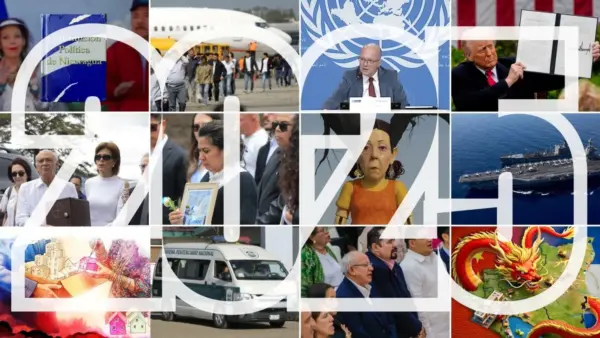
The dynastic co-presidency, purges within power, Chinese influence, transnational repression, and the impact of the Trump era defined 2025.
HAVANA TIMES – _The year 2025 closes as a decisive cycle in Nicaragua’s recent history, marked by the definitive institutionalization of the totalitarian model of Daniel Ortega and Rosario Murillo. The entry into force of a new Constitution—tailor-made for the family clan—not only formalized the co-presidency and dynastic succession, but also buried the separation of powers, ushering in absolute control over the judiciary and state institutions.
Alongside this process of centralization came an unprecedented purge within the regime’s inner circle, in which former collaborators and loyalists moved from government offices to the cells of El Chipote, confirming the fragility of loyalties in a system that devours its own.
In the realm of human rights and historical memory, 2025 leaves deep scars. The death in exile of former president Violeta Barrios de Chamorro and her legacy of peace in Nicaragua contrasts with a climate of repression that this year reached transnational levels with the assassination in Costa Rica of retired Major Roberto Samcam.
At the same time, the UN Group of Human Rights Experts on Nicaragua (GHREN) raised the political cost for the regime by identifying by name the chain of command responsible for crimes against humanity and the complicity of the Nicaraguan Army in the repression and massacre of the April 2018 protests.
Meanwhile, the Catholic Church remained under siege, with the systematic confiscation of its property and the expulsion of its representatives, in an effort to dismantle any space of moral resistance in society.
The national economy and the international context also underwent a sharp turn under the weight of Chinese influence and Donald Trump’s return to the White House. As companies from the China expand into strategic sectors such as mining and retail trade, new US tariff policies and the threat of mass deportations have sown uncertainty in thousands of Nicaraguan households.
This CONFIDENCIAL roundup, selecting the 12 news stories that marked 2025, offers a comprehensive look at a country navigating between the resilience of its political prisoners and its population inside and outside the country, and the imposition of a dynastic system that seeks to perpetuate itself through force and legal reform.
The dictatorship keeps silent on Nicaraguans deported from the US
The government of Donald Trump imposed a record of more than 6,000 Nicaraguans deported through December 15, 2025, according to US State Department data.
Deported migrants arrived in Nicaragua on 54 flights that were received in secret by the Ortega-Murillo dictatorship. This number exceeds the total flights from the previous two years combined: 2023 and 2024.
On September 26, Daniel Ortega referred to the arrival of 119 deportees. “Here they are received with open arms,” he said, but provided no information about their identities or the conditions under which they and other deportees were received in Nicaragua.
Former president Violeta Barrios de Chamorro dies in exile
Former president Violeta Barrios de Chamorro died on Saturday, June 14, 2025, in San José, Costa Rica, at the age of 95, after a prolonged illness.
The former president, who governed Nicaragua from 1990 to 1996, left a legacy of peace, reconciliation, and democracy after the end of the armed conflict of the 1980s.
Doña Violeta was honored by her children, exiled in Costa Rica, and by the Nicaraguan community and Costa Ricans.
Her ashes were laid to rest in Costa Rica until they can return to rest in peace in her country, when Nicaragua once again becomes a republic in freedom.
Retired Major Roberto Samcam assassinated in Costa Rica
The assassination of Roberto Samcam on June 19 shocked the community of Nicaraguan refugees in Costa Rica and the Costa Rican public. The former army major was shot eight times at the door of his home, in a killing considered an act of state terrorism by the Nicaraguan dictatorship.
On September 12, the Judicial Investigation Agency arrested three suspects, all Costa Ricans, for their participation in the attack. However, authorities are still seeking to capture the gunman, 20-year-old Luis Carvajal, who remains at large, as well as the intellectual authors of the crime.
Samcam’s family and international human rights organizations are demanding justice so that this murder does not go unpunished.
Murillo’s Constitution” and dynastic succession enter into force
The dictatorship imposed the new Constitution, which replaces the Presidency with a Co-Presidency, guaranteeing the dynastic succession of Rosario Murillo in power.
The total constitutional reform changed 93% of the articles of the Magna Carta and entered into force on February 18, 2025.
The new constitution eliminated the branches of government, which are now merely state bodies subordinate to the co-presidents, and establishes the red-and-black FSLN flag as a national symbol.
Purge in El Carmen: the jailing of the “loyalists”
In 2025, purges intensified within Daniel Ortega’s circle of power, carried out on orders from Rosario Murillo.
Former presidential adviser and former FSLN leader Bayardo Arce was detained on July 30 and is currently in a condition of forced disappearance.
In June, retired former general and Ortega adviser Álvaro Baltodano was sentenced to 20 years in prison for money laundering and alleged treason.
Former national security adviser to Ortega and Murillo, Nestor Moncada Lau, an operator of repression, was jailed on August 16.
Retired police commissioner general Horacio Rocha also fell from grace by order of Rosario Murillo.
Rosario Murillo imposes absolute control over the Supreme Court
Rosario Murillo consolidated her control over the justice system by forcing the resignation of seven Supreme Court justices, including the Court’s vice president, Marvin Aguilar, who were replaced by judges loyal to Murillo.
From the former Supreme Court, only three justices survived: former president of the Court Alba Luz Ramos, who was de facto ousted in October 2023; Justice Gerardo Arce, brother of former adviser Bayardo Arce; and Justice Juana Méndez.
GHREN confirms Army participation and identifies repressors
The UN Group of Human Rights Experts on Nicaragua revealed the names of 54 senior officials of the dictatorship who make up the chain of command of the repression that committed crimes against humanity.
Among them are 11 senior Army commanders who, following orders from Ortega and Murillo, participated in the repression of the April 2018 uprising.
The Group’s report, presented to the UN General Assembly on October 30, identified the institutions directly involved in the repression, including the Presidency, the Army, the Police, and the Judiciary.
Mass confiscations from the Catholic Church
A CONFIDENCIAL investigation revealed that the dictatorship has confiscated 39 Catholic Church properties since 2022, including schools and universities, retreat houses, and the headquarters of religious orders.
The seizures have been rebranded as supposed public works of the regime. In 2025, confiscations continued with 18 properties taken from religious organizations and nongovernmental entities.
Chinese mining companies and shops take over Nicaragua
In 2025, the Ortega–Murillo dictatorship strengthened its economic dependence on the People’s Republic of China.
The regime contracted 11 onerous loans with Chinese companies to develop infrastructure projects worth US $1.4 billion, but will pay more than $2 billion.
The dictatorship has given nearly 920,000 hectares in concessions to Chinese companies for mining exploitation since 2023.
Meanwhile, Chinese merchants opened more than 400 retail stores through October 2025, displacing local commerce in most municipalities.
United States applies gradual sanctions to Nicaragua
On December 10, the Trump administration announced a gradual tariff of up to 15% over two years on Nicaraguan exports that use inputs from countries that are not part of CAFTA.
The sanction is part of the response by the Office of the United States Trade Representative to Nicaragua’s human rights violations and breaches of the rule of law, in contravention of the DR-CAFTA treaty.
Deaths in prison and a de facto shift to house arrest
In 2025, political prisoners Mauricio Alonso (August 25) and Carlos Cárdenas Cepeda (August 29) died in the dictatorship’s prisons.
The dictatorship sent 25 political prisoners to a de facto house-arrest regime between November and the first week of December 2025, in addition to 17 other prisoners who were not on the list of prisoners of conscience.
According to the Mechanism for the Recognition of Political Prisoners, 62 prisoners of conscience remain imprisoned in Nicaragua.
Donald Trump’s return creates uncertainty worldwide
On the international front, Donald Trump’s second presidency has weakened democratic institutions in the United States, strengthening authoritarian tendencies worldwide.
Trump launched an offensive against migrants in the United States, as well as against the media, universities, and the judiciary.
Internationally, he eliminated the Agency for International Cooperation (AID), abandoned the historic US alliance with Europe, and launched a new security doctrine aimed at imposing US hegemony while coexisting with Russia and China in their respective spheres of influence.
Trump imposed a tariff policy as an instrument of political negotiation, which in Nicaragua translated into new 18% taxes on exports.
In Latin America, the United States maintains an extraordinary military deployment in the Caribbean, threatening the dictatorship of Nicolas Maduro in Venezuela. Meanwhile, the Norwegian committee awarded the Nobel Peace Prize to Venezuelan opposition leader María Corina Machado, who led the mobilization in the 2024 elections won in a landslide by Edmundo Gonzalez. However, Maduro refused to relinquish power through electoral fraud.
First published in Spanish by Confidencial and translated and posted in English by Havana Times.